Airflow Volume Calculator
Estimate how much air a room actually moves by combining volume, target air changes, fan duty cycle, delivered airflow loss, and outlet free area in one refresh-planning view.
📌Quick volume presets
These presets are built around volume, not just floor area. Each one changes duty cycle, outlet free area, and delivered-air loss so the comparison stays grounded in real refresh behavior.
📏Refresh inputs
💡Planning rail
📊Calculated airflow volume
⚙Core airflow relationships
📋Common zone targets
| Zone | Example volume | Target ACH | Active CFM | Why it lands there |
|---|
🌌Outlet velocity bands
| Band | FPM | m/s | Readout |
|---|
📈Preset comparison snapshot
| Scenario | Volume | Active CFM | Avg ACH | 1 swap |
|---|
When a fan only runs part of each hour, the room still experiences the full volume. Divide the continuous CFM target by duty cycle to see the active airflow you really need while the fan is on.
Velocity should be based on free area after louvers, not nominal grille size. A grille that looks generous on paper can still create hiss if only 70 to 80 percent of the face is actually open.
Airflow in a given room refers to the process of replacing the air that is contain within a specific volume of that room. When a person utilize a fan within that room, the fan helps to move the air within the room, leading to the refresh of the air that is present within the room. Because each room contain a specific amount of air, it is important to ensure that that air is replaced within the room.
If the fan within that room does not effectivelyly move the air that is contained within the room, the fan is simply moving the same air within the space, rather than replace that air. The most important measurement of airflow is the measurement of the Air Changes per Hour (ACH) of the space. ACH is often used to indicate the amount of time that the air within a given space is completely replaced within one hour.
How to Calculate Airflow in a Room
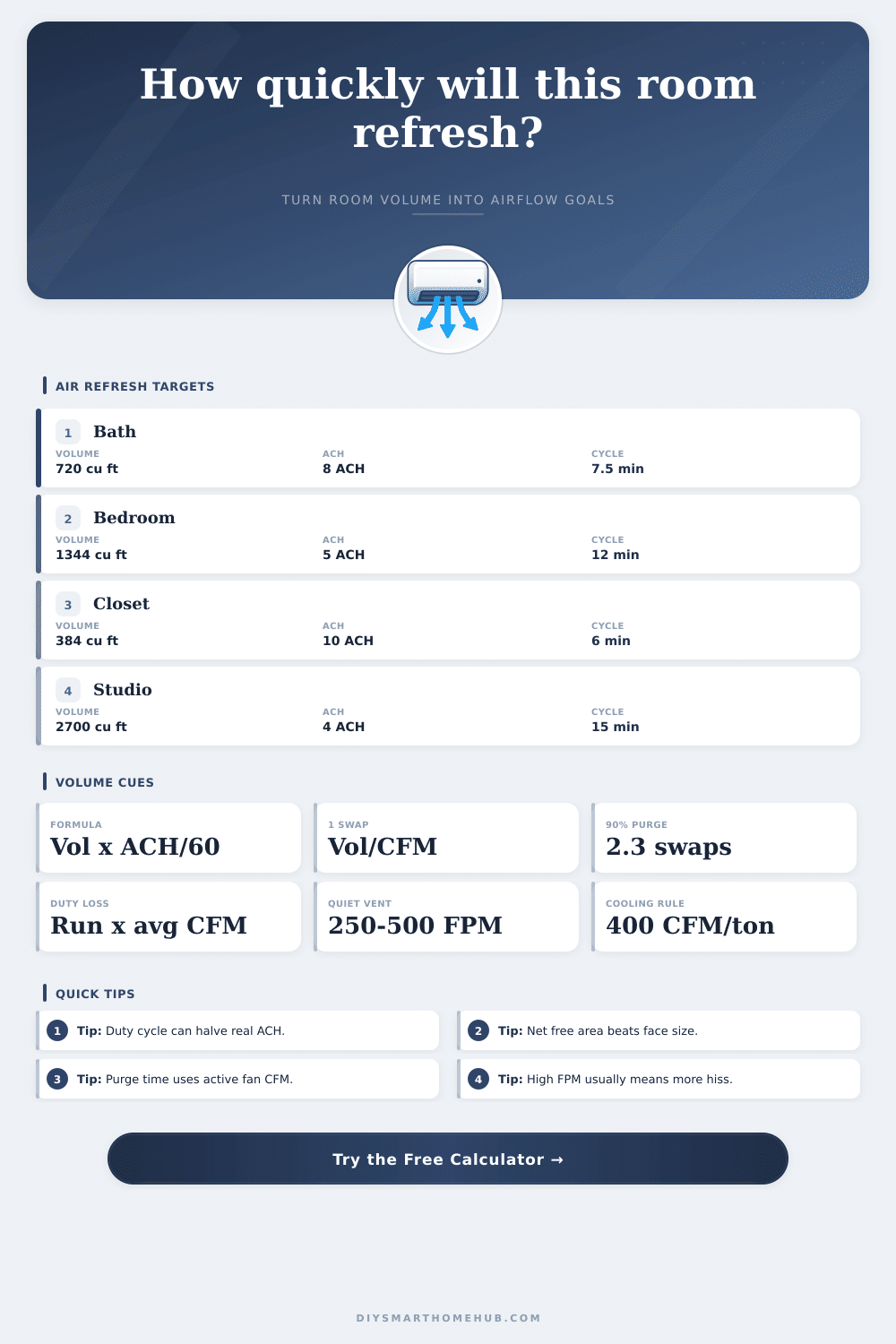
Different space within a building may have different ACH ratings due to the different needs that exist within those spaces. For instance, a bathroom may have an ACH rating of eight, indicating that the air within that space is to be completely replace eight times per hour. Such high ratings are necessary within a bathroom due to the fact that bathrooms often become filled with moisture, and that moisture need to be removed rapidly.
In contrast, a living room may have an ACH of only four, indicating that the air within that room is only to be replaced four times each hour. The living room may have such a low ACH because it does not become as moist as a bathroom. To calculate the airflow within a space, you must calculate the total volume of the space.
The volume is calculated as the area of the space multiplied by the height of the ceiling. The total volume of the space will determine the total amount of air that must be moved to achieve the desired ACH rating. In addition to calculating the ACH of a space, it is also important to consider the fan duty cycle.
The fan duty cycle is the percentage of the time that the fan will be running during an hour. For instance, a fan that has a duty cycle of 70% will be running during 70% of that hour, but will be off during the remaining 30% of that hour. During the periods in which the fan is running, the fan must move the air at a faster rate to provide sufficient airflow.
To determine the necessary airflow of the fan, you can calculate the amount of airflow that is required for the space divide by the fraction of the duty cycle. Furthermore, air movement can be lost in various ways. For example, air can move through grilles that have bars that block the movement of the air, or air may become slowed in relation to the rate at which it move when it exits the duct due to the bends in that duct.
Such losses in airflow are referred to as “delivered losses,” and must also be accounted for in the determination of the amount of airflow that the fan should provide. Another factor to consider is the outlet free area of the space. Many fan are housed within grilles that appear to be large in size.
However, the louvers that are present on those grilles may cover much of the area of that grille. Therefore, the outlet free area is much of the size of the grille itself. Small outlet free areas will result in high velocities of movement of the air within the space.
High velocities of air movement can result in whistling sound created by the moving air. Therefore, fans should be selected according to the purpose of the space in which they are to be used. For instance, the theaters fans should move at lower velocities than fans that is installed in a workspace.
By determining each of these factors, such as the size of spaces, the ACH, the duty cycle, and the outlet free area of the spaces, a person can determine the amount of airflow that a fan must provide in order to ensure that the air within a space is refresh as necessary. You should of looked at these factors to make sure your not wasting energy.