Airflow Velocity Calculator
Calculate air velocity from airflow and opening size, or reverse the math to find airflow capacity from a target velocity. Compare ducts, grilles, filters, and vent openings with one tool.
📌Quick airflow presets
Velocity depends on net free area, not just gross opening size. A grille or filter with only 70 to 85 percent free area can run much faster than the frame dimensions suggest.
📏Air path inputs
💡Live sizing notes
📊Velocity results
Run the calculator to compare actual velocity with the selected application band.
🔧Velocity reference blocks
| Application | Low FPM | Target FPM | High FPM | Best read |
|---|---|---|---|---|
| Supply duct branch | 450 | 550 to 750 | 900 | Quiet room delivery |
| Return duct | 400 | 500 to 750 | 900 | Low grille hiss |
| Filter face | 180 | 220 to 350 | 425 | Lower static rise |
| Supply grille | 250 | 350 to 500 | 650 | Comfort at the register |
| Bathroom exhaust | 450 | 600 to 800 | 1000 | Reliable moisture pull |
| Range hood duct | 700 | 900 to 1200 | 1400 | Grease capture tradeoff |
| Server vent | 400 | 500 to 800 | 950 | Cooling without whine |
| Fresh air branch | 350 | 450 to 650 | 800 | Balanced intake air |
| Round size | Area sq in | CFM at 500 | CFM at 700 | CFM at 900 |
|---|---|---|---|---|
| 4 in | 12.6 | 44 | 61 | 79 |
| 5 in | 19.6 | 68 | 95 | 123 |
| 6 in | 28.3 | 98 | 137 | 177 |
| 7 in | 38.5 | 134 | 187 | 241 |
| 8 in | 50.3 | 175 | 244 | 314 |
| 10 in | 78.5 | 273 | 382 | 491 |
| 12 in | 113.1 | 393 | 550 | 707 |
| 14 in | 153.9 | 535 | 748 | 962 |
| Free area profile | Typical percent | Use it on | Why it matters |
|---|---|---|---|
| Bare round duct | 100% | Round metal or flex duct | Gross and net area match |
| Rect duct opening | 100% | Plain duct section | No louver blockage assumed |
| Stamped grille | 72 to 82% | Supply or return grille | Blades cut real open area |
| Pleated filter face | 68 to 78% | Flat filter face checks | Media and frame reduce net area |
| Egg crate return | 85 to 92% | Open return grille | Lower resistance geometry |
| Louvered vent panel | 55 to 75% | Closet or enclosure vent | Slots shrink effective area |
| Preset project | Area | Flow | Velocity | Status |
|---|---|---|---|---|
| Preset examples load when the calculator starts. | ||||
Two openings with the same frame size can run at very different velocities if one of them loses twenty or thirty percent of its true open area to hardware.
The extra area usually buys quieter airflow, a lower velocity pressure, and a little more margin for dust loading or future airflow changes.
Airflow velocities is the speed at which air move through the duct or grille. Airflow velocity is one of the main cause of the HVAC system making noise. When the airflow velocity are too high, it can lead to high airflow velocity that makes a whistling or hissing sound from the HVAC system.
By managing the airflow velocity correct, the HVAC system will operate quietly while also placing less strain on the blower motor. High airflow velocity can also cause the HVAC systems filters to clog more quickly, so it is essential to monitor the airflow velocity to ensure the filters last longer. Airflow velocity can be calculated by dividing the volume of air that move through the HVAC system by the area where the air exit the system.
How Airflow Speed Affects HVAC
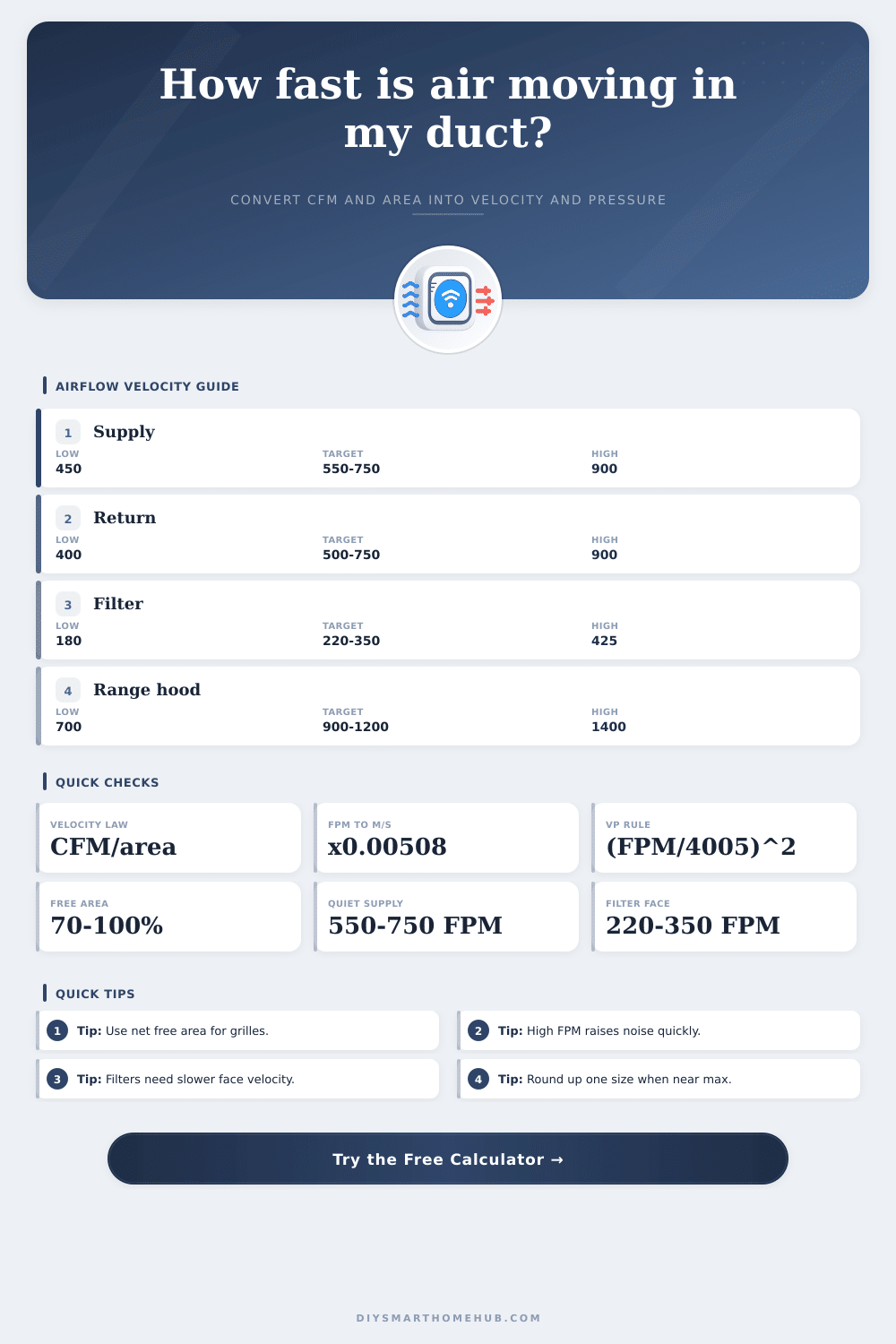
The formula for calculating airflow velocity is velocity equals the volume of air moving through the HVAC system divided by the area of the opening. The volume is in cubic feet per minute. The area measurement is the size of the opening in which the air exit the HVAC system.
If a specific volume of air is forced through a smaller area, the velocity of the air will be more higher. If the same volume of air is forced through a larger area, the velocity of the air will be lower. Supply ducts that distribute air into the living spaces of a home should have between 550 and 750 feet per minute airflow velocity.
This velocity is fast enough to effectively distribute the air to the living spaces while being slow enough to avoid creating noise. Return air ducts can have a higher airflow velocity than supply ducts. However, the filters for the HVAC system require a lower airflow velocity.
Airflow velocity for HVAC system filters should be between 220 and 350 feet per minute. This low airflow velocity allows the air to pass through the filter without allowing the dust in the air to clog the filter to quick. Airflow velocity calculations is based on the gross dimensions of the grille and the free area of the grille.
The gross dimensions of the grille are the overall dimensions of the grille. However, the free area of the grille is the area of the grille that allow the air to pass through the grille. Many grilles has metal blades that limit the free area of the grille to 20 to 30 percent of the gross dimensions of the grille.
If you use the gross dimensions of the grille to calculate the airflow velocity, the measurement will be incorrect. To calculate the airflow velocity correctly, the user should use the free area of the grille to determine how large the grille should be for the required volume of air to move through the HVAC system. Airflow velocity have a direct effect on the pressure in the HVAC system.
As the velocity of the air moves through the HVAC system increases, the velocity pressure of the system increase. Velocity pressure is a measurement of the dynamic push of the air that is moving through the HVAC system. Additionally, as the airflow velocity increases, the velocity pressure increase significantly.
For example, if the airflow velocity is doubled from 500 feet per minute to 1,000 feet per minute, the velocity pressure quadruple. High velocity pressure creates high static pressure in the HVAC system. The higher the static pressure in the HVAC system, the higher the energy bill for the household that employs the HVAC system as it consume more electricity.
The various components of the HVAC system has different requirements for airflow velocity. For example, the bedroom supply duct will require a low airflow velocity so that the air does not create noise for the sleeping individual in the bedroom. The bathroom exhaust fan will have a higher airflow velocity than a supply duct because it dont matter as much for the comfort of the individual in the bathroom whether the exhaust fan is silent or not as much as it do for the bedroom.
The kitchen range hood will require a higher airflow velocity than supply and exhaust fans because it must remove the harmful smoke and grease from the kitchen. However, a high airflow velocity in a kitchen range hood will also create alot of noise from the ductwork of the kitchen range hood. There are many mistake that people make when sizing their HVAC system components.
One of the most common mistake is using the volume of air to size the components of the HVAC system while also forgetting to account for the free area of the grilles. Another mistake is ignoring the free area of the filters and using filters with a smaller free area than what is required for the HVAC system. Finally, people also make mistakes with the size of the flexible ductwork.
If the ductwork is undersized, it will create a high airflow velocity through the HVAC system. This high airflow velocity will not only create noise but also could damage the HVAC system over time. To avoid these common mistakes, ensure that all components of the HVAC system have enough free area to move the amount of air that is required.
Additionally, if the size of the duct or grille is increased, the free area will also increase. By providing more free area, the airflow velocity can be lowered while still allowing the HVAC system to effectively move air through the system.