🌬 Air Purifier Room Size Calculator
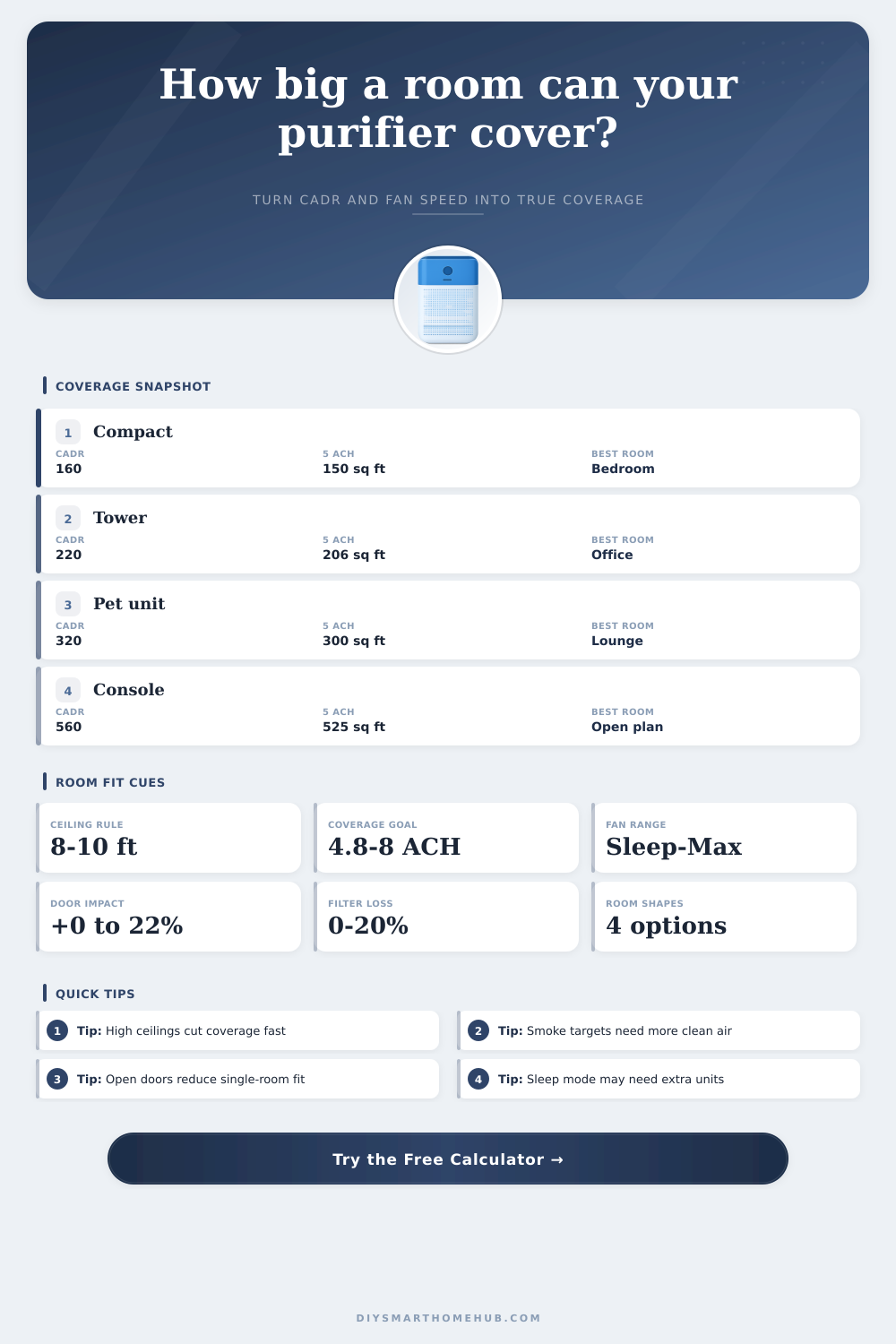
Find how much room a purifier can realistically cover by combining CADR, fan speed, ceiling height, pollutant goal, filter loading, and airflow losses from placement or connected spaces.
📌Preset Coverage Checks
Each preset loads a realistic room layout, purifier class, pollutant focus, fan speed, and airflow penalty so you can compare bedroom, pet, smoke, and open-plan room-size limits quickly.
⚙Room Size Inputs
💡Coverage Logic
The calculator turns rated CADR into usable room size by adjusting for selected fan mode, placement, filter loading, connected spaces, and the pollutant target you care about most.
Supported room-size estimate
Coverage summary updates after each calculation.
📊Purifier Family Grid
These reference cards show the baseline max CADR, typical quiet performance, and where each purifier family usually fits before room losses are applied.
📋Coverage by Purifier Type
| Purifier family | Rated CADR | Quiet CADR | Std room size | Typical fit |
|---|
🔬Pollutant Coverage Factors
| Focus | Factor | ACH lift | Main driver | Best use |
|---|
🏠Common Room Checks
| Scenario | Area | Target ACH | Supported size | Selected family |
|---|
🛠Coverage Tips
An air purifier is a machine that is design to clean the air within a given room. However, the effectiveness of the air purifier is dependent upon the specific dimension of that room. For this reason, many individual may think that an air purifier will be able to effectively clean an entire room in which they would like to use that air purifier, even if the manufacturer of the air purifier suggest that the device is effective within a certain size of room.
The size of the rooms within which the air purifier manufacturers calculates the effectiveness of their products is typically based off the assumption that the ceilings within those rooms are eight feet in height, that the air within those rooms contains the average amount of pollutants of the environment, and that the fans within the air purifier is operating at their maximum fan speeds. Each of these dimension of the air purifier and the air within the room may, however, be different than those suggested dimension by the manufacturer, which must be accounted for when purchasing the air purifier. One of the factor that relates to the effectiveness of the air purifier is the Clean Air Delivery Rate (CADR) of that air purifier.
Choose the Right Air Purifier for Your Room
The CADR is a measurement of how many cubic feet of air that the air purifier can clean per minute. Each of the individuals that purchase air purifiers can use this rate to determine if the air purifier is appropriate for the individual’s room by dividing the CADR by the size of the room that is to be clean, and by the number of air changes per hour that the air purifier is to provide to the area. The size of the room can be calculated by multiplying the area of the floor of the room by the height of the ceiling.
Rooms that have high ceilings will have a greater volume of air that the air purifier must clean to provide the same number of air changes per hour as a room with lower ceilings. The type of air pollutants that are common within the room also impact the way that the air purifier must function. For instance, a slower air purifier may successfully remove ordinary household dust.
However, particles such as smoke or pet dander are fine particles that remain in the air for longer periods of time, and, therefore, require air purifiers with higher rates of air changes per hour. Thus, individuals that own pets may require an air purifier that can remove pet dander from the air, or individuals that areas where smoke is common in the air may require air purifiers with higher rates of air changes per hour. Additionally, the fan speed at which the air purifier is to be operated will impact the CADR of that device.
For instance, air purifiers can be set to run at the maximum fan speed to ensure that the CADR is at its highest rate, but those who wish to minimize the noise that the air purifier creates may desire to utilize the air purifier in quiet mode. Quiet mode will reduce the fan speed at which the air purifier is operating, which will also reduce the amount of clean air that the air purifier delivers to the area. Another factor that impacts the effectiveness of the air purifier is the placement of the air purifier within the room.
For instance, if you place the air purifier within a corner of the room or behind a chair within the area, some of the air that the air purifier cleans and circulates will be blocked. Thus, the blocked air will reduce the effectiveness of the air purifier. Air purifiers must, therefore, be placed such that their intakes of air are unobstructed and their exhausts of air are also unobstructed.
Additionally, if an air purifier is placed near an open doorway, some of the clean air will exit the room and enter into the adjacent room. This movement of air will increase the effective coverage area of the air purifier by ten to twenty percent. However, in an open-plan living space, the air within the adjacent rooms will mix with the air within the primary room that the air purifier is assigned to cleaning.
Another factor in the effectiveness of the air purifier is the condition of the filters of the air purifier. As the air purifier removes dust and other particulates from the air, those particulates will collect within the filter of the air purifier. Over time, these collected particles will lead to the filter becoming clogged.
Air that cannot pass through the air purifier will reduce the effectiveness of the air purifier. Therefore, individuals will need to plan to change the filters every few months to ensure that the air purifier continues to effectively perform its task. Finally, individuals that calculate the required amount of effectiveness of the air purifier should also account for the buffer of the air purifier.
A buffer accounts for the fact that the filters will eventually become clogged. Therefore, a buffer of ten to twenty percent can be factored into the calculation of how many air changes per hour is required to effectively provide clean air within the room. Overall, there are many factors that relate to the effectiveness of air purifiers.
Each individual will have different need of air purifier based upon their home. For instance, individual offices that contain little amount of dust may only require the purchase of a mid-range air purifier. However, individuals that own pets may require an air purifier that includes settings to remove pet dander from the air.
Additionally, individuals that live in areas where wildfire smoke is common in the air will require an air purifier that can efficiently cycle a high amount of air within the sealed area that is to be cleaned. Thus, each individual can calculate the volume of the air within the room that is to be cleaned, account for the height of the ceilings within the room, and account for the type of pollutants that are to be remove to determine the appropriate amount of clean air that an air purifier will provide to its environment.