Pool Dehumidifier Calculator
Estimate indoor pool evaporation, dehumidifier capacity, cover-adjusted daily moisture load, and ASHRAE-style outdoor air from water area, temperatures, humidity, and use profile.
📌Quick presets
The design calculation uses the common natatorium evaporation form W = 0.1 x A x AF x dP, then compares current RH against target RH and blends open-water and covered hours into a daily load.
📏Calculator inputs
💡Design insights
📊Pool moisture results
Use the design capacity result as the leading equipment check and compare it with your intended control RH, open-water peak load, cover schedule, and natatorium airflow plan.
📦Capacity classes
📘Pool activity factors
| Use profile | Factor | Recirc ACH | Best fit | Load behavior |
|---|
🛡Cover reduction guide
| Cover type | Reduction | Open load left | Typical use | Effect on average day |
|---|
🏘Preset scenario comparison
| Scenario | Water area | Activity | Peak load | Design size |
|---|
📝Pool moisture planning tips
If the pool sees a few intense open-water hours, the dehumidifier still has to hold target RH during that window. Covers help average load, but peak occupied evaporation sets the tougher control point.
Outdoor air alone rarely solves a warm indoor pool room. A strong cover schedule drops moisture generation, while recirculation and dehumidification keep glass lines, deck edges, and spectator zones more stable.
Indoor pool enclosures tend to create high level of humidity within the enclosure due to the evaporation of water from the pool. The warm water within the pool tend to push the water vapor into the cooler air within the enclosure. Additionally, if the water within the pool is warmed, more water will evaporate from the enclosure; the higher the water temperature within the pool, the more greater the gap in vapor pressure between the water and the air.
High levels of humidity within the enclosure create condensation within the enclosure on the glass wall of the pool enclosure and on the pool decks. Condensation on the glass walls of the pool creates a fog effect on those walls, and condensation on the pool decks can create slippery floor that can be dangerous for individuals who are using the deck areas of the pool enclosure. A variety of factor, including the surface area of the pool, the temperature of the water within the pool, and the activity that occurs within the enclosure, influence the amount of humidity within the pool enclosure.
How to Control Humidity in an Indoor Pool
For instance, if many individuals are splashing within the pool, the humidity within the enclosure will increase as a result of that activity. An enclosure that is used for swimming lessons will tend to have higher humidity levels than an enclosure that is use for quiet swimming due to the increased activity within the water. Therefore, the dehumidifier that is installed within the enclosure should be sized according to the expected activity levels within the pool, and should be able to handle the maximum amount of humidity that those activity levels create.
Pool covers are one means of reducing the evaporation of water from the pool. Pool covers create a barrier between the water within the pool and the air within the enclosure. By using pool covers during periods when the pool is not in use, you can reduce the amount of moisture that evaporates into the air.
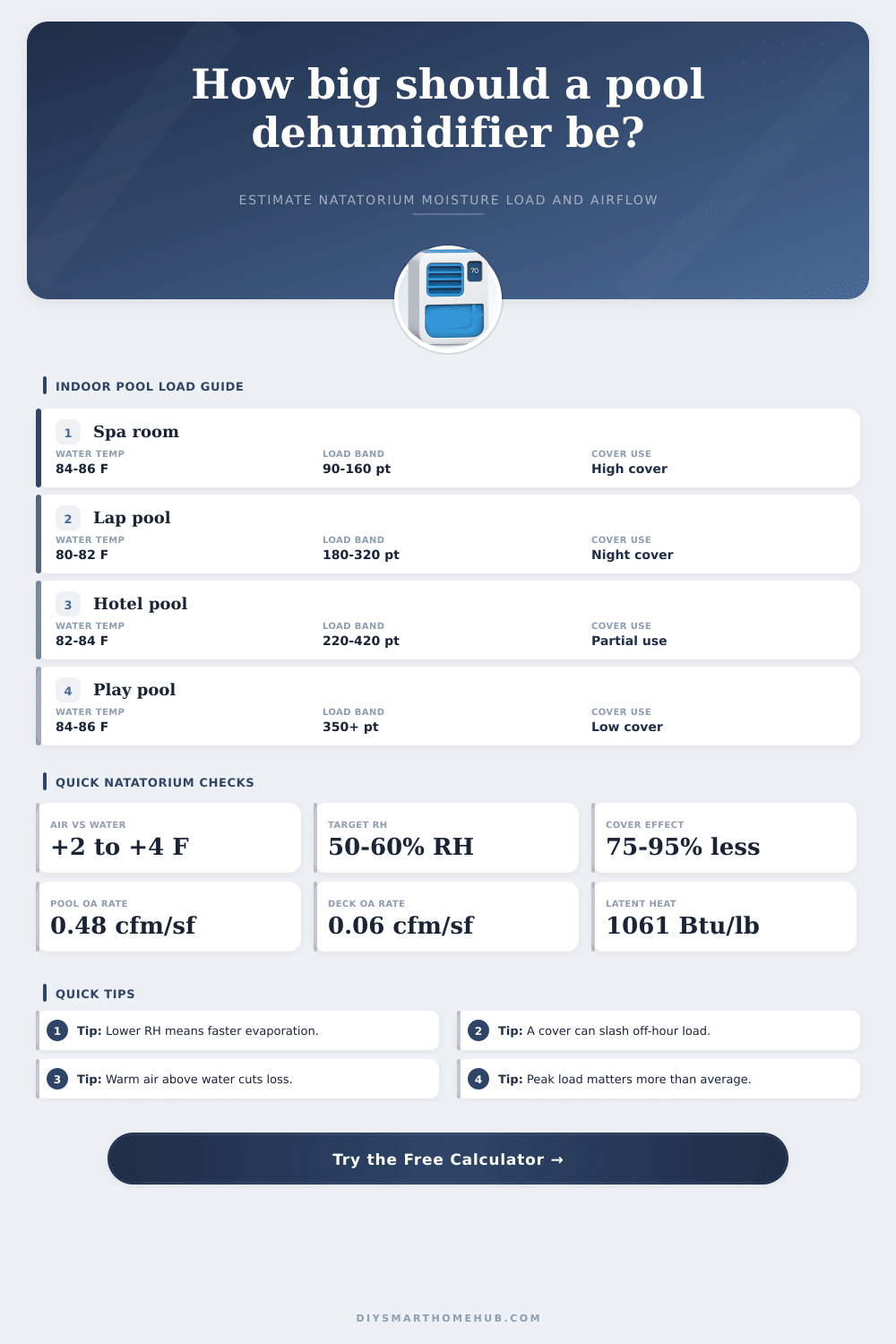
By reducing the amount of moisture that is within the air, you can reduce the amount of dehumidification equipment that is required. Additionally, the air temperature within the enclosure should be set to between two and four degrees warmer than the water temperature within the pool so that the comfort of the individuals swimming within the pool is increased. The target humidity levels within the pool should be between 50 and 60 percent.
If the humidity levels within the enclosure are allowed to drop to less than 50 percent, the evaporation rate of the pool will increase, and the number of dehumidifiers that is required to remove that moisture from the enclosure will increase. Additionally, if the humidity within the enclosure is permitted to rise to levels above 60 percent, the moisture will condense on the cold surfaces of the glass walls and pool decks within the indoor pool. Additionally, the area of the pool decks that experience the splashing of individuals will contribute to the humidity within the enclosure.
The dehumidification equipment that is installed within the indoor pool enclosure should allow for proper air movement within the enclosure. The dehumidifier should allow for the movement of air throughout the indoor pool enclosure to ensure that dry air can contact the pool and pool deck area. The dehumidifier should aim for four to six air change per hour to ensure proper recirculation of indoor enclosure air.
If the indoor pool enclosure does not allow for the movement of air at the necessary rates, the dehumidifier will not be able to remove moisture from all areas of the enclosure. The types of pools that is installed within indoor areas can influence the amount of dehumidification that is required of those pools. For instance, therapy pools often use warm water temperatures of around 92 degrees F; the higher the water temperature, the higher the vapor pressure of the pool water, and the more dehumidification that is required of the pool.
School pools must balance the humidity levels created by swimming lessons with the humidity levels removed by using pool covers. Additionally, competition pools are often of a larger size than school or therapy pools, so they require higher air turnover to control their humidity levels. Finally, residential pools often require less dehumidification than any of the other types of pools described above; they often utilize pool covers and experience less activity within the pool enclosure.
The dehumidification units that are to be purchased for the indoor pool enclosure should include a factor of 10 to 20 percent extra capacity beyond that which is calculated for the enclosure. This factor, known as the reserve factor, provides additional capacity for the dehumidifier to handle additional humidity within the enclosure due to unexpected increase in the activities within the indoor pool. Dehumidifier manufacturers produce dehumidifiers of different capacities; the smallest dehumidifiers may only be able to remove 120 pints of water from the indoor pool enclosure each day, while school pools may require dehumidifiers that can remove 550 pints of water each day.
Additionally, the largest municipal pools can require dehumidifiers that can remove more than 1100 pints of water per day. By calculating the amount of evaporation that will occur within the enclosure, by ensuring the installation of pool covers, and by ensuring proper airflow within the indoor pool enclosure, it will be possible to maintain a stable environment within the pool enclosure.