Industrial Dehumidifier Sizing Calculator
Estimate a plant-ready dehumidifier size by combining process moisture, exposed wet surface evaporation, and outside-air latent gain. The calculator returns peak pounds per hour, daily pints, airflow, and target dew point.
📌Quick plant presets
This model sizes for the larger of two checks: the 24-hour equivalent of peak latent load, or the schedule-adjusted total pints per day required to hold the target room RH.
📏Calculator inputs
💡What this model counts
Industrial sizing summary
The dehumidifier size, airflow basis, and dew point check will appear here after calculation.
📚Reference sizing tables
| Process profile | Base load | Default ACH | Target RH | Best fit |
|---|
| Traffic profile | Added ACH | Opening pace | Typical use | Load effect |
|---|
| Scenario | Area | Peak load | Daily size | Outside air |
|---|
If target RH is much lower than the present room condition, expect the wet-surface and outside-air loads to climb even before process moisture changes.
A frequent dock or freezer opening can add more latent load than the line itself, so traffic profile selection matters as much as room square footage.
Dehumidifiers that only match average daily moisture often lose RH control during sanitation, rinse cycles, or humid outdoor design hours.
The recirculation target shown here helps with air distribution across wet zones, while outside-air CFM is only the latent source used in the sizing math.
When you are selecting a dehumidifier for an industrial space, you need to make sure that the capacity of the dehumidifier is appropriate for the levels of moisture in the room. If the dehumidifier is too small for the moisture load in the area, that can cause problems with the products in the room, such as warped cardboard box or labels that stick to the products. If the dehumidifier is too large, on the other hand, it will use more electricity than is necessary to perform its tasks.
To find an appropriate dehumidifier for an industrial space, there are several factors to consider beyond the square footage of the area. Moisture enters an industrial space in a variety of ways. In a storage vault, air from outside the building seeps into the storage vault and moisture can enter the space.
How to choose the right dehumidifier for an industrial area
In a production room, moisture can enter the space as a result of the production processes in the area. For instance, a bakery room may release moisture from the evaporation of water from the dough being prepare, and a washdown area may release moisture from the water that enters the air from the hoses in the area. Thus, an area with many wet surface will have a higher moisture load than an area with fewer wet surfaces.
Another factor that can impact the moisture levels in an area is the traffic in and out of the area. For instance, when a forkllift move through a door, or when a dock door opens, outdoor air can enter the facility. Outdoor air often contains high levels of moisture, so these movements of door traffic will increase the moisture levels within the facility.
Many people dont consider this a significant factor in moisture load, but it is one of the factors that can have the most significant impact. Finally, the volume of the facility will also impact the moisture load; an area with high ceilings will contain more air than an area with low ceilings. When sizing a dehumidifier, people often make mistakes in considering the moisture load.
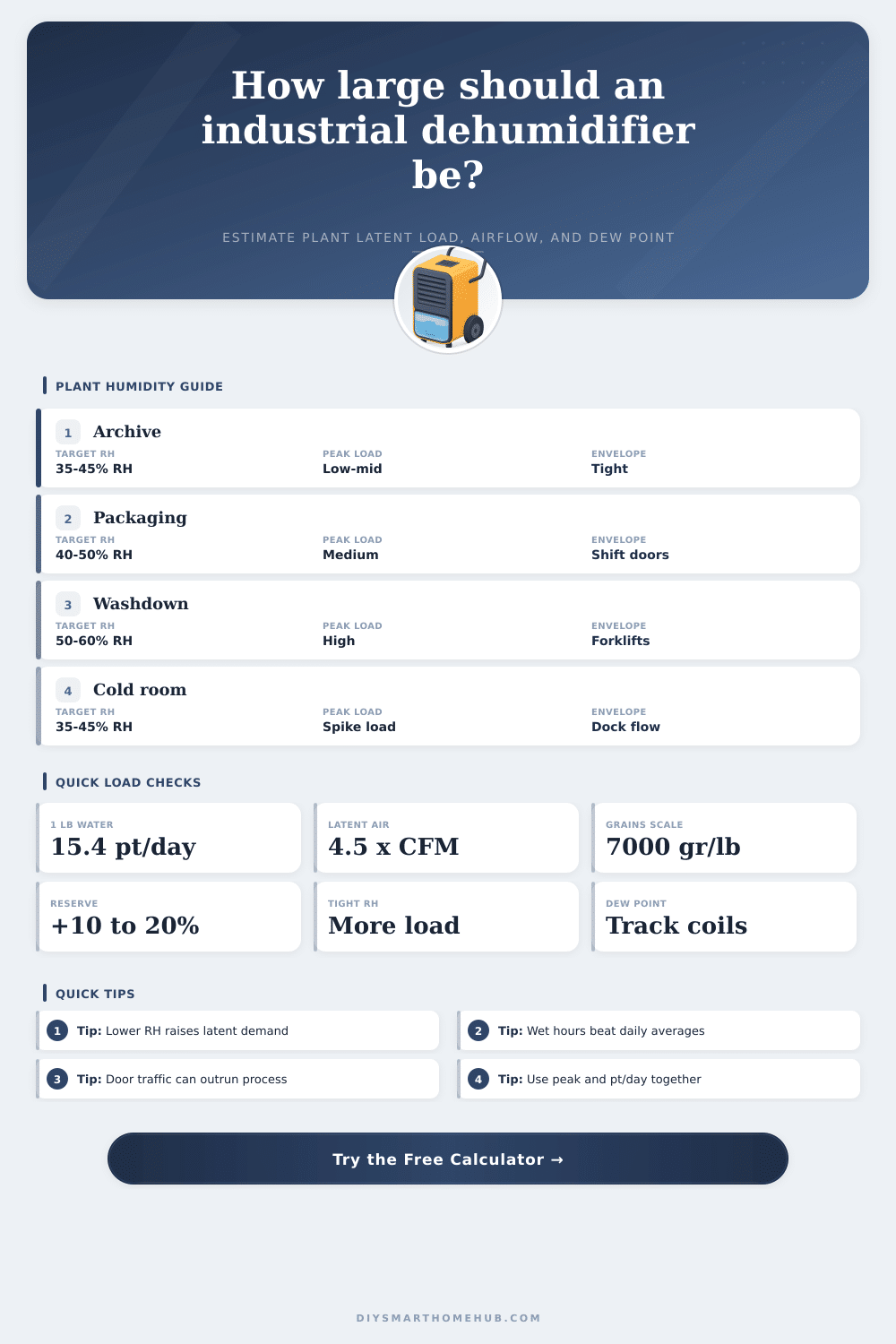
For example, people may size the dehumidifier according to the average moisture load in the area during each days. However, there are both peak and standby moisture loads in most facilities, so the dehumidifier must be able to handle each of these moisture loads. More specifically, someone should calculate the peak latent load (in pounds per hour) to size the coils of the dehumidifier, as well as the total removal of moisture in the area (in pints per day).
The larger of these two figures should be selected, and you should add a margin of error (reserve margin) to that figure. This added margin will ensure that the dehumidifier can handle any increases in the moisture levels that may occur. The type of facility that is to be dehumidified will affect the type of dehumidifier that are required in the area.
For instance, the levels of humidity in a printing area may need to be stable in order to ensure the integrity of the ink and laminates. An area that produces beverages may have high humidity levels due to the splash of water from the beverage lines. Cold storage areas may require specific humidity levels due to the ways that cold temperatures impact moisture in the air.
Profiles can be used in the sizing of dehumidifiers to account for the different shapes of floors in the facility, as well as the degree of moisture that exists in different areas of the facility. Some of the most common mistakes in sizing dehumidifiers include only considering the average moisture levels in the area. People often do not consider the peak and standby loads in the facility, and assume that the average of the humidity levels throughout the area will be sufficient for the dehumidifier.
Additionally, the other common mistake is to not consider the dew point of the facility. The dew point will impact whether or not the humidity levels are compatible with the dehumidifier’s condensing coils. Finally, people often do not consider that the recirculation of indoor air (rather than outside air) is much less moisture than outside air.
Thus, people should of not use a dehumidifier to replace outside air with indoor air. In addition to the considerations of the different types of facilities and their moisture loads, there are also various ways to physically alter the facility to aid the function of the dehumidifier. For instance, curtains can be used to create a barrier between areas with high moisture levels and the remainder of the facility.
Air locks can also be constructed to reduce the amount of outside air that enters the facility. In a facility that is performing food preparation, for instance, it is important to ensure that the products that are released from hot preparation areas contain a high level of moisture. An archive or library area does not need to have air infiltrating into the space to allow for the movement of individuals in and out of the area.
Finally, a reserve margin of 10-20% of the total moisture load of the area should be added into the calculations of how many pounds per hour of moisture the dehumidifier will remove from the area. This margin will allow for unknown factor in the facility.