Dehumidifier CFM Calculator
Estimate how much airflow a room, basement, crawlspace, or whole-home return path should move so your dehumidifier can recirculate moist air fast enough without oversized grilles or undersized ductwork.
📌Quick presets
The calculator starts with target air changes for each zone, then layers in humidity gap, wetness class, filter drag, duct length, leakage, and extra moisture sources to create a realistic CFM target.
📏Calculator inputs
💡What the numbers mean
📊Unit airflow spec grid
📋Airflow band comparison
| Unit family | Nominal CFM | Typical range | Rated capacity | Best fit | Pressure note |
|---|
🌡Zone ACH reference
| Zone | Base ACH | Starting CFM | Best use | Notes |
|---|
🏠Common project sizes
| Preset | Area | Humidity gap | Target CFM | Suggested band |
|---|
🛠Practical airflow tips
A unit rated at a certain airflow in free discharge can lose meaningful delivery through long flex duct, dense filters, and small grilles. If the calculation points near the top of a unit family's band, move up a duct size or the next airflow class.
The first day after rain, seepage, laundry marathons, or a humid weather swing usually needs more recirculation than steady-state maintenance. The reserve margin helps avoid a unit that is technically sized but too slow to recover the space.
CFM or cubic feet per minute is a measurement of how much air the dehumidifier can move through a space. Dehumidifiers use CFM to move air through the dehumidifier so it can remove moisture from an air. If a dehumidifier dont have enough CFM, it will not be able to move enough damp air over the dehumidifiers coils to extract the moisture.
As a result, the humidity in that space will remain highly. Airflow is a critical element in determining the CFM of a dehumidifier. Airflow determine how quickly the dehumidifier reaches the humidity level it is targeting.
What CFM Means for Dehumidifiers
Many dehumidifiers is rated in terms of how many pints of moisture it can remove per day. A laboratory derives this rating under perfect conditions. In a basement installation, many factor will reduce the CFM of a dehumidifier.
Air filters, ducts, and grilles restrict air movement. In order to compensate for the reduced airflow, a dehumidifier will have to cycle on for longer period of time. In these cases, the dehumidifier will use more energy to accomplish the same task than a model with higher CFM rating.
Dehumidifiers work because they move air over cold coils. The moisture in the air condenses over these cold coils and collects in a reservoir in the unit. Higher CFM ratings means that the dehumidifier will cycle the air in the room more fast.
This leads to a faster reduction in the humidity in the room to the level targeted by the dehumidifier. The zone where the dehumidifier is installed matters. For example, a bedroom may require a different CFM than a crawlspace.
Crawlspaces require more CFM because they generally have higher levels of moisture in them. High levels of moisture and high temperatures impacts the CFM that a dehumidifier will require. High levels of moisture from the walls or laundry area will require higher CFM from the dehumidifier to remove the excess moisture.
Additionally, high temperatures means that the air can hold more moisture. This means that the dehumidifier will need to remove more moisture from the air in warm temperatures. The ductwork and air filters will impact the CFM of the dehumidifier.
Air filters with higher ratings of efficiency, such as MERV 13, will capture more dust and particles in the air. However, the rating of 13 creates more resistance for the air to move through the dehumidifier. The CFM of the dehumidifier will drop if the air moves through ductwork with many elbow or if the dehumidifier is installed with long ducts into the basement.
In these cases, the CFM will be less than the CFM listed on the unit. A reserve of CFM should of been allowed for the installation site to account for future moisture loads in that basement. The size of the grille impacts the CFM ratings of the dehumidifier.
The grille must have enough space in the grille for the air to move through it. A grille that is too small will restrict the movement of air, thus lowering the CFM ratings of the dehumidifier. To keep the noise level of the dehumidifier low, the manufacturer sets a specific velocity for air movement through the grille.
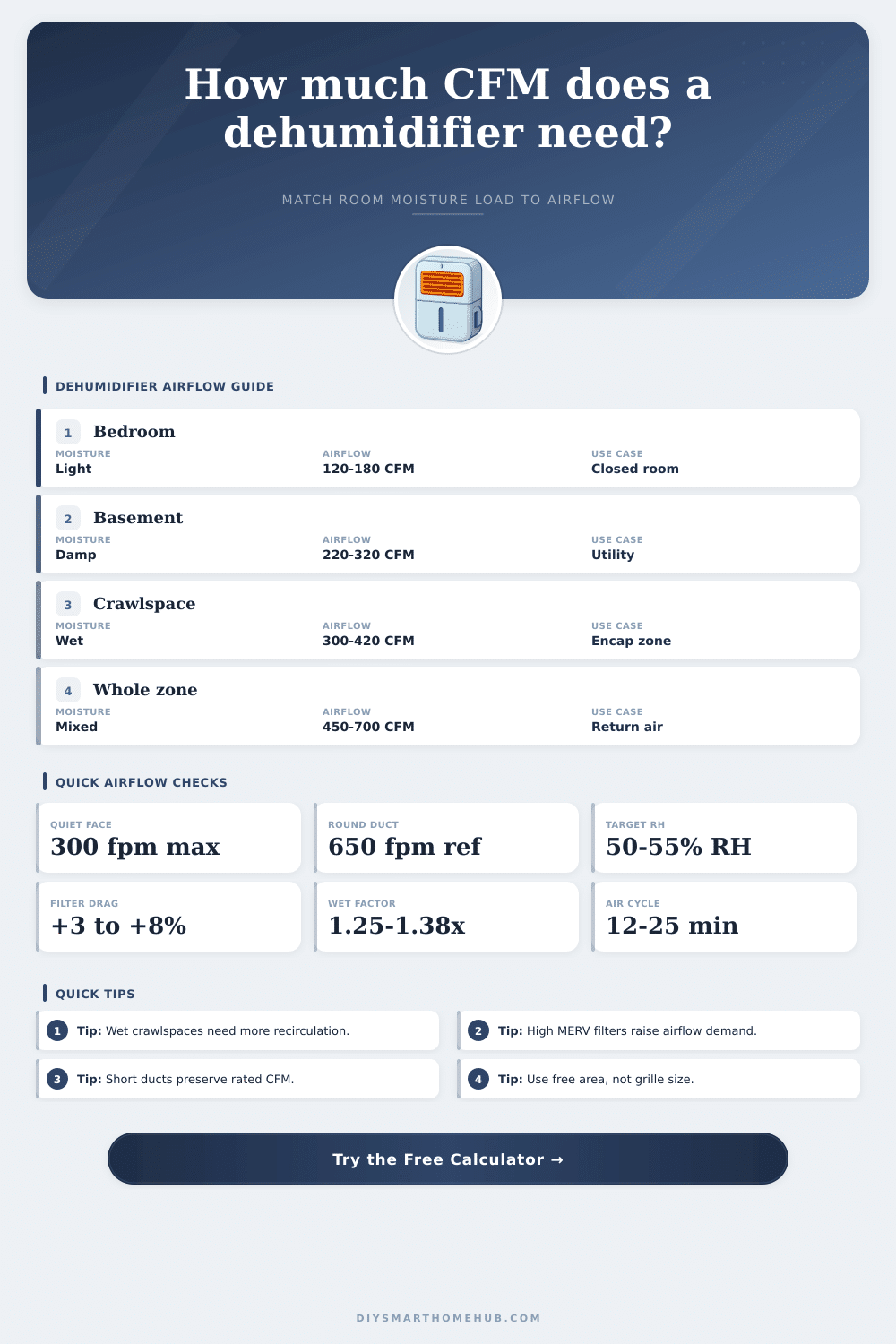
The grille must be large enough to provide the CFM that is required. Certain spaces require different CFM ratings to other areas of the same structure. A bedroom with a dehumidifier might have a CFM of 120 to 180.
A crawlspace might require a CFM of 300 to 420. This is because crawlspaces have more moisture in them. Using a dehumidifier with too low of a CFM for the size of the space will cause the dehumidifier to struggle to lower the humidity in that space.
Using a dehumidifier that can move the proper amount of air to meet the spaces CFM requirements will efficienty remove the moisture from the air and maintain the humidity that is desire in that space.