Inverter AC Power Consumption Calculator
Estimate how many watts an inverter air conditioner actually uses once room size, weather, humidity, part-load modulation, and thermostat behavior are all working together.
📌Cooling Scenario Presets
Each preset loads a realistic combination of room area, thermostat target, humidity, inverter class, and control mode so you can compare low-load efficiency against heavy afternoon demand.
🌡Inverter AC Inputs
📊Selected System Snapshot
How low the compressor can modulate before the unit starts cycling around its minimum stable output.
Base nameplate efficiency used as the anchor for part-load interpolation and hot-weather derating.
Most inverter AC systems are happiest when they spend long periods in the middle of the modulation range.
Indoor fan, logic board, sensors, and communication overhead still consume power even at low compressor speeds.
Remote receiver, Wi-Fi module, crankcase heater logic, and display electronics add a small constant baseline.
Compressor power rises faster once outdoor conditions move well beyond the efficiency test point.
Inverter AC Type Benchmarks
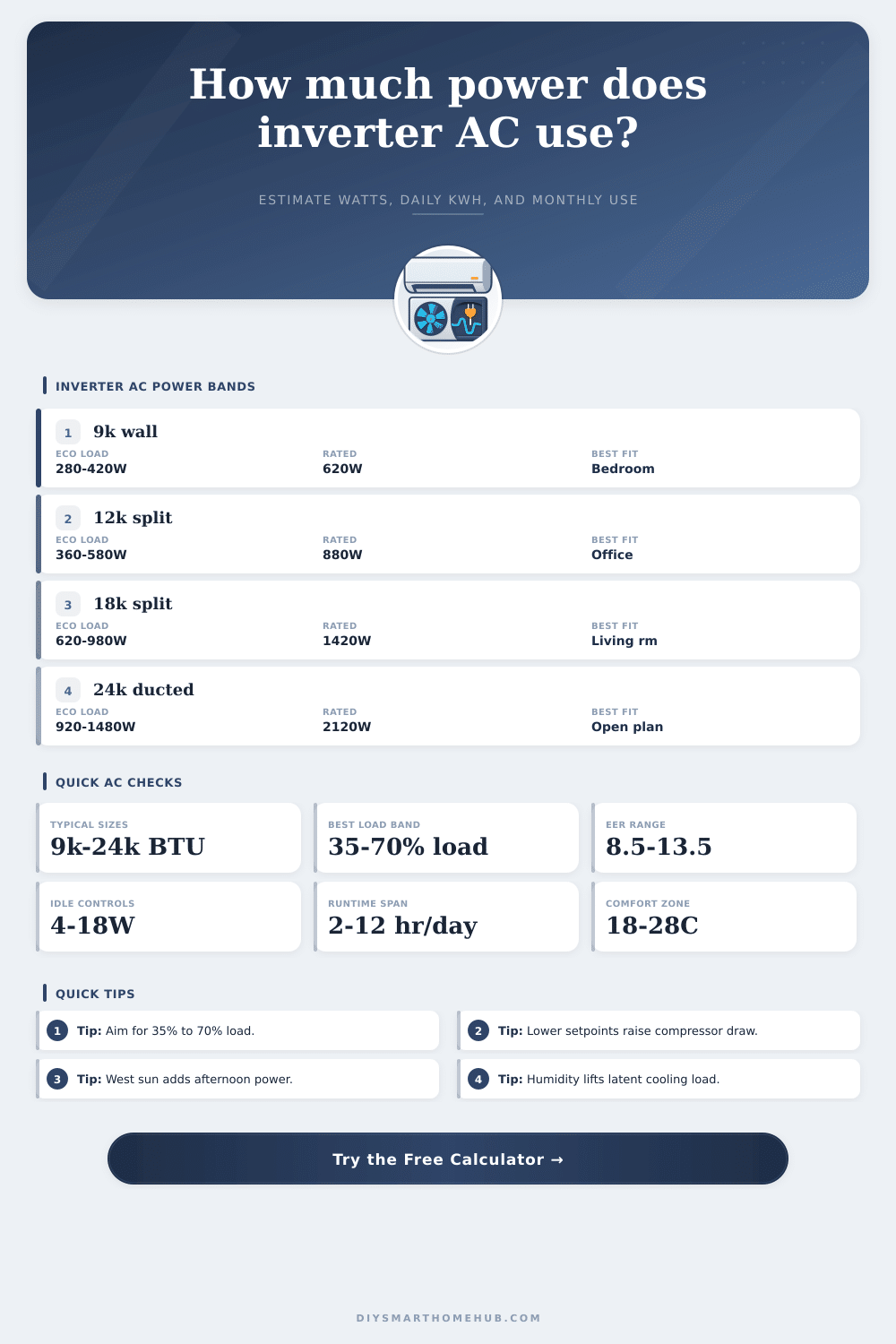
These reference bands show why similar capacity labels can still produce different power use once minimum modulation and fan overhead are factored in.
| System type | Rated EER | Min load | Typical match |
|---|---|---|---|
| High-wall split | 11.8 | 22% | Bedrooms and offices |
| Ceiling cassette | 10.9 | 28% | Open rooms |
| Slim ducted | 10.3 | 30% | Whole-zone cooling |
| VRF indoor zone | 12.6 | 18% | Long occupied hours |
Load Ratio and Compressor Behavior
The same inverter AC can look extremely efficient at mid load but less impressive when it is oversized and hovering near the minimum compressor speed.
| Load band | Compressor state | Input share | Guidance |
|---|---|---|---|
| Below 25% | Near minimum | High baseline | May cycle or idle often |
| 25% to 45% | Stable low speed | Very efficient | Excellent overnight band |
| 45% to 70% | Mid modulation | Sweet spot | Best all-day performance |
| Above 85% | Near full output | Highest draw | Check sizing headroom |
Common Room Profiles
Use these room-size references to sanity-check whether your selected cooling capacity and runtime feel proportionate before relying on the exact kWh result.
| Project | Area | Suggested BTU | Daily kWh |
|---|---|---|---|
| Quiet bedroom | 140-220 sq ft | 9k BTU | 2.2-3.6 |
| Home office | 180-260 sq ft | 12k BTU | 3.1-4.8 |
| Living room | 280-420 sq ft | 18k BTU | 5.0-8.2 |
| Open great room | 500-750 sq ft | 24k-30k BTU | 7.8-12.5 |
Weather and Setpoint Multipliers
The bigger the gap between indoor target and outdoor conditions, the faster inverter modulation moves toward the higher-power end of the curve.
| Indoor-outdoor gap | Load factor | Comfort note | Power effect |
|---|---|---|---|
| 15°F gap | 0.91x | Mild cooling day | Lower compressor speed |
| 20°F gap | 1.00x | Reference condition | Typical running watts |
| 25°F gap | 1.09x | Warm afternoon | Noticeable kWh rise |
| 30°F gap | 1.18x | Heavy heat stress | Near-full modulation |
If the room load lives below roughly one-quarter of rated capacity most of the time, the system may cycle around its minimum output and waste some of the inverter advantage.
A two-degree lower thermostat or a west-facing window wall can push the compressor into a much higher modulation zone even when the BTU label never changes.
This calculator estimates inverter AC running power from room load, part-load efficiency, fan overhead, and hot-weather derating. Confirm the exact minimum and rated input watts from your model's data plate for final planning.
An inverter air conditioners uses a compressor that can change speed to meet the cooling need of the room. Unlike a conventional air conditioner, an inverter air conditioner dont turn on and off to cool or warm the room. Instead, the inverter air conditioner adjust the power that it outputs.
An inverter air conditioner is most efficient between 35% and 70% of it’s total capacity. At loads below 20% to 30% of total capacity, the air conditioner will idle at a low power level. At this low setting, the air conditioner does still consume power to run its fan and control boards, yet it does not come equip with the capability to cool the room at this rate.
How Inverter Air Conditioners Use Power
At loads above 85% of total capacity, the inverter air conditioner will begin to operate at high speeds to cool the room. This high speed mode, however, is less efficient than the others settings for the air conditioner. The environment in which the inverter air conditioner is placed will have an impact upon the amount of power that the air conditioner will use.
For instance, a bedroom that does not receive sunlight will require the air conditioner to use less power then a living room that has large windows that face the sun. The sunlight that enters the room add to the heating of that room, which increases the workload of the air conditioner. Additionally, the humidity within the room can also impact the air conditioners workload.
If the air conditioner must cool the room and extract moisture from the rooms air, its workload will increase. The size of the area that the inverter air conditioner must cool have an impact upon the air conditioner’s efficiency. Small areas with good insulation will require the air conditioner to use less power than large areas with high ceilings.
Additionally, every person that enters the room add to the cooling load of that room; each person contribute to the warm and moist air within the area that the air conditioner must cool. The settings that are configured within the inverter air conditioner will impact how much power the air conditioner use. If sleep mode or a smart setback mode is selected for the air conditioner, the fan within the air conditioner will slow in speed so that the indoor air temperature can increase slight.
By slowing the fan, the air conditioner will use less power to cool the air to the desired setting within the room; thus, sleep mode increase the efficiency of the air conditioner. If boost mode is enabled, however, the air conditioner will use more power. When in boost mode, the fan and compressor within the inverter air conditioner will increase in speed so that the cooling of the room can take place at a rapid rate.
When the outdoor temperature is much higher than the setting that is desired within the room, the inverter air conditioner will use more power to cool the indoor air to the desired temperature. Not all type of inverter air conditioner systems use the same amount of power as other types of air conditioner systems. For instance, people often use high-wall split systems within bedrooms; these inverter air conditioning unit are capable of reaching low levels of power output.
Ducted inverter air conditioners are often used within large areas, but those systems will use more power than the split systems because the ducted inverter air conditioner system must move large amount of air with its fans. Additionally, portable inverter air conditioners are often less efficient than split systems because the portable air conditioner system lose some of it’s energy within the unit. The way in which the system is maintained and prepared for use can impact the amount of power that an inverter air conditioner system use.
If the air filter within the system is dirty, the system will have to work harder to circulate air within the room, thus using more power. If the ducts that the air conditioner system use to move air within the home are leaking air, the system will have to work to cool more air in order to maintain the indoor temperature; thus, the cooling load of the room increase. Using window shades to block the solar gain of sunlight entering the room will impact the cooling load of the room.
By maintaining the inverter air conditioner system and reducing the amount of heat that enters the room, the system will use less electricity.