RV Inverter Calculator
Estimate inverter size, DC battery current, usable runtime, and battery-bank requirements for real RV loads including compressor starts, idle draw, reserve limits, and battery chemistry.
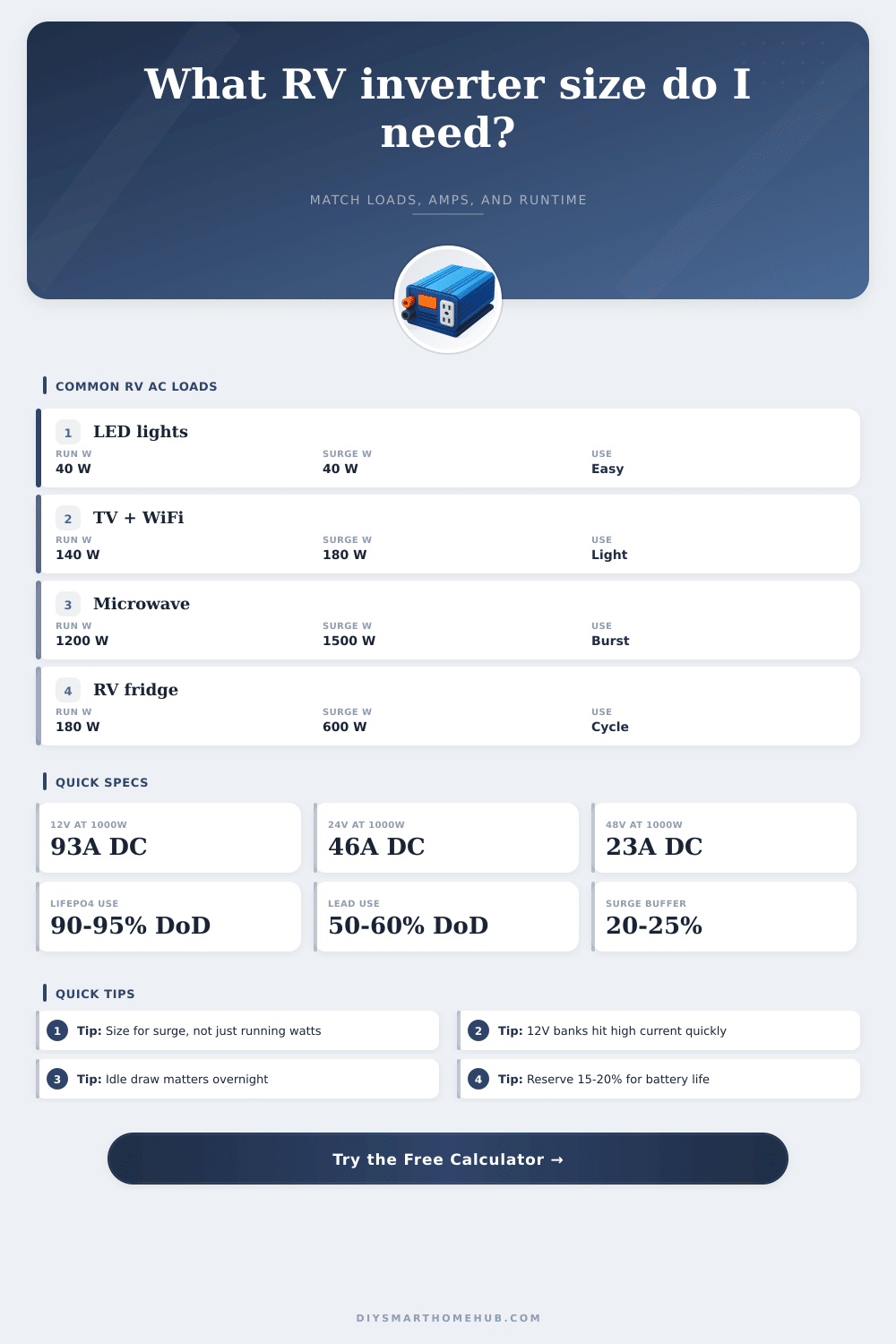
Use running watts for what stays on, surge watts for the biggest startup event, and reserve percent for battery capacity you do not want to consume.
Calculation Breakdown
| Appliance | Running Watts | Startup Surge | Common RV Note |
|---|---|---|---|
| LED lighting circuit | 20-60 W | 20-60 W | Nearly pure resistive load |
| TV and router | 100-180 W | 150-220 W | Easy evening entertainment load |
| Residential refrigerator | 120-220 W | 500-800 W | Compressor surge drives inverter choice |
| Microwave oven | 1000-1500 W | 1300-1800 W | Short burst but high current on 12V |
| Coffee maker | 900-1400 W | 900-1400 W | Often no surge, just heavy draw |
| Induction burner | 1300-1800 W | 1500-1900 W | Wants larger inverter and battery bank |
| Inverter Tier | Typical Surge | 12V DC Amps at Full Load | Best Fit |
|---|---|---|---|
| 600 W | 1200 W | 56 A | Fans, chargers, laptops, TV |
| 1000 W | 2000 W | 93 A | Small galley loads and office gear |
| 1500 W | 3000 W | 139 A | Microwave and fridge combinations |
| 2000 W | 4000 W | 185 A | Heavier kitchen and mixed evening loads |
| 3000 W | 6000 W | 278 A | Whole-coach inverter systems |
| Battery Bank | Usable Wh | Runtime at 500W AC | Runtime at 1000W AC |
|---|---|---|---|
| 12V 200Ah AGM | 1224 Wh | 2.2 hr | 1.1 hr |
| 12V 300Ah LiFePO4 | 2754 Wh | 5.0 hr | 2.5 hr |
| 24V 200Ah LiFePO4 | 3672 Wh | 6.6 hr | 3.3 hr |
| 48V 100Ah LiFePO4 | 3672 Wh | 6.6 hr | 3.3 hr |
| Scenario | Load | Suggested Inverter | Battery Target |
|---|---|---|---|
| Quiet overnight CPAP | 120 W | 600 W | 12V 100-150Ah LiFePO4 |
| Remote work van desk | 320 W | 1000 W | 12V 200-300Ah LiFePO4 |
| Microwave lunch stop | 1250 W | 2000 W | 12V 300Ah or 24V 150Ah |
| Induction prep and fridge | 1700 W | 3000 W | 24V 200Ah LiFePO4 |
| Whole-coach evening loads | 2100 W | 3000 W | 24V 300Ah or 48V 150Ah |
Microwaves, fridges, and compressors can fit the continuous watt rating but still trip an undersized inverter. Choose a tier that clears both your running watts and the single largest startup event.
A 1500W AC load can pull well over 130 amps from a 12V bank after inverter losses. Short cables, healthy batteries, and honest reserve settings matter as much as inverter size.
An inverter is an electrical device that converts DC power to AC power. Understanding how to size an inverter correct is essential, as incorrectly sizing an inverter can result in appliances failing and the battery bank rapidly depleting of it’s energy. Inverters is used to convert the power stored in the battery bank to AC power needed to operate household appliances.
However, some energy are lost in the conversion of power from DC to AC. Therefore, when determining the size of an inverter, it is important to account for the energy that will be lost during the conversion process as inverters are not 100% efficient. Most quality inverters are between 90% and 95% efficient in there conversion from DC to AC power, meaning 5% to 10% of the energy stored in the battery bank will be lost as heat in the inverter.
How to Size an Inverter and Battery Bank
When determining the size of an inverter, it is necessary to consider the continuous watts and the surge watts that the appliance will require. Continuous watts is the amount of power that an appliance will require to operate. Surge watts is the amount of power that an appliance will require when initially turned on.
Appliances often require more power when first turned on than when they are in operation, such as refrigerators. If the inverter is too small to handle the surge watts that is required to start an appliance, the inverter will turn off to protect itself and the appliances. In this case, the inverter should be sized according to the highest surge wattage of the appliances that will be operated rather than the continuous wattage ratings of those appliance.
Another factor to consider when determining the size of an inverter is the relationship between the AC watts and the DC amps that will be drawn from the battery bank. The wattage of an appliance divided by the system voltage of the battery bank will determine the DC amps that will be drawn from the battery bank. For example, appliances with high wattage requirements will draw a high amperage requirement from the battery bank.
Appliances such as a 1000 watt microwave will require 1000 watts of power from the inverter, but will also require 90 to 100 amps from the 12-volt battery bank. High amperages can lead to high temperatures within the DC cables and a drop in the voltage delivered to the inverter. In order to avoid dropping the voltage to the inverter to levels that will cause it to shut off, thick wire gauge cables and short cable runs to the inverter will be necessary.
Beyond the amperage and wattage of the appliances that will be operated, another consideration for sizing an inverter is the chemistry of the batteries within the battery bank. Lead-acid batteries are the most common form of deep cycle batteries, but they should not be discharged to below 50% of their total capacity. If deep cycle lead-acid batteries is discharged to levels below 50% of their capacity, those batteries will be damaged.
An alternative to deep cycle lead-acid batteries are lithium batteries. Lithium batteries can be discharged to 90% or more of their total capacity without being damaged. Therefore, lithium batteries will provide longer run times for the same size battery bank as lead-acid batteries.
Additionally, even when no appliances are being used, the inverter will still require a small amount of power to remain on. When no appliances are being used, the inverter will draw 10 to 20 watts of power. This standby power will slowly drain the battery bank if not accounted for in the sizing requirements of the inverter and battery bank.
Another way to reduce the amperage that is drawn from the battery bank is to increase the system voltage. If an inverter system uses DC voltages of 12 volts, appliances with a wattage of 1000 watts will require 1000 watts from the inverter, but will also require 93 amps from the battery bank. If, however, a 24 volt system is used, the same 1000-watt appliance will only require 46 amps from the battery bank.
Furthermore, a 48 volt system will only require 23 amps of DC current to power the same 1000-watt appliance. Using higher voltages will reduce the amperage that is drawn from the battery bank, which allows for thinner DC cables to be used in the system. It will also reduce the amount of heat that is created by the DC cables.
However, increasing the system voltage can be more difficult and costly to implement than increasing the ampere ratings of the system. In order to ensure that an inverter and battery bank system works as intended and lasts for the life of the batteries, there are several things that can be done to maximize the systems performance and lifespan of the batteries. First, adding 20% headroom to the continuous wattage rating of the inverter will allow for the inverter to not run constantly at maximum power.
Second, setting a reserve limit for the battery bank will ensure that the batteries are not completely drained of their energy. Third, ensuring that the inverter system is sized according to the DC amperage that will be drawn by the appliances will ensure that the voltage to the inverter is not dropped to levels that will damage the batteries and prevent the proper running of the appliances. If these factors are not accounted for in the creation and operation of the inverter and battery bank system, the batteries will be damaged and the inverter will not be able to effectively supply power to the appliances.
By calculating the continuous watts, the surge watts, the capacity of the batteries, and the DC amps that will be drawn from the battery bank, it is possible to ensure that the inverter effectively provides power to the appliances.