Inverter Run Time Calculator
Estimate how long a battery bank can support your inverter, compare DC current draw, and check whether surge loads and chemistry limits still fit your outage backup plan.
📌Quick Presets
⚙Backup Inputs
Runtime Summary
Compare inverter runtime, DC battery draw, and surge headroom before you lock in a backup plan.
🔋Battery And Inverter Spec Grid
Flooded Lead-Acid
Lowest cost backup option, but it needs a wider reserve and loses more capacity in cold garages or sheds.
AGM Deep Cycle
Cleaner indoor form factor than flooded cells, with moderate current delivery for office and router circuits.
Gel Deep Cycle
Great for slow steady loads, but it dislikes heavy inverter surges and high recharge currents.
Golf Cart FLA
Popular for weekend cabins and pump backups because series pairs scale cleanly into mid-sized inverter banks.
LiFePO4 Pack
Best all-around chemistry for repeat outage cycling, high inverter efficiency, and stable voltage under load.
Rack NMC Lithium
High energy density wall storage that keeps battery current lower during whole-home essential circuit backup.
LTO Module
Specialty chemistry for harsh climates where fast discharge and winter performance matter more than energy density.
Pure Sine Hybrid
Aim for pure sine units with low idle draw and double-surge support when compressors or pumps are on backup.
📊Runtime Reference Table
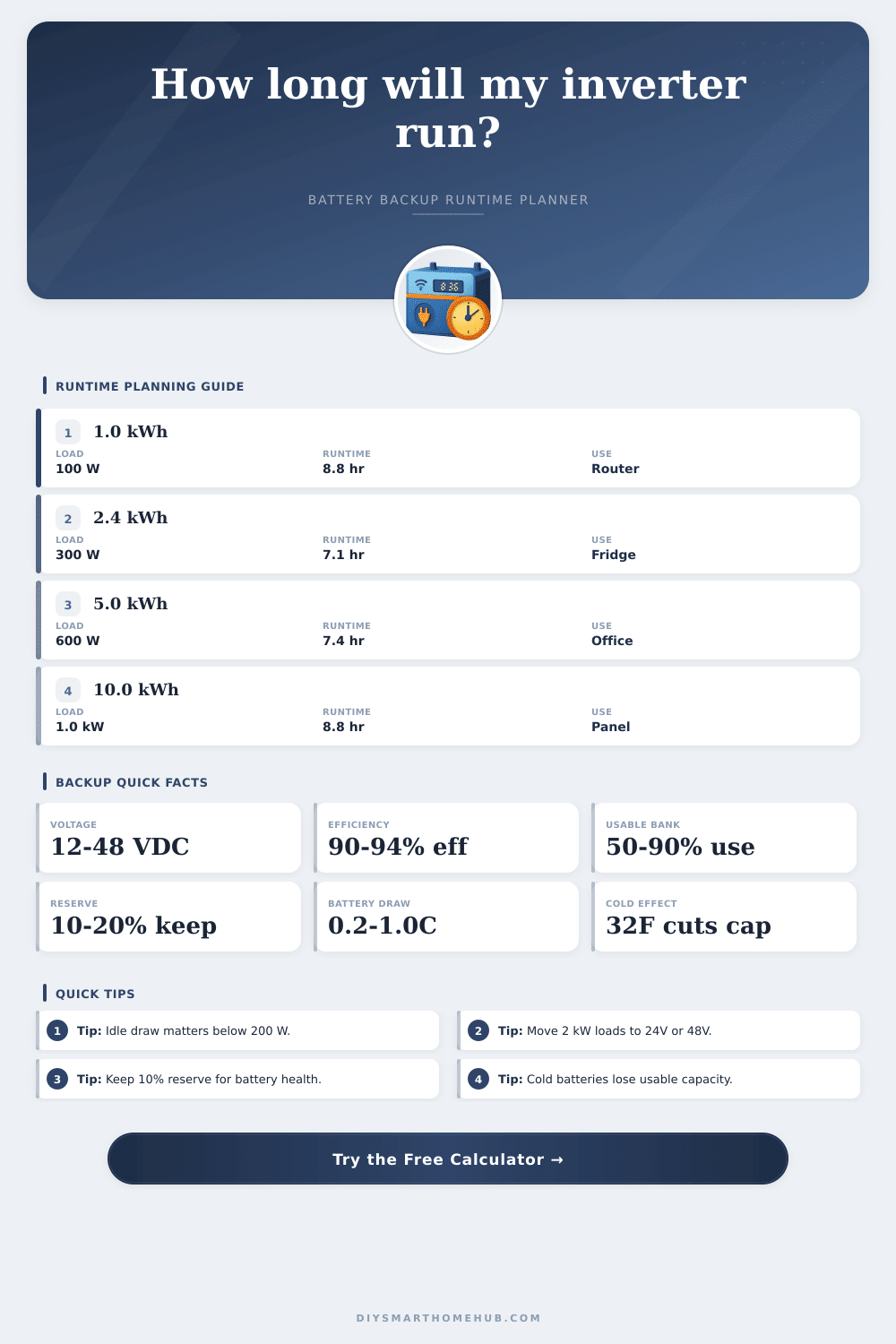
Approximate runtimes below assume a pure sine inverter near 92% efficiency with a 10% reserve already held back.
| Usable Bank | 100 W Load | 300 W Load | 600 W Load | 1000 W Load |
|---|---|---|---|---|
| 1.0 kWh | 8.8 hr | 3.0 hr | 1.5 hr | 0.9 hr |
| 2.4 kWh | 21.2 hr | 7.1 hr | 3.5 hr | 2.1 hr |
| 5.0 kWh | 44.1 hr | 14.7 hr | 7.4 hr | 4.4 hr |
| 10.0 kWh | 88.2 hr | 29.4 hr | 14.7 hr | 8.8 hr |
🧪Battery Chemistry Planning Table
| Chemistry | Usable DoD | 32°F Factor | Cont. C-Rate | Best Fit |
|---|---|---|---|---|
| Flooded Lead-Acid | 50% | 0.80x | 0.20C | Rare outages |
| AGM Deep Cycle | 55% | 0.84x | 0.30C | Indoor backup |
| Gel Deep Cycle | 50% | 0.86x | 0.25C | Low steady draw |
| Golf Cart FLA | 60% | 0.83x | 0.25C | Cabin banks |
| LiFePO4 | 90% | 0.90x | 1.00C | Daily cycling |
| Rack NMC Lithium | 88% | 0.92x | 0.75C | Wall storage |
| LTO Module | 95% | 0.97x | 2.00C | Cold climates |
⚡Inverter Class Comparison
| Inverter | Continuous | Surge | Idle Draw | Good For |
|---|---|---|---|---|
| 1 kW Compact | 1000 W | 1800 W | 10 W | Routers, LEDs |
| 2 kW Portable | 2000 W | 3500 W | 18 W | Fridge circuits |
| 3 kW Hybrid | 3000 W | 6000 W | 22 W | Office plus fridge |
| 5 kW Split-Phase | 5000 W | 9000 W | 35 W | Pumps and panels |
| 8 kW Rack | 8000 W | 16000 W | 55 W | Essential subpanel |
🏠Typical Backup Load Table
| Circuit | Avg W | 12 V Draw | 24 V Draw | Notes |
|---|---|---|---|---|
| Router + Modem | 40 W | 3.7 A | 1.9 A | Low idle-friendly load |
| PoE Camera Rack | 120 W | 10.9 A | 5.4 A | Switch plus NVR |
| Refrigerator | 180 W | 16.3 A | 8.1 A | Compressor cycles |
| Home Office Core | 275 W | 24.9 A | 12.5 A | Laptop, monitor, network |
| Sump Pump | 450 W | 40.8 A | 20.4 A | High start surge |
| Essential Circuits | 850 W | 77.0 A | 38.5 A | Fridge, lights, network |
Tip: Small electronics backups can lose a surprising amount of runtime to inverter idle draw. If the protected load sits below 150 to 200 watts, prioritize low-idle pure sine models.
Tip: Current rises fast on 12 volt systems. Once a backup plan regularly exceeds about 2000 watts, moving to 24 or 48 volts keeps cable size, fuse size, and voltage sag more manageable.
An inverter allows for a use of electricity from the battery to the appliance. Furthermore, the runtime of the inverter will allow the appliance to operate during a power outage. In order to determine the runtime of the inverter, it is important to understand the relation of the loads of the appliance, the chemistry of the battery, and the voltage of the system.
Should you not understand the relationship of these three factors, it is possible that there will not be enough electricity to power the appliances. One of the factors to consider in calculating how long an inverter will run an appliance is the capacity of the battery. The rated capacity of the battery cannot be used.
How to Calculate Inverter Run Time and Choose the Right Battery
Instead, you should calculate the capacity that the battery can use. Lead-acid batteries only have fifty percent of the battery capacity available before the voltage of the battery drop. Furthermore, lead-acid batteries do not provide there full capacity if the battery is at a cold temperature.
In contrast, lithium batteries can provide ninety percent of their rated capacity, and they are more efficient than lead-acid batteries. Additionally, the capacity of lithium batteries declines at lower temperatures, as well. Another factor to consider is the inverter itself.
The inverter convert the DC power from the battery to the AC power required by the appliance. However, the inverter also draws electricity itself when it is turned on, which is referred to as the idle draw of the inverter. Small inverters will have a lower idle draw than large inverters.
Furthermore, the higher the idle draw of an inverter, the more shorter the runtime of that inverter. Inverters are most efficient at fifty percent of their maximum load. Furthermore, when the inverter is at a very low load or at a very high load, efficiency decline.
Additionally, many appliance will have a surge capacity. For instance, refrigerators and sump pumps require high amounts of electricity to start. If the inverter does not have enough surge capacity to handle the appliances, the inverter will “trip” and stop providing power.
The duty cycle for an appliance will also have an impact on the length of time that the battery will last. Appliances like refrigerators will not be constantly running. Instead, the refrigerator will only be running for a percentage of the time.
Thus, the appliance will use less energy. It is important to understand the difference between the connected load and the surge load of the appliances. The connected load is the total amount of electricity that all of the appliances use when they are running.
The surge load is the amount of electricity that the appliances use when they are starting. The voltage of the battery will also impact the efficiency of the system. Systems that use twenty-four volt batteries will be more efficient than those that use twelve volt batteries.
This is due to the fact that twenty-four volt batteries will require less current to provide the same amount of power to the inverter as twelve volt batteries. Furthermore, low amounts of current create less heat in the system than high amounts of current. Thus, less cables will be needed.
Forty-eight volt systems will be the most efficient for larger loads of appliances, as they require even less current than twenty-four volt systems to supply the same amount of power. Finally, not all battery chemistry are the same. Flooded lead-acid batteries are relatively inexpensive, but they do require maintenance.
AGM batteries are considered to be much cleaner than flooded batteries, and are, therefore, appropriate for indoor applications. Lastly, lithium iron phosphate batteries are best for daily use, as they retain their voltage throughout deep discharge. Each type of battery can have different use in an inverter system based off the needs of the users.
Common mistakes with inverters include overdrawing the system; that is, providing more power to the system than the inverter is designed to handle. Furthermore, some do not account for the idle draw of the inverter. It is important to measure the load of all of the appliances to be used, and to provide a buffer of ten to twenty percent of the power of the system.
This will ensure that the voltage does not drop to a level that will drain the battery to quick, and ensure that the battery does not deteriorate quickly. Finally, it is important to ensure that there is some means of recharging the batteries, as the batteries will need to be recharged after they are used to power the appliances during a power outage.