Inverter Battery Calculator
Estimate the battery bank, inverter class, DC current, and recharge target needed to keep critical loads running through outages without draining the bank too deeply.
📌Preset Backup Scenarios
⚙Battery and Inverter Inputs
Backup Sizing Snapshot
Enter a load profile to compare usable outage energy, the nominal battery bank required, inverter fit, and the recharge power needed to reset the bank.
📈Selected System Spec Grid
LiFePO4
High usable capacity and strong cycle life for frequent outages or daily cycling.
2000W Pure Sine
Clean waveform for compressors, CPAP units, routers, and electronics with moderate surge loads.
24V 100Ah Pack
Series and parallel strings update after each calculation to show a practical module count.
24 V bank
Continuous current, surge current, and cable advisory help catch high-current layouts early.
🔋Battery Chemistry Reference
| Chemistry | Usable DoD | Round-Trip | Cycle Life | Best Fit |
|---|---|---|---|---|
| AGM Lead-Acid | 50% | 88% | 500-800 | Occasional backup circuits |
| Flooded Deep-Cycle | 50% | 85% | 400-700 | Ventilated shed or cabin banks |
| Gel Deep-Cycle | 55% | 87% | 500-1,000 | Quiet standby use |
| Carbon Lead | 60% | 90% | 1,200-1,800 | Frequent outage use |
| LiFePO4 | 90% | 96% | 3,000-6,000 | Daily cycling and deep backup |
| NMC Lithium | 85% | 95% | 2,000-3,500 | Compact high-density packs |
⚡Inverter Class Reference
| Inverter Class | Continuous | Surge | Best Bank | Typical Loads |
|---|---|---|---|---|
| 1000W Modified Sine | 1,000 W | 1,600 W | 12 V | Routers, chargers, resistive loads |
| 1500W Pure Sine | 1,500 W | 3,000 W | 12 or 24 V | CPAP, laptops, networking |
| 2000W Pure Sine | 2,000 W | 4,000 W | 24 V | Fridge, freezer, office circuits |
| 3000W Hybrid | 3,000 W | 6,000 W | 24 or 48 V | Apartment essentials, sump pumps |
| 5000W Hybrid | 5,000 W | 10,000 W | 48 V | Multi-circuit home backup |
| 6000W Split-Phase | 6,000 W | 12,000 W | 48 V | Well pumps, light whole-home service |
📋Preset Scenario Reference
| Scenario | Effective Load | Runtime | Battery Bank | Inverter Fit |
|---|
📏DC Current by Bank Voltage
| AC Load | 12 V Bank | 24 V Bank | 48 V Bank |
|---|
Tip: If your continuous load is above about 1,200 watts, move quickly toward a 24 V or 48 V bank. Lower current usually means cleaner starts and easier conductor sizing.
Tip: For lead-acid banks in cold spaces, keep a wider reserve than usual. A battery that looks large on paper can lose meaningful usable capacity before sunrise.
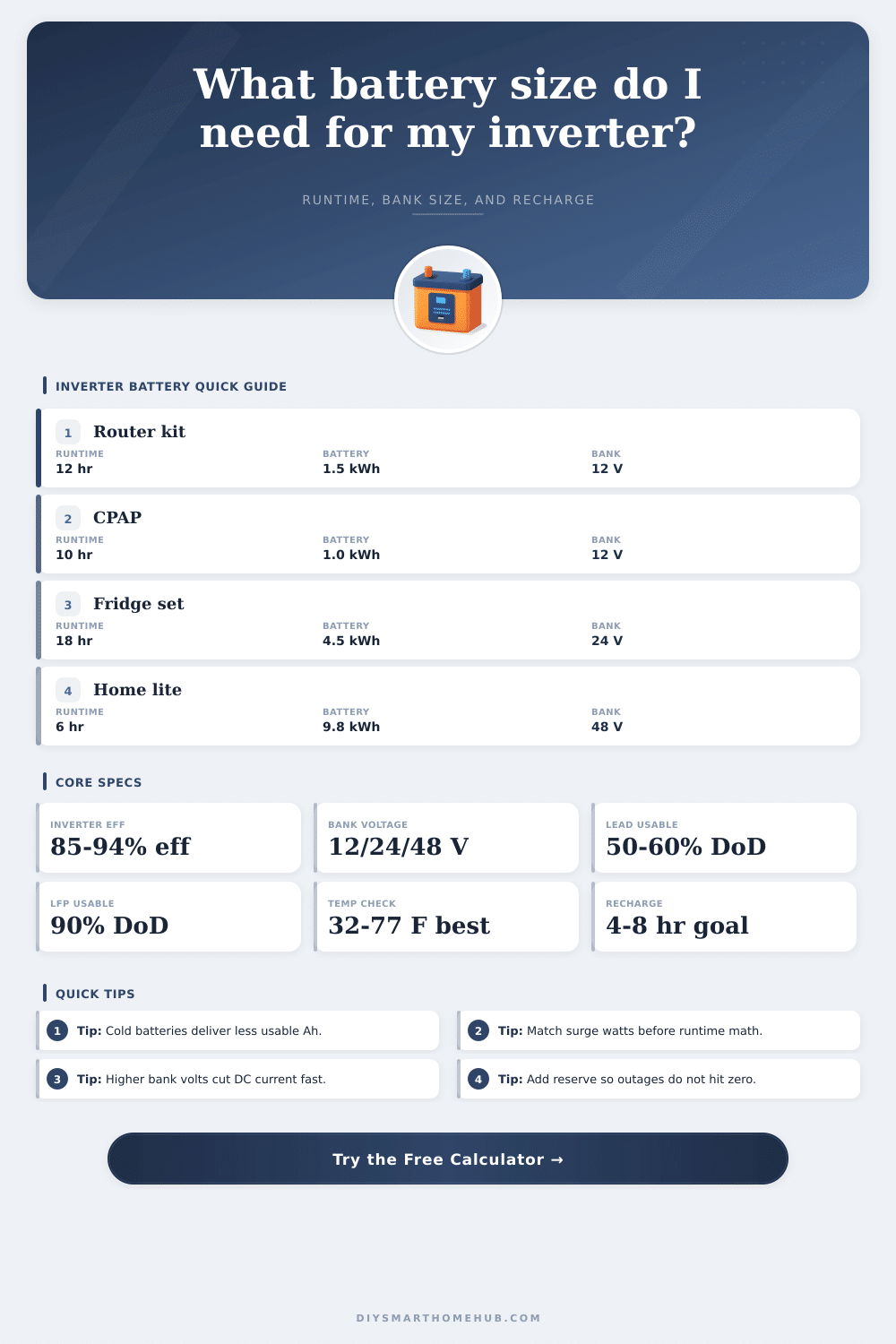
To calculate the correct battery size, you must determine both the energy needs of the appliances you wish to power and the number of hour that you need power outages to last. Many people make the mistake of purchasing the largest battery available instead of calculating the wattage and number of hours of outages needed by the appliance that they have. If you purchase a battery without performing such a calculation, however, you run the risk of buying a battery that is too small to supply the needs of those appliances.
To calculate the energy needs of the appliances, you must calculate the number of watts that each appliance use and the number of hours that each appliance will need to be on. The capacity of the battery, however, will not need to be equal to the energy needs of the appliances due to the fact that inverter electronics will lose 10-15% of the batterys energy transforming that energy into usable electricity for the appliances. Beyond the energy output of the battery, the chemistry of the batteries will affect there capacity.
How to Calculate the Right Battery Size
Lead-acid batteries can only be safely discharge to 50% of their capacity, for example, while lithium batteries can be safely discharged to 90% of their capacity. The temperatures at which the batteries are store can also affect the chemistry of the battery; batteries stored in a cold garage will have less energy than batteries stored at more typical storage temperatures. Beyond the chemistry and capacity of the batteries, there are other consideration of the appliances themselves.
Appliances often have a surge wattage; the amount of power that the appliance draws when it start to run. Such a wattage is often much higher than the wattage that the appliance continuously uses. For instance, a refrigerator may use 150 watts while it is running, but may use 1200 watts to start moving.
If the inverter does not have enough surge wattage to supply that surge, the inverter will fail to start that appliance. Thus, the surge wattage of the inverter should be higher than the maximum wattage of all of the appliances. Similarly, appliances like sump pump may have a low duty cycle; the number of hours that an appliance is on versus off during a specific period.
If the duty cycle of those appliances is low, they will not need to use as much energy as a device that is on all of the time. In addition to considering the appliances themselves, you must consider the voltage of the battery bank; the higher the voltage, the less current that will be require to run the appliances. If the battery bank is 12 volts and the appliances require 2000 watts of power, for instance, the battery bank will have to supply 200 amps of current to those appliances.
200 amps of current, however, will require relatively thick wires to move that amount of electricity. Using a 24 volt or 48 volt battery bank will reduce the current that the appliances require, reducing the amount of thick wiring that is required for installation. Higher voltage battery bank can also be used with inverter batteries; inverters that can handle the power from the electrical grid, solar panel arrays, and battery banks.
The chemistry of the batteries also determines how many time that battery can be used. AGM lead-acid batteries are relatively inexpensive, but often only provide around 500 charging cycles before they wear out and die. In contrast, LiFePO4 batteries are more expensive, but provide thousands of charge cycles before wearing out.
In addition to the chemistry of the batteries, you should provide a reserve buffer; a battery bank that can provide an additional 10-20% of power beyond that which is calculated for the appliances to be run during power outages. Additionally, the battery bank should be able to be recharged. The battery bank and charger should have enough wattage to provide enough power to recharge the batteries within the timeframe that you would like the batteries to last.
Additionally, long electrical cable can reduce the voltage that is provided to the appliances. If the cables between the battery bank and the appliances are too long, the voltage drop that results from the long cable could result in malfunctioning of the appliances. Thus, calculating each of these factors will allow you to create a battery bank and power system that perform in the way that you intend for it to function.