Inverter Size Calculator
Estimate inverter continuous watts, startup reserve, DC battery draw, fuse sizing, cable demand, and bridge runtime for routers, PoE gear, pumps, refrigerators, NAS racks, and essential circuits.
📌Quick Scenario Presets
⚙Load and Battery Inputs
Recommended Inverter Plan
Choose a preset or enter your own outage load profile.
📊Selected Profile Snapshot
Smart panel friendly backup class.
Always-on overhead while waiting for load changes.
Best voltage window for the selected topology.
Typical continuous loading range for stable efficiency.
📘Critical Load Guide
| Load Group | Typical Run Watts | Typical Startup | Sizing Note |
|---|---|---|---|
| Router + modem + mesh | 25-60 W | 80-120 W | Very light surge, but it often defines your minimum inverter idle efficiency target. |
| PoE switch + 4 cameras | 85-180 W | 220-320 W | Rack UPS style inverters work well when PoE gear must stay online continuously. |
| NAS + mini PC + router | 110-260 W | 250-420 W | Electronics prefer pure sine output and stable transfer timing. |
| Refrigerator | 150-250 W | 1000-1500 W | Compressor startup is the usual reason a small inverter trips. |
| Gas furnace blower | 500-900 W | 1200-1900 W | Blower motors like extra surge reserve and good low-voltage cable design. |
| Sump pump | 800-1300 W | 2200-3400 W | Storm backups should bias toward pump-heavy inverter profiles. |
| Garage freezer | 100-220 W | 700-1200 W | Cold restarts push surge above the apparent steady load requirement. |
| Microwave or coffee circuit | 1200-1600 W | 1800-2200 W | Short duty loads can justify a bigger surge target without a huge battery runtime. |
🔋DC Current by Inverter Class
| Inverter Class | 12V @ 90% | 24V @ 90% | 48V @ 90% |
|---|---|---|---|
| 600 W | 56 A | 28 A | 14 A |
| 1000 W | 93 A | 46 A | 23 A |
| 1500 W | 139 A | 69 A | 35 A |
| 2000 W | 185 A | 93 A | 46 A |
| 3000 W | 278 A | 139 A | 69 A |
| 4000 W | 370 A | 185 A | 93 A |
| 6000 W | 556 A | 278 A | 139 A |
| 8000 W | 741 A | 370 A | 185 A |
🔧Copper Cable Reference
| Copper Cable | Metric Area | Practical Amp Range | Use Case |
|---|---|---|---|
| 8 AWG | 8.4 mm² | Up to 80 A | Small 12V shelves and compact electronics loads. |
| 6 AWG | 13.3 mm² | Up to 120 A | 1000W class inverter at a short cable run. |
| 4 AWG | 21.1 mm² | Up to 160 A | 1500W class backup with lower drop target. |
| 2 AWG | 33.6 mm² | Up to 210 A | 2000W 12V or 3000W 24V systems. |
| 1/0 AWG | 53.5 mm² | Up to 260 A | 3000W 12V short-run batteries and busbars. |
| 2/0 AWG | 67.4 mm² | Up to 300 A | 24V high-draw inverter trunks or parallel battery strings. |
| 3/0 AWG | 85.0 mm² | Up to 330 A | Low-drop main links for bigger hybrid inverter banks. |
| 4/0 AWG | 107.2 mm² | Up to 380 A | Large off-grid or whole-home inverter DC feeds. |
📋Common Backup Project Sizes
| Project | Run Load | Startup | Typical Inverter Class |
|---|---|---|---|
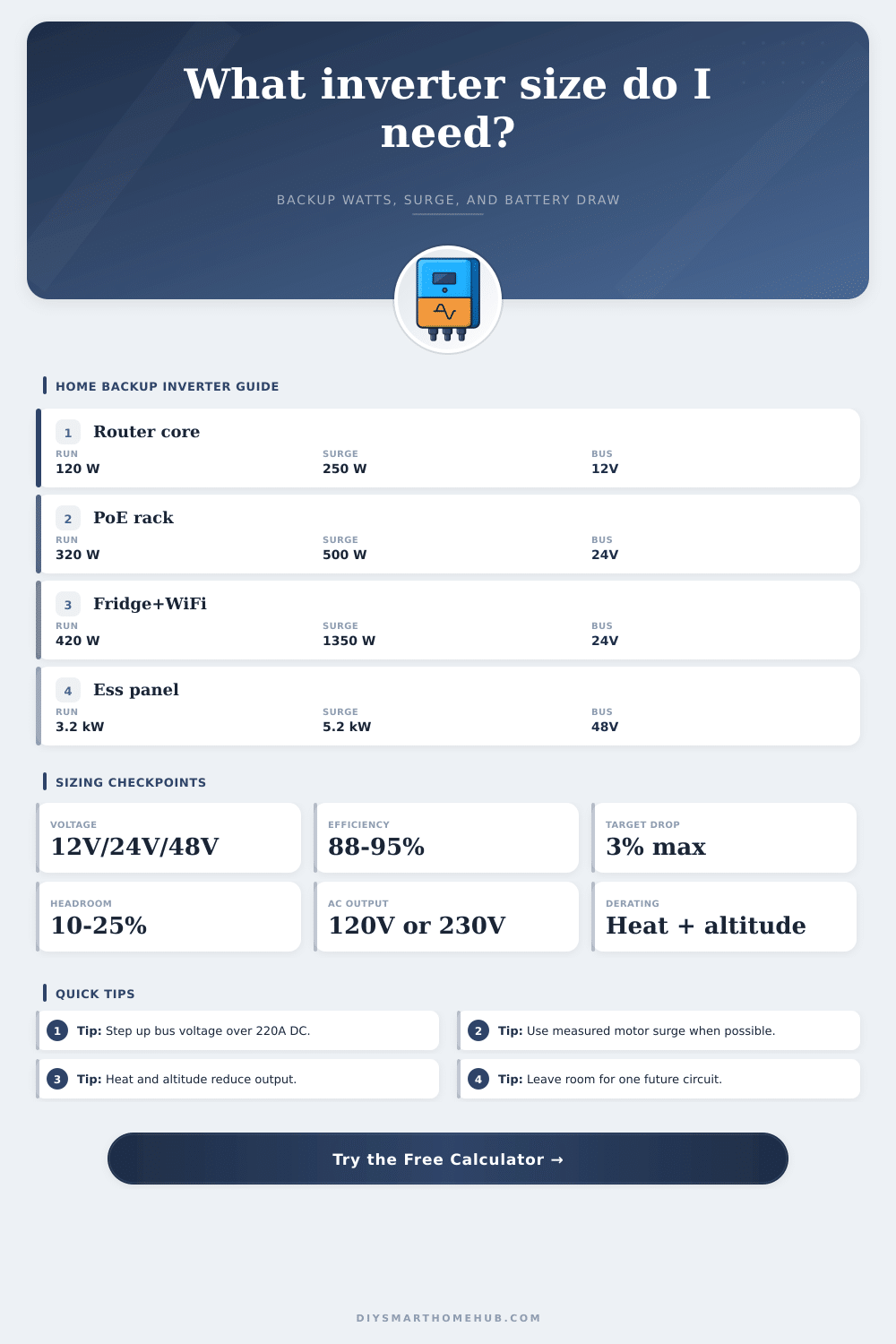
| Router + modem core | 120 W | 250 W | 400W pure sine |
| PoE security rack | 320 W | 500 W | 800W rack UPS |
| Fridge + WiFi core | 420 W | 1350 W | 1500W / 3000W surge |
| Furnace + network | 780 W | 1800 W | 2000W / 4000W surge |
| Garage freezer circuit | 520 W | 1600 W | 1500W / 3000W surge |
| Home office + NAS | 900 W | 1400 W | 1500W hybrid |
| Server closet 24/7 | 1350 W | 1800 W | 2000W rack UPS |
| Essential panel half-day | 3200 W | 5200 W | 5000W hybrid on 48V |
Bus Voltage Tip: If the DC current result climbs much past 220A on a 12V system, moving the same load to 24V or 48V usually trims cable size, fuse size, and voltage drop stress dramatically.
Surge Planning Tip: Startup watts from refrigerators, blowers, and sump pumps are often the real limiter. Measure that surge with a power monitor or clamp meter before locking in the inverter class.
Inverter sizing require you to understand the difference between steady running watts and startup surge watt. Steady running watts represent the wattage that a device use while it is running. Startup surge watts, however, represent the extra wattage that a device require to start up.
For instance, an refrigerator may use 200 running watts, but the same refrigerator may require seven times more than that amount of power for a short period while the compressor turn on. If the inverter you select does not have the power to handles these startup surge watts, the inverter will continually trip and shut off power to the device. Therefore, you must calculate the total running watts that all of your device will use, as well as account for the largest single watt requirement for startup surge power.
How to Size an Inverter
Such startup surge watts can be found on the appliance itself, as well as with the use of a clamp meter. Additionally, many people also incorporate a diversity factor into their calculation; a diversity factor is a calculation that suggests not all appliance will be in use at the same time. The other consideration for your inverter is it’s battery bus voltage.
The battery bus voltage will determine the amperage that will travel through your power cables. If you use a 12-volt battery bus to provide power to your inverter, you will push high amperage through your power cables. High amperage can create issues with your power cables in that they can become too hot to touch or they can experience a voltage drop.
If you use a 48-volt battery bus, however, you will push less current through the cables because 48 volts are more efficient than 12 volts. Your cable gauge must be selected such that the voltage drop is less than 3 percent; otherwise, your inverter may shut off because it read a low battery voltage. Additionally, you must also consider the effect of heat and altitude on the inverters performance.
An inverter located in a hot attic or at an altitude may not be able to reach 100% of its rated capacity. An inverter placed in these condition may lose 10 to 15 percent of its designated capacity. Batteries contains different chemistries and can provide different amount of energy to your inverter.
For instance, lithium batteries can discharge to 90% of their total energy, while you should only use lead acid batteries to 50% of their total energy to avoid damage to the battery. In addition to the chemistry of the batteries, inverters do consume power even if the inverter is not powering any appliances; this power is referred to as idle watts. Therefore, you must account for the idle watts of the inverter.
Additionally, you can factor in a growth margin for your inverter; a growth margin is extra watt provided in the inverter system that allow for additional device to be added to the inverter system. For instance, including a 20% growth margin will allow for additional device to be added to the system without altering the current inverter. There are different type of inverters, each suitable for different applications and setups.
For instance, a 12-volt inverter is suitable for small load, such as a router and a modem. A 48-volt system is better for larger loads, such as an essential electrical panel. Additionally, if you are powering device that are sensitive to electricity, such as a NAS drive, you must use a pure sine wave inverter.
A pure sine wave provides the most efficient power transfer; a modified sine wave inverter can cause damage to these sensitive electronic. Additionally, you must also size the fuse and circuit breakers for the inverter system appropriately. Fuses and circuit breakers should be sized to 125% of the continuous wattage of the device being powered.
If they are sized too small, the inverter will continuously trip; if they are sized too large, there will be waste in the energy provide by the batteries due to high idle draw of the inverter. Thus, it is important to ensure that the inverter is sized according to the watts that the devices will use, the startup surge watts of those device, and the battery voltage.