Refrigerant Recovery Tank Calculator
Estimate the safe recovery stop weight for a cylinder by refrigerant type, water capacity, ambient temperature, tare weight, and planned safety margin before you start pulling liquid.
📌Field Presets
⚙Tank Inputs
How the calculator works: It multiplies tank water capacity by refrigerant liquid density and your effective fill factor, then compares that safe net fill to the cylinder tare and the current gross scale reading.
Recovery Tank Snapshot
Use the inputs above to estimate a safe gross stop weight and the remaining liquid recovery headroom for this cylinder.
📊Refrigerant And Tank Spec Grid
R-410A - High pressure blend
At 90°F
Current stop multiplier
Shell guidance
📘Common Recovery Cylinder Profiles
| Nominal Tank | Water Capacity | Typical Tare | Service Rating | Common Use |
|---|---|---|---|---|
| 30 lb cylinder | 26.2 lb water | 16.8 lb | 400 psi | Residential split service calls |
| 50 lb cylinder | 47.6 lb water | 24.9 lb | 400 psi | Rooftop and light commercial recovery |
| 62 lb cylinder | 55.1 lb water | 29.4 lb | 400 psi | Medium charge comfort and cooler work |
| 90 lb cylinder | 85.0 lb water | 47.0 lb | 400 psi | Large pump-down or rooftop jobs |
| 125 lb cylinder | 113.8 lb water | 63.0 lb | 400 psi | Receiver cleanout and parallel racks |
| 240 lb drum | 214.0 lb water | 118.0 lb | Transfer rated | Bulk reclaim staging in the shop |
These are planning baselines only. Always verify the exact water capacity, tare weight, and pressure class stamped on your own cylinder collar.
📈Liquid Density And Fill Multipliers
| Refrigerant | 70°F Density | 110°F Density | 80% Fill At 90°F | Typical Use |
|---|---|---|---|---|
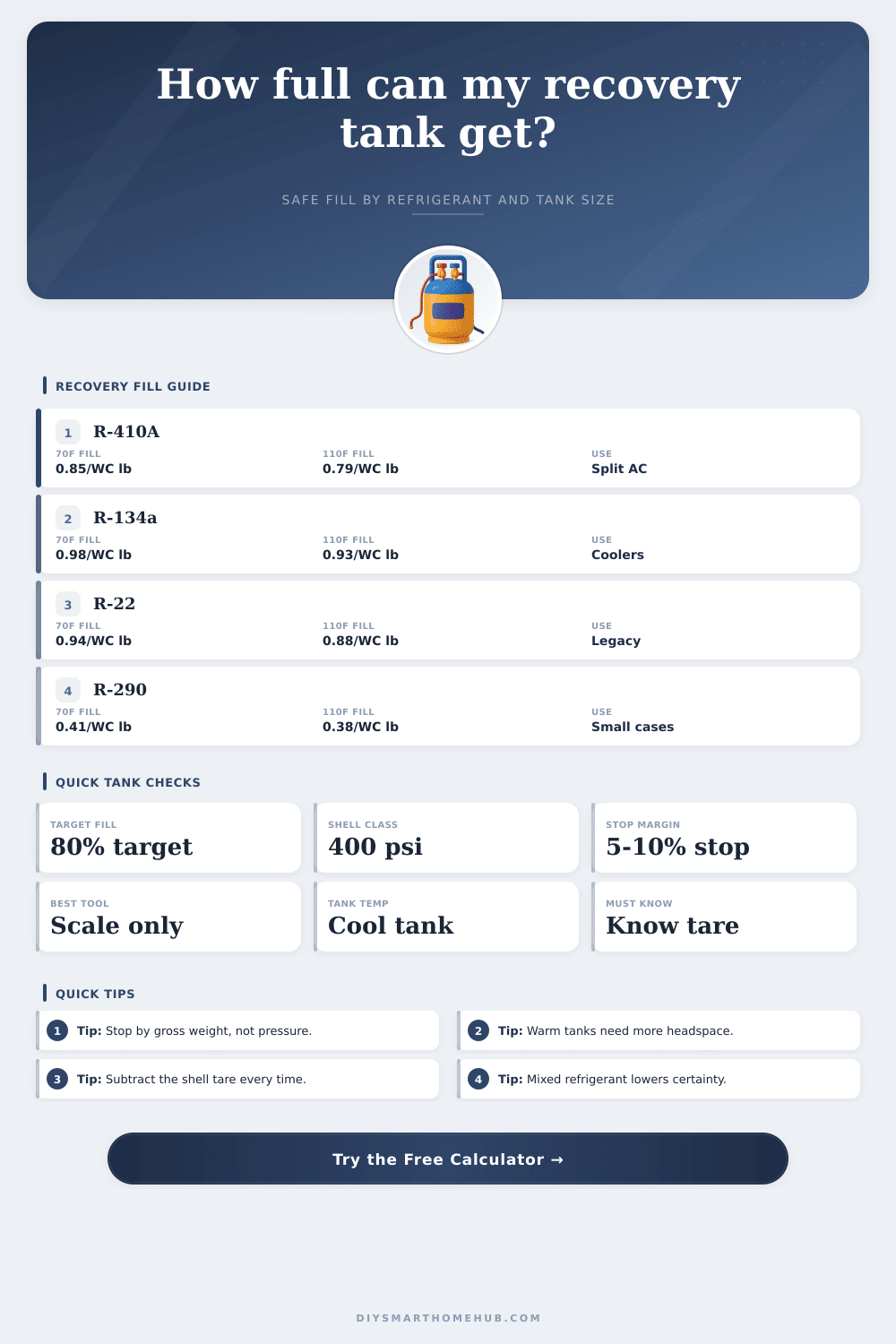
| R-410A | 1.06 kg/L | 0.99 kg/L | 0.82 lb per lb WC | High-pressure residential split systems |
| R-32 | 0.98 kg/L | 0.92 kg/L | 0.76 lb per lb WC | A2L mini-split and light commercial |
| R-454B | 0.96 kg/L | 0.90 kg/L | 0.74 lb per lb WC | A2L replacement for newer comfort systems |
| R-134a | 1.23 kg/L | 1.16 kg/L | 0.96 lb per lb WC | Medium-temperature coolers and auto A/C |
| R-22 | 1.18 kg/L | 1.10 kg/L | 0.91 lb per lb WC | Legacy HCFC comfort cooling systems |
| R-407C | 1.10 kg/L | 1.03 kg/L | 0.86 lb per lb WC | Retrofit medium-pressure blends |
| R-404A | 1.07 kg/L | 1.00 kg/L | 0.83 lb per lb WC | Low-temperature commercial racks |
| R-290 | 0.51 kg/L | 0.47 kg/L | 0.39 lb per lb WC | Hydrocarbon merchandisers and small appliances |
| R-1234yf | 1.07 kg/L | 1.00 kg/L | 0.83 lb per lb WC | Automotive and light-duty A2L service |
☀Ambient Temperature Derate Guide
| Tank Temperature | Ambient Factor | Effective 80% Cap | Why It Matters |
|---|---|---|---|
| 70°F and below | 1.00 | 80.0% | Cool cylinders leave the most expansion room for transport. |
| 71–90°F | 0.98 | 78.4% | Normal field recovery still benefits from a slight cushion. |
| 91–100°F | 0.95 | 76.0% | Warm liquid expands and can erase your safety headspace quickly. |
| 101–110°F | 0.92 | 73.6% | Recovery should slow early unless the cylinder is actively cooled. |
| 111–120°F | 0.89 | 71.2% | Use a larger tank or additional cylinder to keep transport safer. |
| Above 120°F | 0.85 | 68.0% | Hot cylinders need aggressive headspace and close weight monitoring. |
📋Worked Stop-Point Examples
| Scenario | Tank | Refrigerant | Safe Net Fill | Recommended Gross Stop |
|---|---|---|---|---|
| Condenser swap on a split system | 30 lb shell | R-410A at 90°F | 21.1 lb | 37.4 lb gross |
| Legacy rooftop cleanout | 50 lb shell | R-22 at 95°F | 42.4 lb | 66.8 lb gross |
| Reach-in cooler compressor change | 62 lb shell | R-134a at 85°F | 51.8 lb | 80.7 lb gross |
| Warm retrofit day with A2L blend | 90 lb shell | R-454B at 105°F | 56.8 lb | 103.3 lb gross |
| Shop reclaim staging | 240 lb drum | R-1234yf at 90°F | 174.4 lb | 291.9 lb gross |
Tank handling tip: Put the cylinder on the scale first, zero your process, and log the tare from the collar before any hose is opened. Recovery decisions should be made from gross weight, not gauge pressure.
Recovery planning tip: If the cylinder has mixed refrigerant, unknown oil carryover, or a high ambient exposure, choose a larger stop buffer and a lower fill limit so transport headspace stays conservative.
When completing refrigerant recovery, it is essential to monitor the weight of the refrigerant cylinder to ensure it isnt overfilled. An overfilled refrigerant cylinder is dangerous because the liquid refrigerant will expand when exposed to higher temperature, which could result in the refrigerant cylinder rupturing. The pressure gauge on the refrigerant cylinder cant be used to determine if it is full, as it does not factor in the density of the refrigerant nor the temperature of the refrigerant.
However, by using a scale to monitor the weight of the refrigerant cylinder, you can have an accurat measurement of the amount of refrigerant currently in the cylinder. To calculate the amount of refrigerant that should be in the cylinder, you must first determine the water capacity of the cylinder and the tare weight of the cylinder. The water capacity of the cylinder is the amount of water the cylinder can hold when full.
How to Safely Weigh and Fill a Refrigerant Cylinder
This number is stamped on the refrigerant cylinders collar. The tare weight is the weight of the refrigerant cylinder when it is empty. This value is also stamped on the refrigerant cylinders collar.
To find the net weight of the refrigerant, subtract the tare weight from the gross weight of the refrigerant cylinder. To find the gross stop weight, also referred to as the safe fill weight, add the refrigerant’s calculated maximum safe fill weight to the tare weight. If you dont use the tare weight in the refrigerant cylinders fill calculation, it is impossible to determine the gross stop weight of the refrigerant cylinder.
The ambient temperature of the refrigerant cylinder affect the refrigerants density and how much space the refrigerant will need to expand. If the refrigerant cylinder is in an area with a high ambient temperature, the refrigerant will expand more when heated. For example, if an ambient temperature of 70 degrees Fahrenheit exposes the refrigerant cylinder, you can fill the refrigerant cylinder to an 80% fill limit.
However, at 110 degrees Fahrenheit, the refrigerant expansion rate will cause the refrigerant to need a lower fill limit for the refrigerant cylinder. Due to the potential expansion of the refrigerant in the cylinder, the temperature need to be accounted for in the refrigerant recovery process. By using an 80% fill limit for refrigerant cylinders, 20% of the refrigerant cylinder will be left as vapor space for the refrigerant.
A 70% fill limit is required for hydrocarbons and refrigerants classified as mildly flammable to ensure there is a safety margin in case of fire. The stop buffer ensures there is a 5% to 10% margin below the refrigerant cylinders maximum fill limit. The stop buffer accounts for errors in the refrigerant weight such as refrigerant in the recovery hoses.
By using a refrigerant fill limit and a stop buffer, there will always be enough headspace within the refrigerant cylinder. Due to the chemical composition of the refrigerants, some refrigerants is more dense than others. For example, R-134a refrigerant is more dense than refrigerant blends such as R-290. Because refrigerants have different densities, refrigerants will occupy different amounts of space within the same refrigerant cylinder.
To find the proper headspace for refrigerant recovery, you must select the type of refrigerant on the refrigerant cylinder scale. Additionally, when using refrigerant blends, you must take care in the refrigerant recovery process. If refrigerant vapor is recovered instead of liquid refrigerant, refrigerant blend components can fractionate.
Therefore, recovering liquid refrigerant will preserve the refrigerant blends purity and will take less time than recovering refrigerant vapor. Always double-check the refrigerant cylinders stamps to ensure the refrigerant recovery scale does not use the refrigerant cylinders profile to determine the refrigerant cylinders parameters. The stamps will read the water capacity of the refrigerant cylinder and the tare weight of the refrigerant cylinder.
The gross weight of the refrigerant must also be monitored throughout the refrigerant recovery process. When the gross weight of the refrigerant cylinder is near the calculated gross stop weight, the technician must slow the refrigerant recovery process. Following these guidelines will allow the refrigerant technician to know the amount of refrigerant remaining to be recovered and what the gross stop weight should of be for refrigerant recovery.
By monitoring the weight, temperature, and using the proper tare weight, refrigerant technicians can ensure the refrigerant recovery process is completed in a safe manner.