Refrigerant Properties Calculator
Compare evaporator and condenser saturation points, convert pressure to temperature, and estimate density, line state, compression ratio, and rough capacity for common refrigerants.
📌Field Presets
Planning note: This tool uses interpolated pressure-temperature rows and simplified density models for fast service estimates. Final charging and diagnostics should still follow the equipment PT chart and manufacturer targets.
⚙Operating Inputs
Calculated Refrigerant Snapshot
Enter your operating point to compare saturation pressure, density, and rough capacity in one service view.
📊Selected Refrigerant Snapshot
R-410A - High pressure
Use for comfort cooling, ducted splits, and high-pressure service checks.
Near-azeotropic behavior
Low glide means dew and bubble references stay close for most field checks.
At current condensing state
Higher condensing temperatures usually reduce liquid density and storage mass.
At current evaporating state
Lower suction density raises specific volume and can reduce compressor mass flow.
📑Saturation Pressure Reference
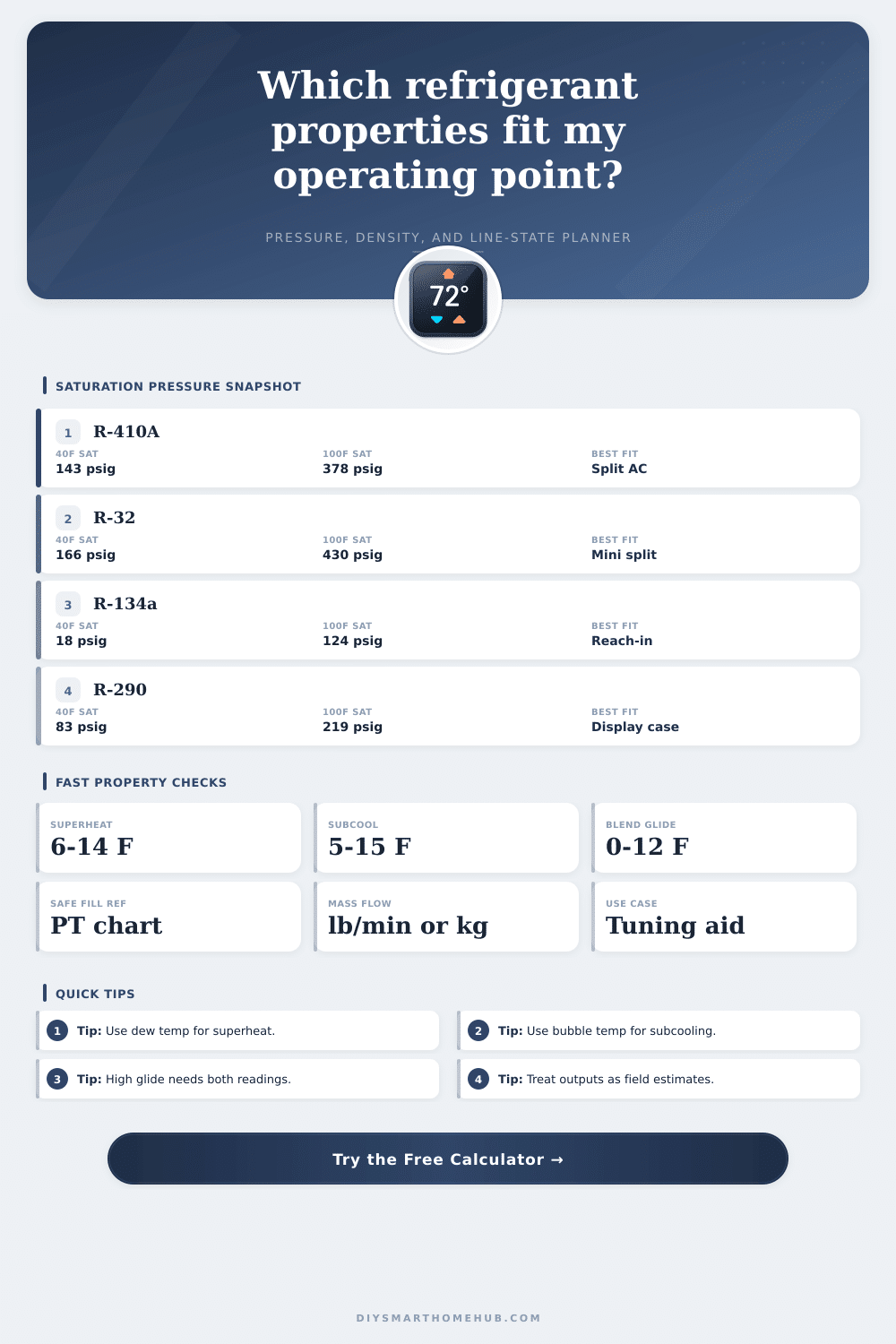
| Refrigerant | 20 F Sat | 40 F Sat | 80 F Sat | 110 F Sat | Pressure Family |
|---|
📚Density and Energy Comparison
| Refrigerant | Liquid @ 100 F | Vapor @ 40 F | Base Effect | Glide |
|---|
📋Application Target Bands
| Profile | Superheat | Subcooling | Evap Range | Cond Range |
|---|
📈Preset Scenario Comparison
| Preset | Refrigerant | Evap | Cond | Bias |
|---|
Tip: When a blend has glide, use dew temperature or dew pressure for evaporator superheat checks and bubble temperature for condenser subcooling checks.
Tip: If capacity and density both fall while compression ratio climbs, double-check airflow or water flow before adding charge. A PT shift alone does not confirm undercharge.
Refrigerants is chemicals that are used to move heat within the refrigeration systems. Each refrigerant have different physical properties. These physical properties help to determine how each refrigerant will behave within the refrigeration system under different loads.
Without understanding the behavior of refrigerants, technician will make incorrect adjustment to the refrigerant charge within refrigeration systems. Refrigerants such as R-410A work at high temperature and high pressures. R-410A is often used in ducted split refrigeration systems.
How Different Refrigerants Affect Refrigeration Systems
R-32 refrigerant has a higher energy density per pound than other refrigerants. R-32 refrigerant is often used in mini-split systems. Because R-32 refrigerant is mildly flammable, technicians should take care around R-32 refrigerant in tight work space.
The type of refrigerant that is used will determine the line sizing requirement for that refrigeration system, as well as the amount of refrigerant charge that is required. Using the wrong amount of refrigerant or using lines of the wrong size will make it difficult for the technician to stabilize the superheat in that refrigeration system. Refrigerants that are blended, such as R-407C or R-454B has a physical property known as glide.
Pure refrigerants will reach their boiling or condensing point at the same temperature. Blended refrigerants will change temperatures during the phase change process. This change in temperature is known as glide.
For blended refrigerants like R-407C, which has a glide of 10 degrees, technicians will need to decide if the refrigerant temperature is being measured at its dew point or its bubble point. The dew point will be used for refrigeration systems that are evaluating the evaporator. The bubble point will be used for refrigeration systems that are evaluating the condenser.
If the wrong temperature is used for refrigeration system evaluation, technicians may believe refrigerant charge is too low. Another physical property of refrigerants is density. The density of the liquid refrigerant will decrease as the temperature of the condenser increase.
The density of the vapor refrigerant at the evaporator will determine the mass of refrigerant that flow through the system. The capacity of the system will depend upon this mass of refrigerant. If the suction line density is low, the specific volume of the refrigerant will be highly.
This means that the compressor will push more refrigerant gas but less mass through the system. This will cause the output of the refrigeration system to drop. This drop in the output of the refrigeration system will often occur on hot days.
High temperatures will affect the density of the refrigerant. Field presets on refrigeration calculators will simulate refrigeration systems with specific refrigerants. For instance, a preset can be made for an R-134a refrigerant reach-in cooler with an evaporator temperature of 24 degrees.
These presets will allow technicians to input the parameters of the refrigeration system and ensure that the superheat is within its typical range of 6 to 14 degrees, and that its subcooling is within its typical range of 5 to 15 degrees. By inputting the refrigerant pressures and temperatures into a calculator, refrigeration technicians can calculate the mass of refrigerant that is flowing through the system, and the amount of energy that the refrigerant moves per pound of refrigerant; the net refrigeration effect. By knowing the net refrigeration effect of the refrigerant, technicians can calculate the capacity of that refrigeration system in kBtu/h or in kW.
The capacity of a refrigeration system can help tell technicians if the saturation temperature of the evaporator is drifting from its target range of 34 to 45 degrees. Refrigerants can be categorized according to their safety class. For instance, R-410A is classified as an A1 refrigerant (meaning it is non-flammable).
R-32 and R-454B are classified as A2L refrigerants… Meaning it is mildly flammable. Because these refrigerants are mildly flammable, refrigerant charge limits must be followed when technicians are being charge in occupied spaces.
R-290 is an A3 refrigerant, meaning it is highly flammable. Because R-290 is highly flammable, it is typically only used in small merchandisers. It is important to always check the airflow of refrigeration systems prior to assuming that the refrigerant charge is low in the system.
Incorrect refrigerant charge can be caused by poor airflow. It is also important to always cross-check refrigeration system readings with those specified by the manufacturer of the refrigeration system. Tools based off pressure-temperature tables allow for technician calculations to be performed at a rapid rate.
However, these tools dont certify the charge of refrigerant within refrigeration systems. For refrigeration systems to be properly maintained, technicians will need to monitor the superheat in the system. For mini-split systems that use refrigerant R-32, the superheat should be maintained between 7 and 13 degrees to avoid the possibility of liquid slugging.
Roof mounted refrigeration units that use refrigerant R-454B when the roof temperatures are hot will require the use of dew-point superheat because of the glide of that refrigerant. Propane refrigeration systems that use refrigerant R-290 will typically require subcooling to be maintained between 4 and 8 degrees because R-290 has a high latent heat. Refrigeration calculators allow technicians to convert measurements between the imperial and metric systems.
Additionally, refrigeration calculators allow technicians to interpolate between known refrigerant pressures and temperatures to estimate other refrigerant properties. Understanding how refrigerant vapor density impacts the mass flow of refrigerant will allow technicians to understand how the mass flow impacts the net refrigeration effect of the refrigeration system. Thus, technicians can determine the capacity of the refrigeration system.