Refrigerant Emissions Calculator
Estimate startup loss, yearly operating leaks, service-opening loss, and retirement recovery impact for residential HVAC refrigerants so you can compare high-GWP legacy systems against lower-GWP replacements.
📌Scenario Presets
⚙Emissions Inputs
Direct emissions combine one-time startup loss, annual operating leaks, intentional service-opening loss, and unrecovered refrigerant left at retirement. Climate impact uses the refrigerant GWP multiplied by emitted mass.
Emissions Snapshot
Run the calculator to compare direct refrigerant loss and CO2e impact for your selected system and management plan.
📊Selected Refrigerant Spec Grid
R-410A climate factor
Selected refrigerant class
System profile benchmark
Response plan effect
📑Refrigerant Climate Reference
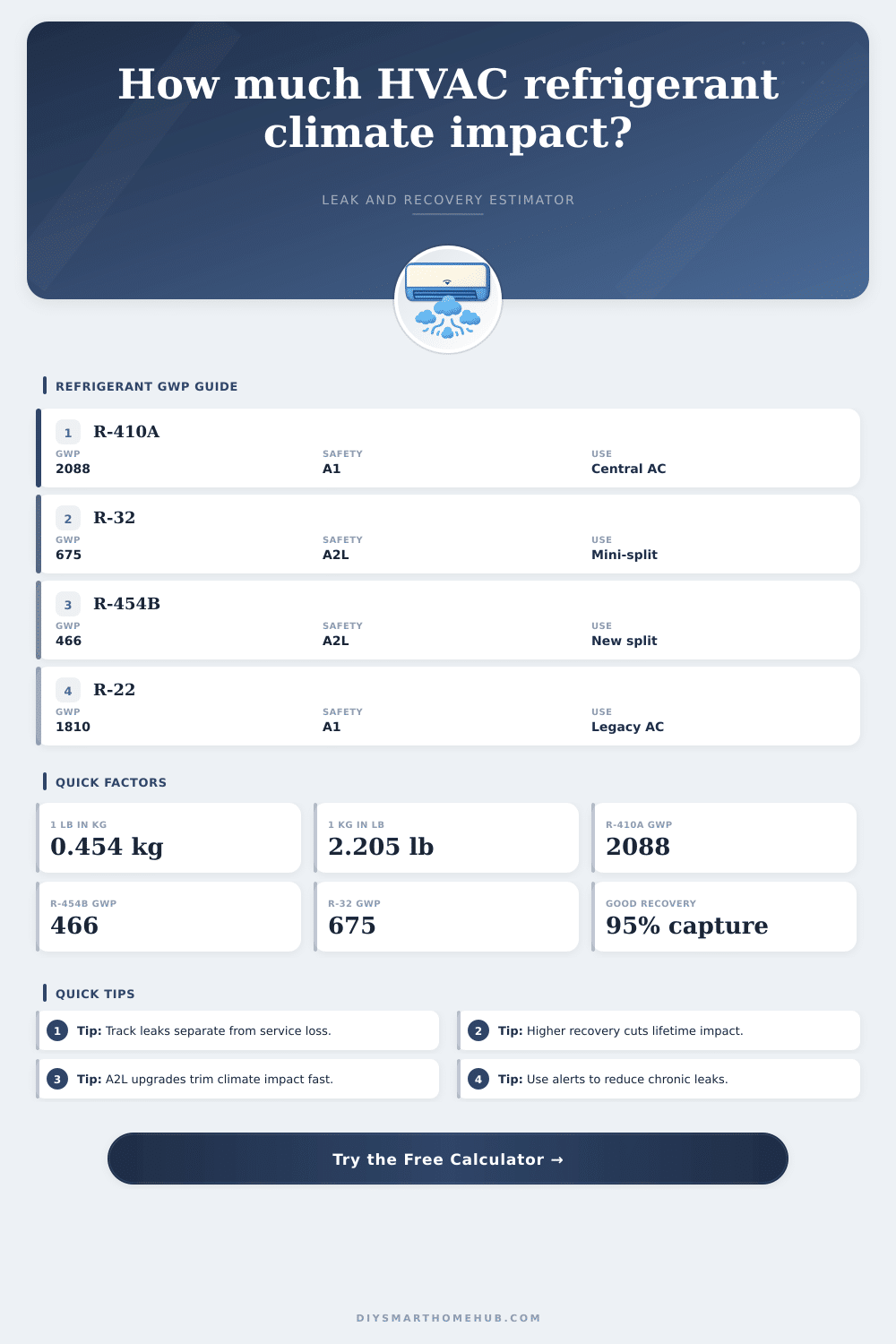
| Refrigerant | 100-Year GWP | Safety Class | Typical Residential Use |
|---|
GWP values are used as direct multipliers: emitted kilograms multiplied by GWP equals kilograms of CO2e.
📋Leak Rate Benchmarks
| System Condition | Operating Leak Rate | Service Visits | Interpretation |
|---|---|---|---|
| Factory-sealed mini-split | 2-4% per year | 0-1 per year | Mostly connection losses and rare repairs |
| Tight TXV split | 4-6% per year | 1 per year | Normal residential maintenance pattern |
| Average heat pump | 6-8% per year | 1-2 per year | More joints and seasonal defrost controls |
| Aging fixed-orifice split | 8-12% per year | 2 per year | Corrosion and repeated top-off risk |
| Retrofit blend system | 7-10% per year | 1-2 per year | Blend fractionation makes good recovery critical |
| Deferred maintenance case | 12%+ per year | 2-3 per year | High direct emissions and chronic recharge demand |
🏠Preset Scenario Comparison
| Scenario | Charge | Leak Plan | Annual Impact |
|---|
♻Recovery Outcome Table
| Recovery Efficiency | Captured Charge | Released at Retirement | Use Case |
|---|
Separate chronic operating leaks from service-opening loss. A system with low operating leakage but frequent invasive service may need procedure changes more than hardware replacement.
Recovery efficiency changes lifetime impact sharply. Raising end-of-life capture from 80% to 95% cuts retirement emissions by three quarters for the same installed charge.
Refrigerant is use to create cool air within air conditioning systems. Because refrigerant contribute to climate change if it escapes into the atmosphere, refrigerant has a negative impact on the environment. Although engineer often make refrigerant to be efficient within air conditioning systems, refrigerant is more effective at trapping heat than carbon dioxide.
Furthermore, the environmental impact of one kilogram of refrigerant are equal to the environmental impact of burning a specific amount of gasoline. Many homeowner that replace their air conditioning systems do not understand its impact upon the environment. Additionally, air conditioning technician often add refrigerant to fix the resulting leak without addressing the actual cause of that leak.
How Refrigerant Leaks Harm the Environment
Thus, the refrigerant used within these systems contribute to the environmental load of air conditioning systems, and results in a greater carbon footprint from air conditioning systems than vehicles emit. Air conditioning system types emit refrigerant at different rate. For example, mini-split systems, which are sealed at the factory, emit refrigerant at a slower rate than older central air conditioning units, which has more joints exposed to the weather.
Furthermore, heat pumps emit refrigerant at a higher rate due to the reversing valves in those systems. Finally, older air conditioning systems that used refrigerants that were phased out has the highest leak rates, and the rate of those leaks will be even higher if the manufacturer of those systems did not perform regular maintenance on those units. These slow leaks of refrigerant can occur over many years, and lead air conditioning systems to emit refrigerant continuous.
Mathematical models can be constructed to understand the amount of refrigerant that is released from air conditioning systems. The mathematical model require the homeowner to input the size of the refrigerant charge, the type of refrigerant that the air conditioning systems use, and the methods that is used to handle refrigerant leaks. The mathematical model will reveal the rate at which the air conditioning system releases refrigerant each year, as well as throughout it’s lifetime.
For example, startup losses occur when the air conditioning system is installed, but account for only about half a percent of the total amount of refrigerant that is fill into the air conditioning system. Operating leaks, or the drips that occur from air conditioning units, is the primary source of refrigerant loss by air conditioning systems each year. Service openings occur when technicians open the air conditioning system to repair the system, and can add to the total refrigerant loss by the system.
Finally, refrigerant is captured during the retirement of air conditioning systems, and the amount of refrigerant captured will determine the total environmental impact of that air conditioning system over its lifetime. By changing from a reactive maintenance plan to a proactive maintenance plan for air conditioning systems, the loss of refrigerant can be reduced. Under the reactive maintenance plan, the homeowner must wait until they recieve a complaint regarding the air conditioning system’s ability to cool the environment in which it is install.
Under the proactive maintenance plan, refrigerant is checked every three months, or leak detector are employed to identify refrigerant leaks. Furthermore, using leak detectors allows technicians to fix refrigerant leaks prior to them becoming a significant amount of refrigerant loss. Thus, the use of leak detectors allow the refrigerant leaks to be fixed in time to offset the cost of purchasing the leak detector.
By combining preventative detection methods with high refrigerant recovery rates at the end of the system’s life, a significant reduction of the environmental impact of refrigerant can be made. The type of refrigerant that an AC unit uses will have an impact upon the environmental impact of any refrigerant leaks. Refrigerants with high Global Warming Potential will lead to a greater environmental impact with each gram of refrigerant that leak out of the system; those refrigerants will lead to the creation of many tons of carbon dioxide equivalent.
New refrigerants tend to have a lower GWP; therefore, fewer refrigerants with lower Global Warming Potential will lead to reductions in the environmental impact of refrigerant leaks, without sacrificing the cooling performance of the AC system. Furthermore, refrigerants with higher safety classes are often easier to handle; A1 refrigerants are non-flammable, but A2L refrigerants are flammable and require specific installation procedures. Refrigerant blends are more difficult to recover than single-component refrigerants, as the components of the blend can separate when the system is refilled with refrigerant; this fractionation can lead to leaks of that refrigerant.
There are some mistakes that people often make during the refrigerant recovery process. For instance, many people tend to overestimate the amount of refrigerant that will be recover during the refrigerant recovery process. Many individuals believe that 90% recovery is the expected standard in the air conditioning repair industry; however, the actual recovery rate is often lower.
Recovery rates tend to be low if technicians do not use techniques like triple evacuation to remove the refrigerant from the system, or if they do not use calibrated refrigerant pump. Furthermore, many people tend to not recognize refrigerant system losses as leak; for instance, they may not recognize that the system is losing refrigerant due to cracked lines, as opposed to opened valves. Many individuals also tend to believe that HVAC equipment will last 20 year; however, most HVAC systems only last 12 years.
Using preset scenarios for HVAC systems is one way to be able to benchmark the refrigerant performance of those systems; benchmarking allows for the comparison of the performance of mini-split air conditioning systems to those of older, legacy air conditioning systems. The benchmarks for refrigerant leakage rates differ with the type of HVAC system. Factory-sealed mini-split systems will lose between 2 and 4 percent of their refrigerant each year under ideal conditions.
Systems that are over time with fixed orifices may lose between 8 and 12 percent of their refrigerant each year; corrosion can eat at the seal of the HVAC system. Heat pumps may have a leakage rate in between those two percentages; heat pumps have both the complexity of a mini-split system as well as the brazing techniques common in HVAC systems of the present day. Furthermore, if HVAC systems are ignored and maintenance is deferred for long periods of time, the rate at which refrigerant can leak from those systems can rise to above 12 percent per year.
When refrigerant loss rates increase to such level, it becomes a habit for those systems to be replenished with refrigerant. Furthermore, refrigerant loss should be tracked separately from the HVAC system service events to monitor refrigerant losses. One factor that can impact the total environmental impact of refrigerant is the environmental factor of the end of the life of the air conditioning system.
For instance, if refrigerant recovery at the end of the life of an AC system is increased from 80% to 95%, the quantity of refrigerant that can be reclaimed for future HVAC systems is significantly increased. Such increased recovery help to prevent refrigerant emissions into the atmosphere that may otherwise be equal to the refrigerant losses of many years of system operation. HVAC system contractors that utilize shop vacuums and scales have the tools to achieve these high percentages of refrigerant recovery.
For homeowners that are in the planning stage of the replacement of their air conditioning systems, it is always important to ask the HVAC contractors about the refrigerant recovery protocols that they will employ during the installation of HVAC system components.