RV Propane Usage Calculator
Estimate daily propane burn across your RV furnace, water heater, fridge, cooking loads, and LP generator, then compare peak demand with cold-weather tank vapor capacity.
📌Trip Presets
⛽RV Propane Inputs
RV Propane Results
Run a calculation to see daily propane draw, trip demand, and whether your tank setup can support the cold-weather peak load.
📊RV Propane Spec Grid
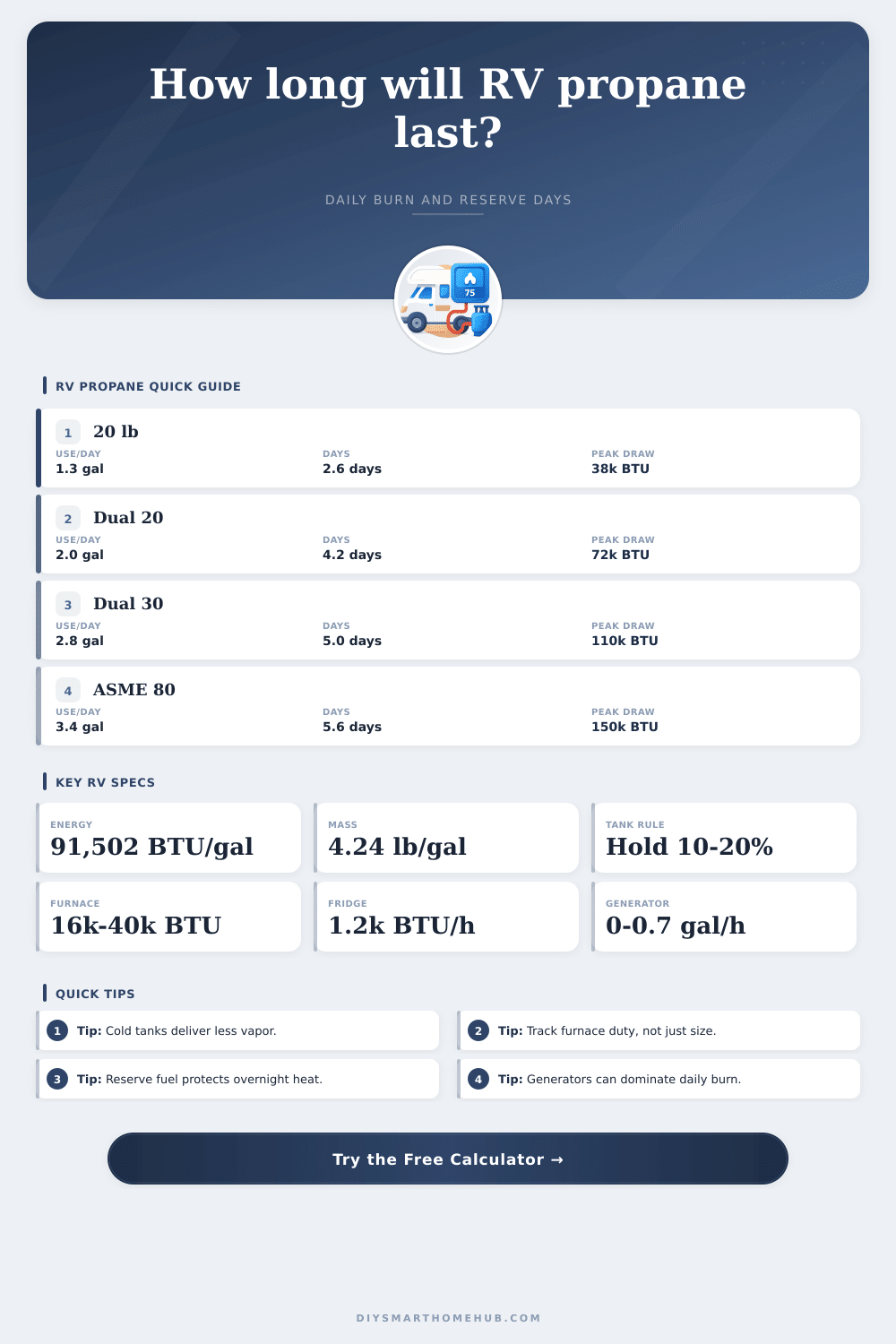
Dual 20 lb Cylinders
Portable dual-cylinder setups are common on trailers and usually balance refill convenience with moderate winter vapor output.
Furnace Input Rate
At 50% duty, a 25k BTU furnace alone burns about 3.3 gallons every four days.
No LP Generator
Generator loads can exceed every kitchen appliance combined, so hours per day matter more than short cooking bursts.
20°F Vapor Capacity
Cold-soaked cylinders deliver less vapor, especially once the fill level drops below roughly half full.
📘Appliance Usage Reference
| Appliance | Typical Input | Full-Fire Burn | Trip Planning Note |
|---|---|---|---|
| RV furnace small | 16,000 BTU/h | 0.17 gal/h | Light trailers and truck campers |
| RV furnace medium | 25,000 BTU/h | 0.27 gal/h | Common family trailer size |
| RV furnace large | 35,000 BTU/h | 0.38 gal/h | Fifth wheels and larger coaches |
| Water heater | 8.8k-16k BTU/h | 0.10-0.17 gal/h | Short bursts add up fast after showers |
| Absorption fridge | 1,200-1,500 BTU/h | 0.01-0.02 gal/h | Small but constant on boondock trips |
| Stove or oven | 7k-9k BTU/h | 0.08-0.10 gal/h | Meal prep is short but can stack with water heat |
| LP generator | 27k-64k BTU/h | 0.30-0.70 gal/h | Usually the biggest non-furnace draw |
Full-fire burn uses 91,502 BTU per gallon of propane and shows how much a single appliance can consume when it runs continuously.
🛢Tank Capacity And Reserve Table
| Tank Setup | Stored Propane | Usable At 80% Start / 15% Hold | Furnace-Only Hours At 25k BTU/h |
|---|---|---|---|
| Single 20 lb | 4.7 gal | 3.06 gal | 11.2 hr full fire |
| Dual 20 lb | 9.4 gal | 6.11 gal | 22.4 hr full fire |
| Dual 30 lb | 14.1 gal | 9.16 gal | 33.5 hr full fire |
| Dual 40 lb | 18.8 gal | 12.22 gal | 44.8 hr full fire |
| ASME 68 lb | 16.0 gal | 10.40 gal | 38.1 hr full fire |
| ASME 80 lb | 18.9 gal | 12.29 gal | 45.0 hr full fire |
| ASME 100 lb | 23.6 gal | 15.34 gal | 56.2 hr full fire |
🥶Cold Weather Vapor Reference
| Tank Setup | 20°F | 0°F | -10°F |
|---|---|---|---|
| Single 20 lb | 36k BTU/h | 22k BTU/h | 12k BTU/h |
| Dual 20 lb | 72k BTU/h | 44k BTU/h | 24k BTU/h |
| Dual 30 lb | 110k BTU/h | 70k BTU/h | 38k BTU/h |
| ASME 80 lb | 150k BTU/h | 95k BTU/h | 54k BTU/h |
These values are planning references for tank vaporization in still outdoor air. Real output changes with fill level, regulator condition, tank surface area, and wind exposure.
🗺Common RV Trip Profiles
| Scenario | Typical Daily Burn | Works Best With | Watch Item |
|---|---|---|---|
| Mild spring weekend | 0.8-1.4 gal/day | Single or dual 20 lb | Fridge and water heat cycles |
| Family shoulder season | 1.5-2.6 gal/day | Dual 20 or dual 30 | Morning furnace demand |
| Cold weather boondock | 2.8-4.5 gal/day | Dual 30 or ASME tank | Vapor limits under freezing |
| LP generator work camp | 3.5-6.0 gal/day | Large ASME tank | Generator runtime hours |
For overnight freeze planning, treat the furnace as the anchor load and add the water heater only if you know morning showers or dish cleanup will overlap the coldest part of the day.
If your RV uses an LP generator, compare both daily gallons and peak BTU draw. Long runtime empties the tank, but cold-weather vapor shortage can stop the generator even before the fuel is gone.
Propane is a fuel that many campsite use to provide heat and power to the various appliances that are located within the campsite. In order to use these propane appliances, it is essential to ensure that there is enough propane within the tanks for the entire camping trip. Without enough propane, these appliances will no longer be able to perform there essential task for the campground.
The amount of propane available to the campground is dependent upon the size of the propane tanks that is used within the campsite as well as the temperature within the environment. A single 20-pound propane tank can hold 4.5 gallon of propane. In the case of a campsite that does not require the use of many propane appliances, a single 20-pound tank may be sufficient for a camping trip that lasts for only a few days.
How Much Propane Do You Need for a Camping Trip
Campsites that use dual 30-pound propane tanks has more propane available and can last longer for camping trips. However, the temperature within the propane tanks has a direct effect on the amount of propane that can be released from the tanks. The lower the temperature, the more slow that propane vaporizes within the tank.
Additionally, even though the tank may appear to have propane remaining within it, the propane tank may not be able to release enough vapor to perform the task of the propane appliances at the same time. In order to determine how much propane is required for a camping trip, it is essential to calculate the propane needs for each appliance based off its duty cycle. The BTU rating for the appliance will indicate the amount of heat that that appliance can release, but the duty cycle will indicate how often that appliance will be utilized during the camping trip.
For instance, if the furnace within a camping trailer has a 50% duty cycle, the furnace will be running for half of the time and off for the other half of the time. If the temperature within the trailer drop, the duty cycle for the furnace will increase. An increased furnace duty cycle will cause the propane within the furnace to be consumed at a faster rate.
Other appliances that will need to be factored into the propane calculation include the water heater, the refrigerator, and the generator. The water heater will use propane in short burst. The refrigerator will use a small amount of propane while in continuous use.
The generator will use a significant amount of propane during long periods of running. The type of propane tanks that should be used within a camping trailer is dependent upon the type of camping trailer that is utilized. For instance, truck campers often use single 20-pound propane tank.
These tanks are easy to replace if they are depleted of propane while traveling to the camping site. Family trailers often use dual 20-pound or 30-pound tanks to increase the amount of propane that can be used during camping trips. Motorhomes often use onboard ASME propane tanks for their ability to produce vapor within deep cold temperature.
Additionally, the propane tanks should be filled to 80% of the tanks capacity. This will allow for 15-20% of the tanks propane capacity to be reserved for situations where that propane will be needed. Using all of the propane within the tanks may result in decreased usability of those propane tanks.
When the propane tanks are depleted to levels less than half full, the usable propane can be significantly less than what is calculated based upon the tanks total capacity. Additionally, if propane tanks are depleted to these levels, the regulators that release propane to the propane appliances may turn off the flow of propane to the appliances to prevent the liquid propane from entering the line of the propane appliances. In addition to the capacity of the propane tanks, another essential factor to consider when calculating propane needs is the peak demand for propane.
Peak demand for propane is created when the majority of the propane appliances are all running at the same time. For instance, running the furnace, the water heater, and the refrigerator at the same time will create peak demand for propane. If a grill or generator is also turned on during this time, it is possible that the propane tanks will not be able to supply enough vapor to each of these propane appliances.
The vapor capacity for propane tanks decreases as the temperature within the propane tanks decreases. Thus, camping trailers must ensure that they can meet the needs of each of the appliances during peak demand with the amount of propane that is contained within the propane tanks. In order to extend the amount of time that propane tanks will need to be refilled, there are various methods that can be used to reduce the demands placed upon those propane tanks.
One method includes the batching of meals to reduce the amount of time that the stove is continuous on. Additionally, the windows and skirts of the trailer can be insulated to reduce the number of times that the furnace must cycle on and off to maintain the desired indoor temperature within the trailer. Additionally, the water heater can be used only when hot water is needed rather than leaving the pilot light on to heat the water.
The generator can be similarly time-stamped to ensure that it is not on for long periods. If camping trailers include a propane meter that measures the amount of propane consumed by the trailers appliances, it is possible to gain a more accurate understanding of the propane consumption of the trailer than if guesses were to be utilized to determine propane consumption. Thus, not only can camping trailers use their understanding of usable propane and peak demand to determine how much propane to purchase for their trip and trailer, but they can also use these understandings to ensure that they have enough propane to perform the tasks of their propane appliances throughout their camping trip.
You should of checked your tanks before leaving. It is actualy better to have more than you think you need. This will make things more comfortabley for everyone.