Propane vs Electricity Calculator
Compare propane fuel draw against electric heating demand for the same space, then check tank endurance, voltage, and circuit headroom before you decide which path better fits the load.
📍Preset Heating Scenarios
Use presets to swap room shape, design load, propane equipment, electric equipment, breaker size, and tank volume before you fine tune a custom comparison.
📏Load and System Inputs
Comparison Results
Delivered heat parity between the selected propane and electric systems for the same room load.
⚙System Spec Grid
📊Reference Tables
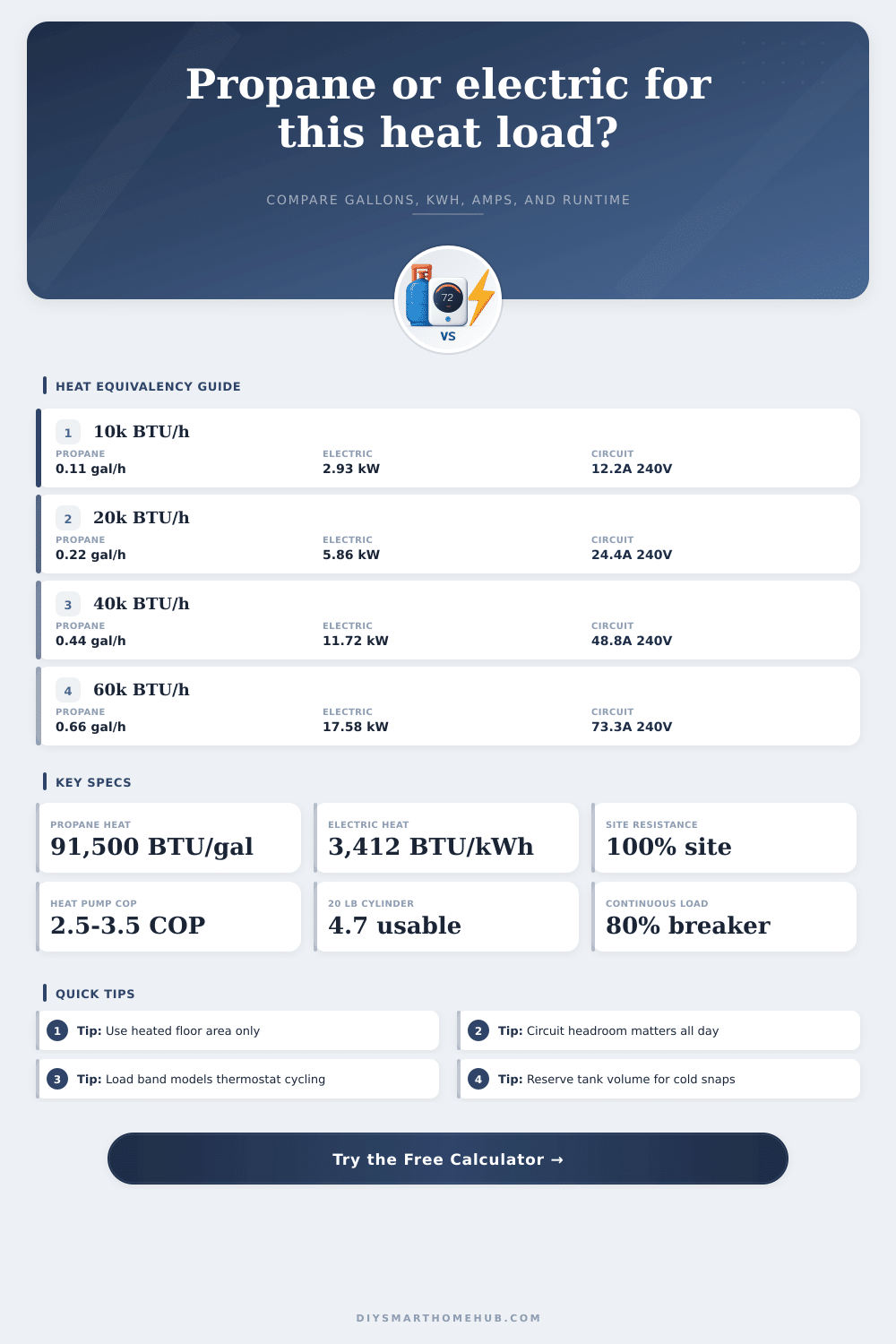
Heat equivalency table
| Delivered heat | Propane at 90% | Resistance kW | Heat pump kW |
|---|---|---|---|
| 10,000 BTU/h | 0.12 gal/h | 2.93 kW | 0.98 kW |
| 20,000 BTU/h | 0.24 gal/h | 5.86 kW | 1.95 kW |
| 40,000 BTU/h | 0.49 gal/h | 11.72 kW | 3.91 kW |
| 60,000 BTU/h | 0.73 gal/h | 17.58 kW | 5.86 kW |
Circuit planning table
| Circuit | 80% limit | Resistance | COP 3 output |
|---|---|---|---|
| 120V 15A | 1.44 kW | 4,913 BTU/h | 14,739 BTU/h |
| 240V 20A | 3.84 kW | 13,102 BTU/h | 39,307 BTU/h |
| 240V 30A | 5.76 kW | 19,653 BTU/h | 58,960 BTU/h |
| 240V 40A | 7.68 kW | 26,204 BTU/h | 78,613 BTU/h |
| 240V 60A | 11.52 kW | 39,306 BTU/h | 117,920 BTU/h |
System comparison matrix
| Pair | Propane path | Electric path | Best fit | Planning note |
|---|
Common project benchmarks
| Scenario | Area | Propane day | Electric day | Focus |
|---|
💡Planning Notes
Propane gallons and electric kWh only make sense when both systems are covering the same delivered BTU demand. The calculator keeps that parity by adjusting each path for efficiency and COP.
Electric heat can run for long stretches, so compare running amps to about 80% of breaker size instead of the full nameplate. The headroom line shows when resistance heat starts to crowd a circuit.
When you experience a power outage during the winter months, you must make a decision as to how you are going to heat your space. You may choose to use propane as a fuel source for your heating system, or you may choose to use electricity as a fuel source for your heating system. Each of these energy sources are different from the other, and each of them provide heat to your living space in a different way.
It is important to compare these two types of fuels, however, because each fuel has different energy densities, and each has different requirements for the electrical circuits in your home. Propane contains a high amount of energy relative to other fuels. One gallon of propane will provide 91,500 BTUs of energy.
Propane or Electric Heating in Winter
Electricity has a different unit of measurement for the amount of energy that it contains, it is measured in kilowatt-hours. One kilowatt-hour will provide 3,412 BTUs of energy. However, not all heating appliance are equally efficient in how they use that energy.
Propane heating systems, for instance, may have an efficiency rate of 95% in relation to the fuel that the system uses; however, the system may still use electric blowers to move the heated air from the propane furnace. Electric resistance heaters are the most efficient form of heating systems in relation to energy; they will convert all of the electricity that the system uses into heat. However, because they are so efficient, they require a high amount of currents in order to function.
Using a heat pump allows the electric system to move heat from outside of the structure to inside the structure of the building, using the coefficient of performance. Heat pumps are more efficient than electric resistance heaters; however, they become less efficiently as the outdoor temperatures drop. In order to determine how much propane or electricity you will need to heat your space, you must calculate the heat load of the space that you wish to heat.
Heat load is the amount of energy that will be required to keep your space at a specific temperature. For instance, a garage that is 400 square feet may have a heat load of 20,000 BTUs per hour. If you use propane to heat that garage, the garage may require one-fifth of a gallon of propane per hour.
However, if you use electric heating to heat that same garage, the electric heater may require six kilowatts of electricity every hour. Six kilowatts of electricity is 25 amps of current on a 240 volt circuit. Thus, the electrical circuit in your home must be capable of providing 25 amps of current to the electric heater; otherwise, the circuit breaker will trip and the electricity will no longer be able to flow to the electric heater.
The amount of propane that you have available will determine for how many days you and your family can remain warm within your home. A 100-pound propane tank will contain 24 gallons of propane. If your propane heater use one-fifth of a gallon of propane per hour, then your tank will last for several days.
However, electricity is different in that your availability of electricity also depends upon the electrical circuits in your home and the power grid. Should the power grid fail, no amount of electricity available within your home will allow electricity to be provided to your electric heaters. Thus, propane is a fuel source that can be helpful in that it can be stored in a tank within your home that will provide heat when the electricity within your home fails.
The size of the area that you intend to heat will also have an impact on the amount of propane or electricity that will be required to heat that space. You can calculate the square footage of the area that you wish to heat, as well as determine the height of the ceilings within that space. The higher the ceilings within a structure, the more volume of the space must be heated.
Thus, the more volume that you must heat, the more energy that will be required to provide heat to that area. Therefore, you should only calculate the amount of energy that will be required to heat the area that you wish to heat with your propane or electric heaters. If you heat only a small area within your home, for instance, you will use less propane and less electricity.
Many people make mistake when they try to calculate the energy that will be required for their heating systems. For instance, some may not account for the fact that heat pumps will not be able to effectively heat structures in very cold climates; the electricity will be required to move heat from outside of the structure to the inside of the structure, and outside temperatures may be too cold for adequate movement of that heat. Furthermore, some individuals may not account for the fact that electric resistance heaters will use a great deal of electricity.
Additionally, if too many electric heaters are placed onto one electrical circuit within the home, the circuit may become overloaded with the amount of electricity that those electric heaters are drawing, causing the power in the home to be turned off. Finally, though propane burns very efficiently and provides a great deal of heat, you must refill it for the heaters to continue to effectively provide heat to the structures in which they are placed. Within your home, you can choose to use propane as your heating fuel, use electricity as your heating fuel, or use both forms of energy.
Many homes have a dual-fuel heating system, for instance, in which the majority of the heating systems within the home utilize electricity (as a heat pump) during the majority of the winter months; however, within the periods of the year when the temperatures are too low for the heat pumps to effectively provide heat to the structures in which they are placed, a dual-fuel system will automatically switch to heat produced by propane. While this type of system is more complex than either propane or electric heating systems alone, it is more reliable in extreme winters. Finally, in each situation, though, you should always consider the size of the areas that the systems will heat, as well as the electrical capacity of your home.