Propane Heater BTU Calculator
Estimate the BTU per hour your room actually needs, compare that load with a candidate propane heater, and project fuel draw from common cylinders or ASME tanks before you commit to a heater size.
📌Preset Scenarios
📋Calculator Inputs
Your Propane Heater Sizing Snapshot
The result compares design room load with the candidate heater and translates that BTU demand into real propane draw.
📊Quick Reference Specs
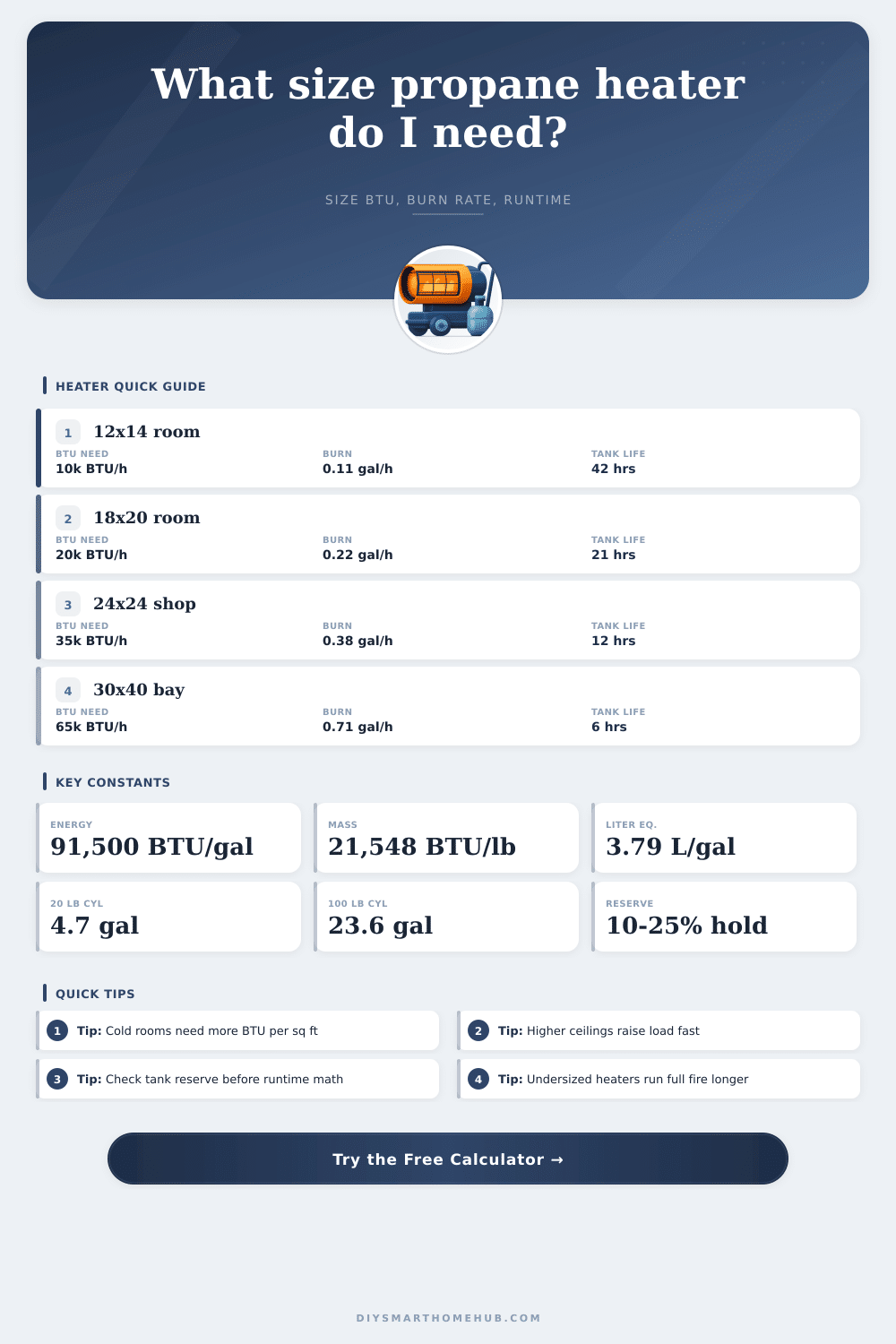
One gallon of propane contains roughly 91,500 BTU of input energy for fuel-use calculations.
Handy for translating small cylinders or bottle weight into burn time estimates.
Every gallon result also maps to liters so metric users can compare storage quickly.
The room-load model scales linearly above the common 8-foot ceiling reference.
🏠Base Heating Factor Table
These starting BTU per square foot values assume an 8-foot room and standard exposure before the calculator applies insulation, ceiling height, and warm-up multipliers.
| Climate | Tight | Good | Average | Drafty |
|---|---|---|---|---|
| Mild winter | 18 | 20 | 22 | 25 |
| Cool winter | 24 | 27 | 30 | 34 |
| Cold winter | 31 | 34 | 38 | 43 |
| Very cold winter | 39 | 43 | 48 | 54 |
🛠Heater Type Comparison
Efficiency affects how much nameplate input you need to deliver the same room heat. Higher-efficiency heaters need less propane input for the same load.
| Heater type | Eff. | Common sizes | Best match |
|---|---|---|---|
| Vent-free wall heater | 99% | 10k to 30k | Tight rooms and short-term zone heat |
| Direct-vent room heater | 82% | 8k to 40k | Bedrooms, living rooms, additions |
| Wall furnace | 80% | 20k to 50k | Cabins, halls, utility spaces |
| Garage unit heater | 78% | 30k to 75k | Garages, workshops, shop bays |
| Radiant cabinet heater | 93% | 10k to 18k | Spot heat and quick warm-up |
⛽Full-Fire Tank Runtime Reference
These examples assume the heater runs at full input continuously and the tank is used down to zero. Your live result uses the selected reserve and the calculated average duty cycle instead.
| Fuel container | Propane | 10k heater | 20k heater | 30k heater |
|---|---|---|---|---|
| 1 lb bottle | 0.236 gal | 2.2 hrs | 1.1 hrs | 0.7 hrs |
| 20 lb cylinder | 4.7 gal | 43 hrs | 21 hrs | 14 hrs |
| 30 lb cylinder | 7.1 gal | 65 hrs | 32 hrs | 21 hrs |
| 100 lb cylinder | 23.6 gal | 216 hrs | 108 hrs | 72 hrs |
| 250 gallon tank | 200 gal | 1,830 hrs | 915 hrs | 610 hrs |
💡Practical Notes
If the room load is 18,000 BTU per hour, a 12,000 BTU heater can burn full time and still miss the setpoint. Matching input size to the room load prevents long run times and unstable comfort.
A 20-pound cylinder can last many days on a lightly loaded zone heater, but the same cylinder disappears quickly in a drafty garage or high-ceiling shop because the heater stays at a higher duty cycle.
When choosing a propane heater for a garage workshop, it is essential to consider teh heat loss of the room. Choosing a propane heater with too low an output will result in the workshop not reaching the desired temperature. Choosing a heater with too high of an output will result in the propane heater consume fuel at a rapid rate.
Propane heaters produce heat by burning propane fuel. The amount of heat that propane heaters produce are measured in BTUs. The number of BTUs that a propane heater will produce will depend on the size of the garage, the insulation of the garage, and how efficient the propane heater is.
How to Pick the Right Propane Heater for Your Garage Workshop
The size of the propane tank will play a significant role in the amount of heat that will be produced. The larger the size of the garage, the more propane fuels will be required to heat the space. Garages with high ceilings will require more BTUs to maintain an even temperature throughout the space.
If the garage is poorly insulated, heat will leak from the garage. The worse the insulation of the garage, the more BTUs the heater should of produce. The outside exposure of the garage to wind will affect the amount of heat that will be lost from the space.
Areas that are exposed to the outside will lose heat at a much faster rate then areas that are internal to the garage. The efficiency of the propane heater will play a significant role in the amount of heat that will be delivered to the workshop. For instance, if the propane heater has an input of 20,000 BTUs and an efficiency of 80%, the amount of heat that is delivered to the space are 16,000 BTUs.
As such, the BTUs of the propane heater should match the amount of heat that the garage loses. Propane heaters of different types will produce varying level of efficiency when burning propane fuel. The rate at which a propane heater will consume propane fuel will depend on the BTU output of the heater and the size of the propane tank.
One gallon of propane fuel contain approximately 91,500 BTUs of energy that will heat the space for a period of time. The higher the BTU output of the heater, the more quickly the propane tank will be emptied of propane fuel. For instance, a heater with a 35,000 BTU output will use propane fuel faster than a heater with a 10,000 BTU output.
However, people should avoid allowing the propane tank to reach an empty level. This will ensure that ice does not form within the propane tank lines. People make mistakes when selecting the correct propane heater for their garage workshop.
Many people will calculate the square footage of the workshop. This isnt enough information to determine the BTU requirements of the propane heater. The square footage of the workshop does not factor in the height of the ceilings inside the garage, the quality of the insulation, or if the workshop has many windows.
If the workshop has many windows, there is a greater amount of heat loss from the workshop. The heat loss will require a higher BTU rate of the propane heater. Another piece of information that one should consider is the climate in which the garage is located.
Garages located in areas with very cold climates will require a higher BTU output of propane heaters per square foot than those in milder climates. In order to ensure that the propane heater function at the highest level of efficiency within the garage workshop, there are a few steps that can be followed. First, you should insulate the doors of the garage to minimize the loss of heat from the workshop.
Second, place the propane heater in a spot where it will not be fighting against the wind in the workshop. Third, maintain the propane heater to ensure that the burners are not become clogged, which will reduce the efficiency of the heater. Finally, make sure that the BTU output of the heater matches the amount of heat loss in the workshop to ensure that the heater does not waste propane fuel to heat the workshop.