Propane Heating Calculator
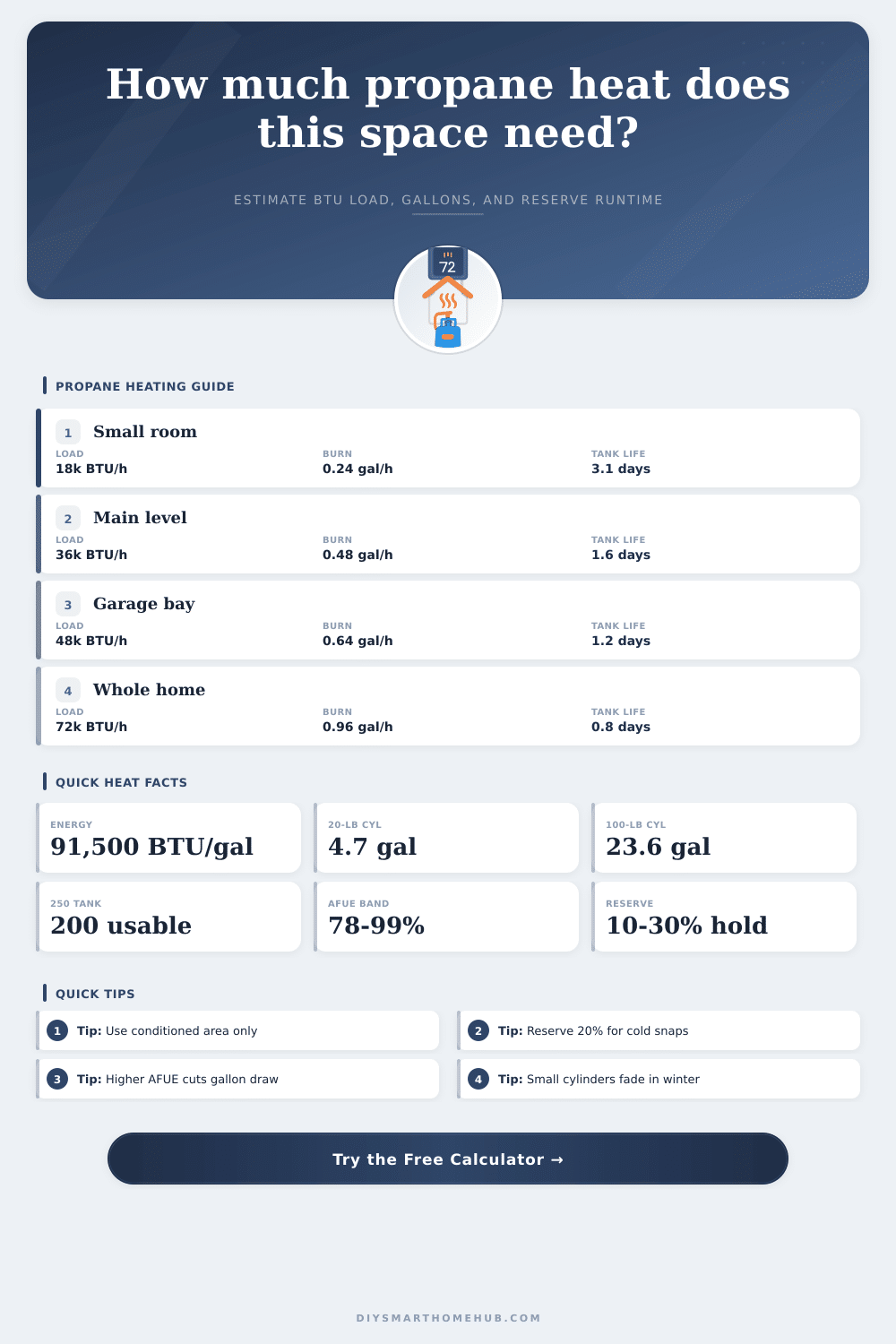
Estimate room or whole-home propane demand from area, design temperatures, shell quality, appliance efficiency, start fill, and reserve target so runtime reflects the tank you actually have available.
📍Preset Heating Scenarios
This default preset uses a modest conditioned room, an average shell, and a direct-vent stove so you can see how design temperature and reserve target shape burn rate and autonomy.
📏Heating Load Inputs
Propane Heating Summary
Your heating profile summary will appear here after calculation.
⛽Propane Heating Constants
📊Appliance Profile Grid
📋Reference Tables
Envelope Load Benchmarks
| Envelope | Base load | Use case |
|---|---|---|
| Very tight | 14 BTU/sq ft | Newer shell, balanced air sealing, lower winter infiltration. |
| Tight updated | 18 BTU/sq ft | Updated insulation and windows, but still a conventional house. |
| Average | 24 BTU/sq ft | Typical insulated shell with ordinary exterior wall exposure. |
| Older mixed | 31 BTU/sq ft | Partial upgrades, mixed windows, or irregular air sealing. |
| Drafty | 38 BTU/sq ft | High-loss zones, detached outbuildings, or loosely sealed rooms. |
Appliance Efficiency Comparison
| Appliance | AFUE | Best fit |
|---|---|---|
| Condensing furnace | 95% | Whole-home ducted heat where longer winter runtimes reward higher AFUE. |
| Standard furnace | 82% | Existing homes with legacy duct systems and simpler venting. |
| Direct-vent stove | 78% | Living rooms and additions that want targeted space heating. |
| Hydronic boiler | 87% | Radiant slabs, baseboard loops, and slower steady-state zone loads. |
| Vent-free heater | 99% | Short-duration emergency zones where local rules permit use. |
Tank Runtime Snapshot
| Container | Usable at 80/20 | Hours at 40k in |
|---|---|---|
| 20-lb cylinder | 2.8 gal | 6.4 hr |
| 100-lb cylinder | 14.2 gal | 32.5 hr |
| 120-gal tank | 34.2 gal | 78.2 hr |
| 250-gal tank | 120.0 gal | 274.5 hr |
| 500-gal tank | 240.0 gal | 549.0 hr |
Common Heating Scenarios
| Project | Area | Load | Daily draw |
|---|---|---|---|
| Bedroom zone | 168 sq ft | 7-12k BTU/h | 0.8-1.6 gal |
| Living room | 320 sq ft | 16-24k BTU/h | 1.8-3.1 gal |
| Garage bay | 480 sq ft | 24-40k BTU/h | 2.6-5.2 gal |
| Small house | 1200 sq ft | 36-58k BTU/h | 4.7-8.5 gal |
| Whole home | 2000 sq ft | 60-90k BTU/h | 7.9-13.1 gal |
💡Planning Notes
Cold-weather planning gets more realistic when you subtract the gallons you refuse to burn below. That keeps refill timing, emergency margin, and expected autonomy aligned with how most propane users actually manage tanks.
A tank that feels small on a drafty garage can look generous on a tight interior room. When you update area, ceiling height, or design temperature, burn rate changes faster than the container size itself.
To effectively manage propane usage, one must understand the relationship between the space that is to be heated and the propane fuel that such a space consumes. The propane that a given space consumes is dependent upon numerous factor, including the size of the space to be heated, the insulation of that space, and the difference in temperature between the indoors and outdoors. The size and condition of the space to be heated will impact the amount of propane that is require to heat that space.
Smaller space with high levels of insulation will require less propane to heat compared to larger spaces with low levels of insulation. Factors that contribute to the size of the space that must be heated include the size of the room and any high ceilings within that room. Propane appliances that is utilized to heat spaces will lose heat to the building envelope of the structure in which those appliances are located, especially if the structure isnt well-insulate.
How to Calculate Propane Use for Heating
The loss of heat from the building envelope causes those propane appliances to burn more propane in an effort to compensate for the loss of heat from the structure. The temperature difference within the space to be heated in comparison to the temperature outside of those structures is another critical factor in determining the consumption of propane by those appliances. The design temperature of the structure is the lowest temperature that will be experienced within the area in which the structure is located during the winter months.
The difference between the desired indoor temperature and the outdoor design temperature is referred to as the temperature difference, which impacts the load intensity that is placed upon the propane appliances. The higher the difference between the indoor and outdoor temperatures, the more higher the load intensity upon the appliances. Furthermore, different propane appliances will have different rates of efficiency in converting propane to heat; appliances with high levels of efficiency will release more heat from propane fuel relative to appliances with low levels of efficiency in performing such a task.
The size of the propane tank in which the propane fuel is stored will have an impact upon the length of time that the appliances can be used to heat the space. Because it is impossible to burn all of the propane that is contained within the tank, a propane reserve must be maintained within that tank. The amount of propane that is manufactured within the tank decrease as the propane appliances burn the propane for heating the space.
Furthermore, the size of the propane tank impacts the ability of that tank to function effective in cold weather climates. Small propane tanks have low levels of vapor pressure in their tanks relative to larger propane tanks. Low levels of vapor pressure in the tank indicate that the amount of propane that can be released from the tank to the appliance is less than in propane tanks with higher vapor pressure.
Thus, large propane tanks will have higher reliability in cold climates when using propane heating appliances. Calculations can be made of the number of days of propane that is available for those appliances based off the size of the propane tanks. The heat load in BTUs per hour that the appliances must release can be calculated, as can the burn rate in gallons per hour of propane.
With the heat load and burn rate of the appliances known, it is possible to calculate how many days the propane will last before the propane reserve is reached. Additionally, it is important to consider the runtime of those propane appliances; those appliances that are continuously running will consume more propane than those that are running for shorter period of time, such as for twelve hours as opposed to twenty-four hours per day. By considering all of the factors related to the system of heating with propane appliances, each of these factors can be addressed to reduce the consumption of propane fuel.
For instance, each structure can be better insulated to reduce the loss of heat to the environment, or the appliances can be managed with thermostats to reduce their runtime. Additionally, the location of propane tanks can be considered, as well; different locations may allow for different amount of propane to be delivered to the tanks. By planning for propane usage by calculating the square footage of the spaces to be heated, the size of the temperature difference between indoors and outdoors, and by calculating the amount of propane that should of been maintained in the tanks as a reserve, it is possible to avoid depletion of the propane tanks during the winter season.