Natural Gas vs Propane Calculator
Compare the same delivered heating load through natural gas and propane equipment, then see equivalent therms, cubic feet, gallons, tank runtime, and gas meter loading before you size a service or choose a fuel path.
📍Preset Heating Scenarios
It estimates delivered heating demand first, then converts that same load into natural gas and propane input using real fuel constants, efficiency assumptions, runtime, meter size, and tank reserve.
📏Load and Fuel Inputs
Comparison Results
Both fuels are sized to cover the same delivered heat demand for the selected zone and runtime.
Average natural gas flow will appear here after calculation.
Tank reserve span will appear here after calculation.
📊Fuel Constants and Planning Anchors
Fuel Equivalency Snapshots
| Delivered Heat | NG at 95% | LP at 95% | Use Case |
|---|---|---|---|
| 250,000 BTU/day | 2.63 therm/day | 2.88 gal/day | Tight room or shoulder zone |
| 500,000 BTU/day | 5.26 therm/day | 5.75 gal/day | Main living level |
| 900,000 BTU/day | 9.47 therm/day | 10.36 gal/day | Garage, shop, or cold snap |
| 1,500,000 BTU/day | 15.79 therm/day | 17.26 gal/day | Whole-home design-day load |
Appliance Pair Assumptions
| Pair | NG Eff | LP Eff | Best Fit |
|---|---|---|---|
| Condensing furnace | 96% | 95% | Whole-house ducted heat |
| Standard furnace | 82% | 83% | Legacy central systems |
| Garage unit heater | 80% | 82% | Shops and bays |
| Hydronic boiler | 87% | 88% | Radiators and slabs |
| Vented wall heater | 78% | 79% | Cabins and zone heat |
| Radiant tube | 84% | 85% | Tall detached spaces |
Common Project Sizes and Rough Fuel Demand
| Project | Area | Design Load | Therms/Day | Gallons/Day |
|---|---|---|---|---|
| Single bonus room | 168 sq ft | 3,700-4,200 BTU/h | 0.45-0.55 | 0.50-0.60 |
| Detached garage bay | 400 sq ft | 13,000-17,000 BTU/h | 2.2-3.0 | 2.4-3.3 |
| Main living floor | 1,500 sq ft | 34,000-45,000 BTU/h | 7.0-11.5 | 7.7-12.6 |
| Whole-house winter load | 2,000 sq ft | 50,000-65,000 BTU/h | 12.5-18.0 | 13.7-19.7 |
💡Practical Comparison Tips
If two appliances do not share the same efficiency, raw BTU input will hide the true difference. This calculator converts the same delivered load into the fuel each appliance actually needs.
Natural gas needs enough meter headroom at the same time propane needs enough gallons on site. Looking at both service paths together avoids choosing a fuel that works only on paper.
When you are choosing between installing a natural gas or propane unit heater in your home, you must decide between these two fuel. Both of these fuels provides the heat that you need in your home. However, the units in which natural gas and propane are measured are different.
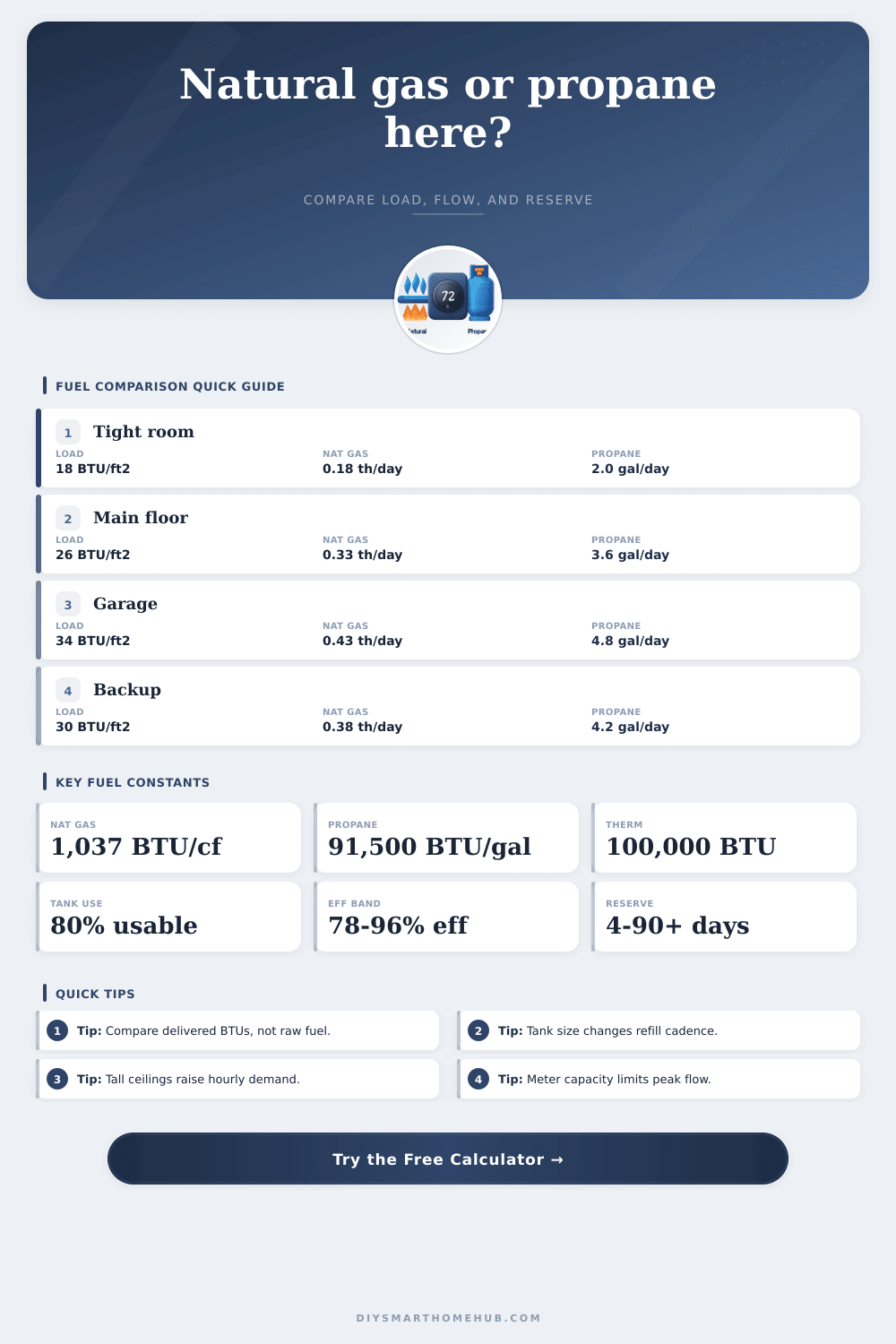
Natural gas is measured in cubic feet, and propane is measured in gallon. Therefore, you must use the mathematics of each fuel to compare propane to natural gas to decide which fuel to install in your home. A cubic foot of natural gas contains 1,000 BTUs of energy, and one gallon of propane contains 91,000 BTUs of energy.
How to Choose Between Natural Gas and Propane Heaters
Since propane contains more energy per unit measure than natural gas, you must calculate the energy need of the space where you will install the unit heater. The energy needs of a space is based off the size and the insulation of that space. The size of a space includes the square footage of the space, the height of the ceilings within the space, and the insulation of the structure itself.
For instance, spaces with high ceilings require more energy to heat than spaces with low ceilings due to an additional volume of air that must be heated. Additionally, the insulation of a space affects the energy needs for heating that space. Spaces that are poorly insulated, like a drafty garage, will require more energy to heat than a well-insulation space.
The efficiency of the heater that you will install in your home will also have an impact upon the amount of fuel that you will use to heat your home. Condensing furnace are typically more efficient than older standard furnaces. Condensing furnaces can extract 95% of the energy from the fuel that is burned in the furnace, while older standard furnances only extract about 80% of the energy from the fuel that is burned.
Thus, if your furnace is less efficient than condensing furnace models, the furnace will use more natural gas or propane fuel to reach the same heating temperature as a highly efficient condensing furnace. Another factor to consider when installing a unit heater is the runtime of that unit heater. Runtime is the amount of time that the unit heater’s burner is active.
For instance, the living room in your house may have a low runtime during the summer month, but the living room will have a high runtime during the winter months. Additionally, you should consider including a reserve margin for extreme weather in your calculations of the fuel requirement of your unit heater. Finally, the exposure of the space to the wind will also affect the fuel consumption of your unit heater.
The more exposed a space is to the wind, the more fuel will be required to maintain the desired heating temperature in that area. Finally, it is important to consider the service limits for both natural gas and propane. Natural gas is delivered to your home through a utility line that has a limit to the amount of gas that can pass through the meter that measures the gas that comes into your home.
If you use too much gas, you may require a service upgrade to your utility company to increase the size of the meter for your home. Propane tanks have a limit to the amount of propane that they can hold. Additionally, people typically fill propane tanks to only 80% of their total capacity to allow for the propane to be able to expand while in the tank.
Therefore, a 250 gallon propane tank will only hold 200 gallon of propane. Many people make mistake when they are choosing between propane and natural gas heaters. One common mistake is to only consider the raw input rating of the heaters.
The raw input ratings do not account for the efficiency of the heater. Thus, if a heater is less efficient than others in the industry, it will waste fuel. Another mistake is to forget to account for the height of the ceilings in your home.
If you do not account for the height of the ceilings, you may purchase a heater that is too small for your livig space. Finally, you should also consider your lifestyle and the rates of natural gas and propane in your area when purchasing your unit heater. Natural gas is typically cheaper than propane, but natural gas may not be available during certain weather outages.
Propane provides more independence to your home because it is stored on your property, but the prices of propane can change more frequently then the prices of natural gas. You should of checked the rates before you buy.