Propane Dew Point Calculator
Translate propane pressure into dew point temperature, compare it with site temperature, and see whether a tank, vapor line, or liquid service point is sitting safely above the saturation boundary.
📌Preset Pressure Scenarios
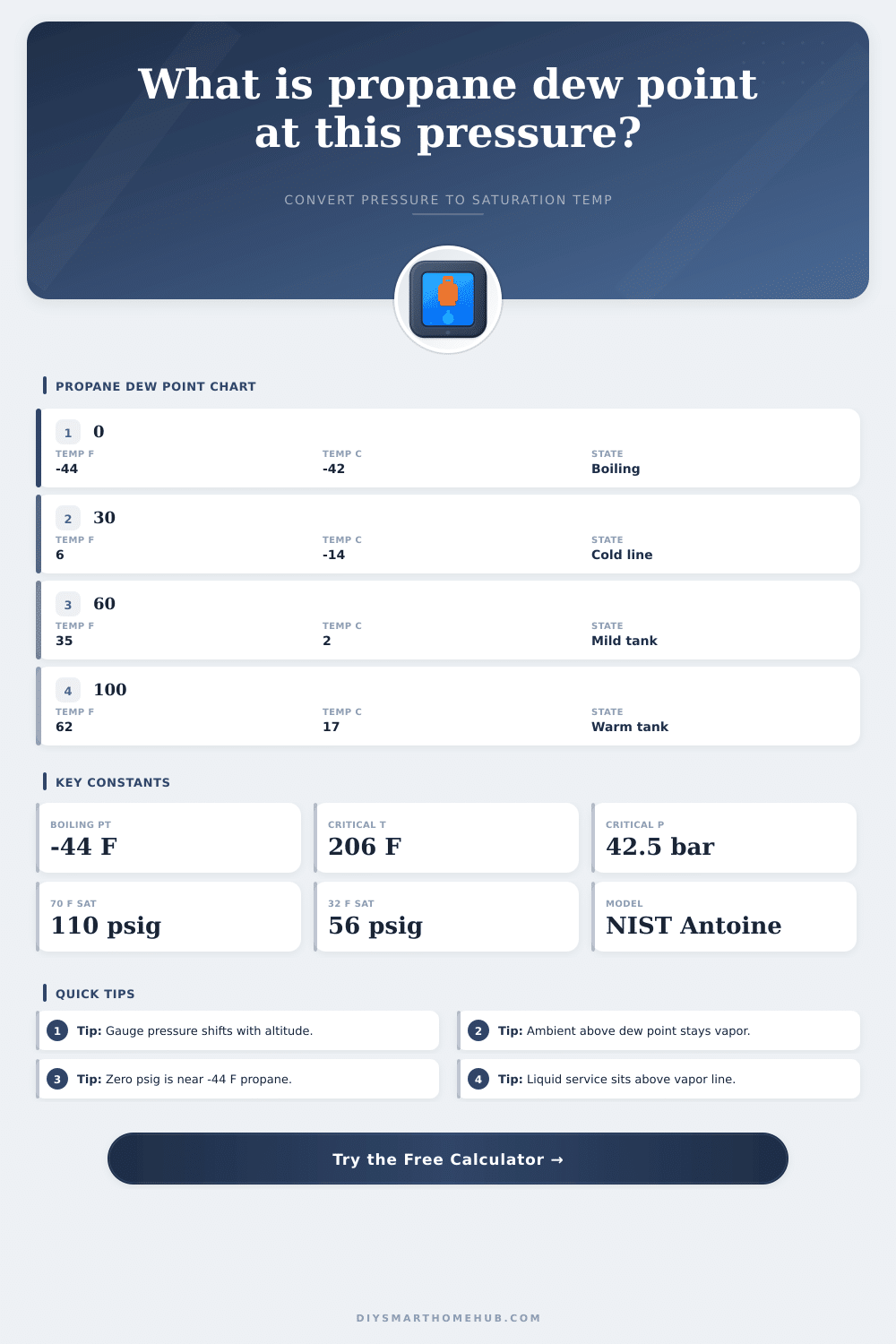
A cylinder sitting at about 0 psig at sea level is already close to propane's atmospheric boiling point, which makes it a helpful baseline for dew point intuition.
📋Pressure and Temperature Inputs
Propane Dew Point Result
The entered pressure has been converted to absolute pressure and matched to propane's saturation curve.
🔬Propane Saturation Markers
Propane boils at about -44 F at atmospheric pressure, so a zero-gauge cylinder is already near the phase boundary.
Above roughly 206 F, propane moves beyond the classic liquid-vapor dome and the usual dew point interpretation stops being useful.
This is about 616 psia, or roughly 601 psig at sea level, far above most residential and light commercial propane service conditions.
The calculator swaps between low-, mid-, and warm-temperature Antoine segments so the pressure-temperature relation stays stable across practical propane ranges.
📊Pressure To Dew Point Table
These reference points are generated from the same propane saturation model used by the calculator. Pressure is shown in both gauge and absolute forms at sea level.
| Pressure psig | Pressure psia | Dew point F | Dew point C | Comment |
|---|
🌡Ambient Temperature Vapor Line
This table works in the opposite direction: it shows the saturation pressure that matches a given propane temperature. If your actual pressure is higher than the value shown, liquid can exist at that temperature.
| Temp F | Temp C | Sat psig | Sat psia | Sat bar(a) |
|---|
📝Preset Comparison Table
Preset rows compare actual ambient temperature with dew point so you can see which examples are vapor-only, near saturation, or likely to condense.
| Scenario | Pressure | Dew point | Margin | Status |
|---|
The preset table uses each scenario's native units and altitude before converting to propane absolute pressure.
💡Propane Dew Point Notes
Published thermodynamic data is absolute. A field gauge reads relative pressure, so altitude changes the absolute pressure behind the same gauge number.
Liquid withdrawal systems often run above the vapor-only line on purpose. In those cases the dew point result explains why flashing can occur after pressure reduction.
The dew point of propane is the temperature at which propane will transform from a vapor into a liquid. Propane exist in a state of equilibrium between its vapor and liquid forms. At the dew point of propane, propane will exist in equilibrium between its vapor and liquid form.
If the temperature of propane are dropped below its dew point, the propane will condense into a liquid form. If the temperature of propane remain above its dew point, propane will remain in its gaseous state. To avoid the issue created by liquid propane, you should maintain the temperature of propane above its dew point.
Propane Dew Point and How It Affects Safety
The issues created by liquid propane include the potential of propane liquids to plug valve, freeze regulators, and create erratic flow of propane through propane lines. The dew point of propane is related to the pressure of propane. The more higher the pressure of propane, the higher the dew point of propane.
For instance, if propane has a gauge pressure of zero pounds per square inch at sea level, the dew point of propane is -44 degrees F. If the pressure of propane are increased to 100 pounds per square inch gauge pressure, the dew point of propane increases to approximately 60 degrees F. Because the dew point of propane change based off the pressure of propane, it is critical to understand the pressure of the propane system to understand it’s dew point. Since most propane service point are in equilibrium with the liquid propane, the metal walls of the propane lines must remain warmer than the dew point of propane to ensure propane remains in gaseous form. The pressure gauge reading for propane systems are relative to the atmospheric pressure of the area in which the system is installed.
The atmospheric pressure of the earths surface change with the elevation of those points from the earth’s surface. If the atmospheric pressure is lowered (high altitude), the absolute pressure of the propane within the system is lowered. A lower absolute pressure of propane result in a lower dew point of propane.
For this reason, it is critical to account for the elevation of propane systems when calculating the dew point of propane systems. For instance, a gauge reading that is within safe limit for propane at sea level may indicate that the same propane system at a high altitude may be within unsafe limits regarding dew point. Ambient temperature is another factor that impact propane systems.
The ambient temperature is the temperature of the air surrounding the propane tanks or lines. If the ambient temperature drop below the dew point of the propane within the lines or tanks, the propane may condense into a liquid form. By comparing the ambient temperature of the propane tanks or lines to the dew point of the propane in those tanks or lines, it is possible to determine the safety margin for the propane system.
A safety margin is the difference between the actual temperature of the propane system and the dew point of that propane. Safety margins help to ensure that propane tanks or lines dont drop to temperatures that lead to condensation. For instance, a safety margin of five degrees may be required for propane tanks and lines to remain within a safe range.
A negative safety margin indicate that the propane system is within limits that can lead to condensation. A safety margin that is near zero indicate that the propane system is near its dew point. Propane systems may be used in different ways.
For instance, propane systems may be designed to provide both liquid service and vapor service. Liquid service of propane require that the propane remains in a liquid form and, therefore, requires higher pressures within the system to ensure that the propane does not condense into a liquid form. Vapor service of propane require that the propane remains in the gaseous state and, therefore, requires that the temperature of propane systems remain above the dew point of propane to prevent propane from condensing into a liquid form.
For lines that are to provide liquid service, the pressure must be high enough to maintain the propane in its liquid form. For lines that are to provide vapor service, the temperature of the system must be high enough to prevent the propane from condensing into its liquid form. Safety is one of the primary considerations regarding the management of propane systems.
Condensation of propane within vapor systems present a safety risk to those systems. For instance, the condensation of propane within a system may lead to the freezing of the system’s regulators. Furthermore, the condensation of propane within a system may lead to the icing over of the system valves.
These types of conditions may impact the flow of propane from the system. Therefore, it is important to continuously monitor the temperature and the pressure of the system to ensure the propane is in the appropriate state for that system. Understanding the relationship between the pressure of propane, the temperature of propane, and the dew point of propane will allow individuals to manage propane systems more effective.