Propane Flow Rate Calculator
Convert appliance demand into propane vapor flow, liquid withdrawal, pipe velocity, and storage runtime. It is built for heater, water heater, fireplace, generator, and whole-home propane checks.
💡What This Solves
Enter the appliance input, how much of that load can run at once, and how hard it operates during active hours. The calculator converts the load into propane cubic feet per hour, gallons per hour, liters per hour, and daily use.
- Peak propane vapor flow in cfh and m3/h
- Peak and average liquid withdrawal rates
- Pipe velocity check with recommended nominal size
- Cold-weather tank vaporization margin and runtime
📌Preset Scenarios
📋Calculator Inputs
A direct-vent fireplace or small heater branch is a good reminder that pipe sizing and runtime can still matter when the connected load looks modest.
📈 Propane Flow Results
⚙Quick Specs
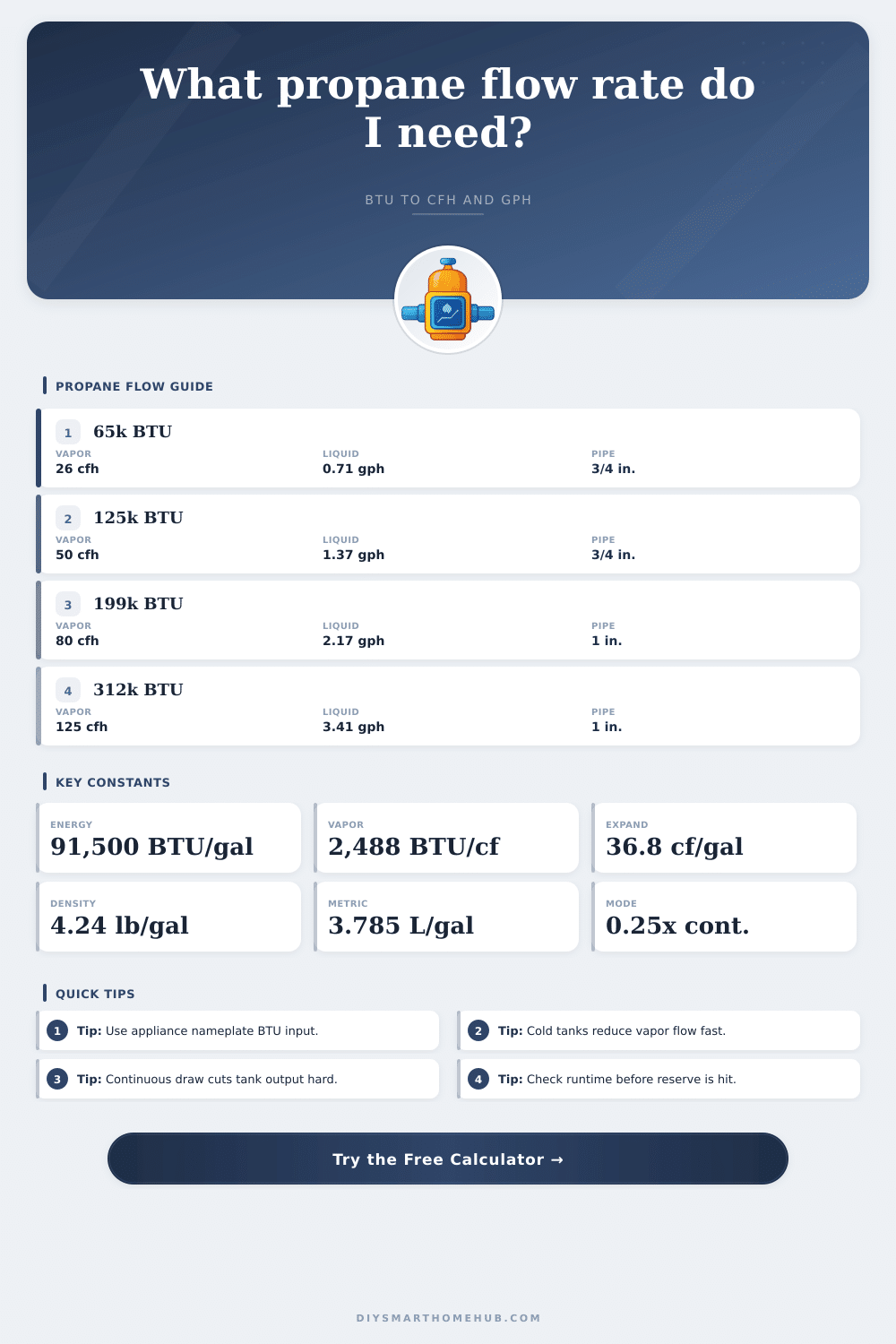
PERC notes propane capacity in standard cubic feet per hour can be converted to BTU per hour by multiplying by 2,488.
This converts appliance load into liquid propane withdrawal so you can compare burn rate and expected storage window.
One gallon of liquid propane becomes roughly 36.8 cubic feet of vapor under the energy basis used in this calculator.
Liquid density helps translate gallons per hour into a mass flow if you want another sanity check on withdrawal.
Metric input mode accepts kW and converts it back to BTU per hour with the standard 1 kW to 3,412 BTU per hour factor.
PERC states continuous loading should be reduced to one quarter of the intermittent withdrawal table values.
Residential propane tanks are typically filled to about 80 percent liquid level, so usable fuel is lower than the water capacity.
The vaporization table is a rule-of-thumb for aboveground tanks at about half full with 70 percent relative humidity.
📊Reference Tables
The first table is flow by common propane appliance load. The second is the PERC intermittent vaporization rule-of-thumb for aboveground ASME tanks. The third converts pipe inside diameter into a rough flow ceiling at 3,000 feet per minute gas velocity.
| Appliance | BTU/h | Vapor cfh | Liquid gph | Suggested pipe |
|---|
| Temperature | 150 gal | 250 gal | 500 gal | 1000 gal |
|---|
| Pipe size | Inside dia. | Max cfh | BTU/h @ 3000 fpm | Typical use |
|---|
| Preset | Peak flow | Peak draw | Tank check | Pipe result |
|---|
Tank vaporization values below come from the Propane Education & Research Council technical pocket guide for aboveground tanks under intermittent loading. If your installation is continuous, frosted, buried, or far from half full, treat the result as a screening estimate and confirm with the propane supplier and applicable code tables.
📝Calculation Notes
Peak cfh and pipe velocity are based on simultaneous firing. Runtime to reserve uses the lower average firing rate across your active hours so the storage window does not get overstated.
A branch that looks fine at 40 F can run short on vaporization at 0 F, especially with generator loads or any application that behaves more like continuous draw.
This tool uses velocity as a quick filter, not as a replacement for full pressure-drop sizing. If the selected pipe is already fast, pressure loss usually deserves a closer look.
Starting level and refill reserve change runtime more than most people expect. A 500 gallon tank at 40 percent is a very different planning case from a freshly filled tank.
The flow rate of propane is one of the most critical measurement for any propane system. The flow rate of propane will determine whether or not the propane system can deliver enough energy to an appliance that is attached to the system. Appliances will have a BTU rating on the appliance nameplate.
The BTU ratings assumes that the propane will be in a gaseous state. If the propane cannot transition from a liquid to a gaseous state quick enough, the flow rate of propane will drop. As a result, the appliance will not recieve enough energy to operate correctly.
How Propane Flow, Tank Heat, and Pipe Size Affect Appliances
In order for propane to be used as a fuel source, it must be vaporized. For propane to vaporize, it require heat from the environment around it. In cold weather, the temperature of the air and the soil in which propane tanks is located will be lower.
This means that the propane tanks will not be able to provide enough heat for propane to vaporize quick. If the temperature is too low, the propane will not be able to turn into a gas quick enough for the system’s propane flow rate to meet the demands of the propane appliance. The lower flow rate of propane place additional strain on appliances that are always in use, such as generators, as compared than appliances that are not constantly running, such as furnaces.
Furnaces are appliances that cycle on and off according to the temperature requirement of a structure. Generators, in contrast, will be in continuous use so they will cool the propane tank more quick, which reduces the tanks capacity to vaporize propane. Pipe sizing is one of the necessary component of a propane system.
The size of the pipes determine the velocity and the pressure of the propane gas that move through the system. If the velocity of the propane gas is too fast, it will create friction within the system’s pipes. This will reduce the propane system’s pressure, preventing it from efficient supplying propane to the appliances.
Therefore, the pipe diameters must be large enough to allow for sufficient propane pressure to meet the BTU requirements of the appliances. For example, the pipes for a fireplace may be smaller in diameter than the pipes need to supply propane to a pool heater. One of the concepts that a person uses to calculate the actual demand on a propane system is the concept of diversity.
Diversity allows a person to account for the fact that appliances will not be running at the same time. It is true that many people may assume that each appliance in the house will need to run at its peak BTU demand at the same time. However, this is rarely the case.
The concept of diversity allows for the calculations to account for the fact that not all appliances will be running at the same time. However, it is still necessary to account for the possibility that several appliance will be running at the same time. It is also necessary to ensure that there is a reserve of propane within the tank.
Individuals should not allow their propane tank to become empty of propane. A propane tank require a reserve of propane to maintain its steady pressure. If the level of propane in the tank is too low, the tank will not have enough volume of propane to allow for proper vaporization.
To account for this, there should be a percentage trigger for when a propane tank should be refilled. In order to create an effective propane system, it is necessary to consider the size of the pipes that will be used, the ability of the propane tank to vaporize the propane liquid, and the number and types of appliance that will be using the propane. Additionally, it is necessary to ensure that the demand of the propane appliances is matched to the capacity of the propane system’s pipes and tank.
If these component are created and built properly, with sufficient flow rates, the propane will be able to meet the BTU demand of the appliances, even in cold weather climates.