Propane Tank Weight Calculator
Estimate total cylinder weight from a fill level, or reverse a scale reading into usable propane pounds, liquid gallons, and approximate appliance runtime using common cylinder and ASME tank data.
📌Scenario Presets
⚙Calculator Inputs
Propane Weight Snapshot
Results combine rated capacity, editable tare weight, liquid density at temperature, and your reserve target so you can judge handling weight and usable fuel at a glance.
Typical nameplate propane rating for the selected tank family.
Usable propane gallons when the tank is at its normal rated full condition.
Approximate vessel water volume before the 80% liquid expansion allowance is applied.
Estimated tank plus rated propane at about 60 F before accessory weight is added.
📚Reference Tables
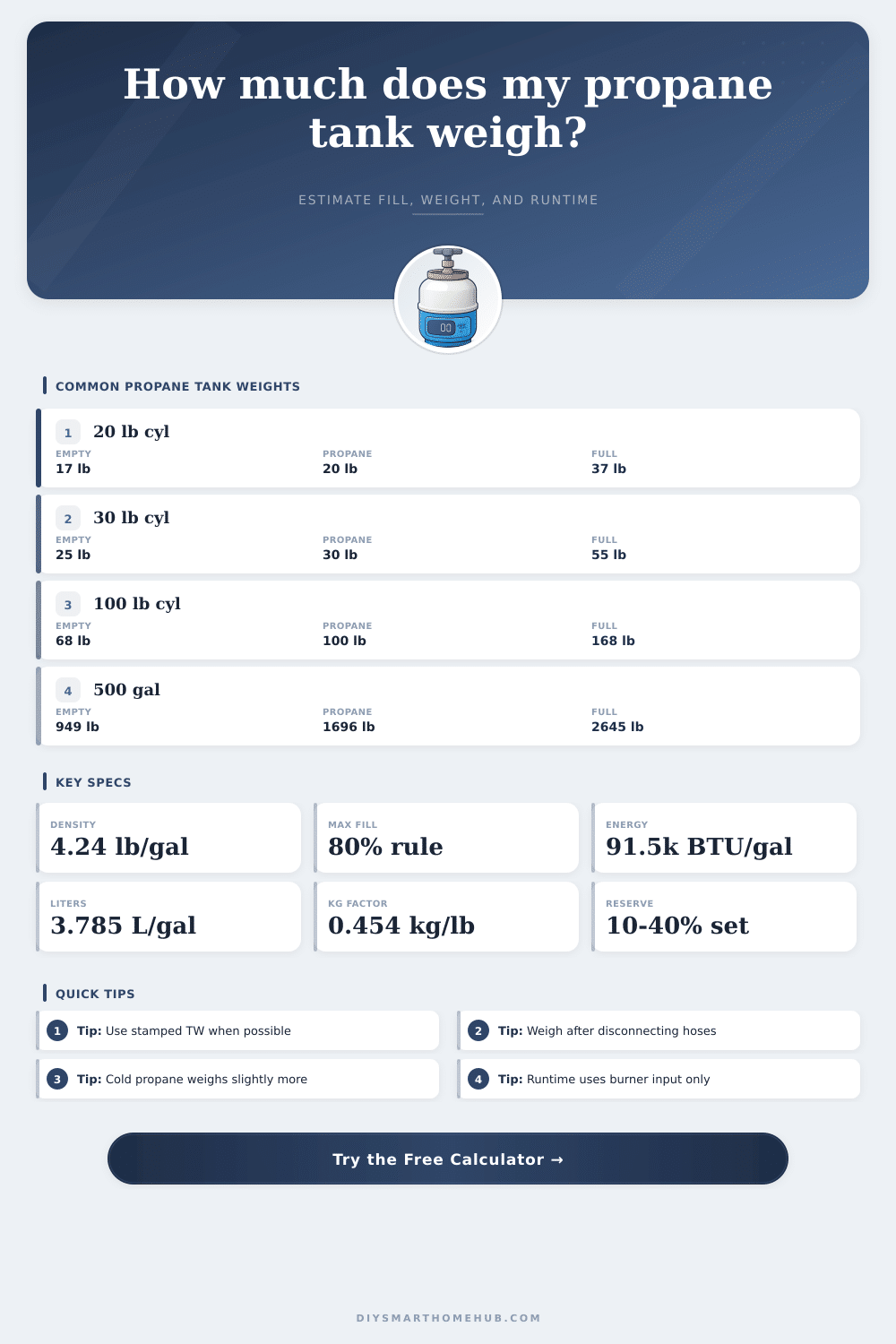
Quick weights assume common nominal capacities. Your actual cylinder collar stamp, ASME plate, and measured tare always win over a generic estimate.
| Tank Type | Rated Fill | Typical Tare | Typical Full |
|---|
| Temp | Density | 1 Gallon | 10 Gallons |
|---|---|---|---|
| -20 F | 4.37 lb/gal | 4.37 lb | 43.7 lb |
| 0 F | 4.31 lb/gal | 4.31 lb | 43.1 lb |
| 40 F | 4.26 lb/gal | 4.26 lb | 42.6 lb |
| 60 F | 4.24 lb/gal | 4.24 lb | 42.4 lb |
| 80 F | 4.20 lb/gal | 4.20 lb | 42.0 lb |
| 100 F | 4.16 lb/gal | 4.16 lb | 41.6 lb |
| Selected Tank Fill | Propane | Loaded Weight | Liquid Volume |
|---|
| Appliance Load | Input Rate | Current Runtime | Above Reserve |
|---|
Most 20 lb cylinders are near 17 lb empty, but collars vary. If the cylinder has a TW stamp or you can weigh it empty, replace the generic tare immediately.
Float gauges can lag when the tank is moving. A disconnected tank on a scale usually gives the most dependable snapshot of propane pounds remaining.
To determine the amount of propane inside a propane tank, you must understand the difference between the total weight of the tank and the weight of the propane fuel that it contain. All propane tanks has a tare weight, or the weight of the empty metal propane tank. The manufacturer can find the tare weight on the tank.
By taking the total weight of the tank and subtracting the tare weight of the tank, you can determine the weight of the propane fuel that is contain within the tank. For instance, if the total weight of the propane tank is 35 pounds, but the tare weight of the tank is 17 pounds, then the tank contains 18 pounds of propane. The weight of accessories to the propane tank, such as hose fitting or valve guards, must also be accounted for in the total weight of the tank.
How to Check How Much Propane Is in a Tank
The density of propane fuel change according to the temperature of the propane fuel within the tank. Propane fuel is denser at colder temperatures than warmer temperatures. Thus, cold propane fuel will weigh more per gallon of propane fuel than warm propane fuel.
At 60 degrees Fahrenheit, propane fuel weigh approximately 4.24 pounds per gallon. At warmer temperatures within the propane tank, however, the propane fuel will be less dense, and will weigh less than the same volume of propane fuel at 60 degrees Fahrenheit. It is recommended to use a scale to measure the weight of the propane fuel within the tank, as scales are more accurate than the gauges that are present on the propane tanks.
The gauges on the propane tanks may not accurately reflect the amount of propane fuel that is contained within the tank. When determining how much propane fuel is available for use, you should consider the rated capacity of the propane tank. Propane tanks should never be filled to 100% of there total capacity.
Some headspaces within the propane tanks is required to allow for the propane fuel to expand. The capacity of propane tanks is typically rated to 80% of the tank total capacity. Thus, a 20 pound propane tank will contain 20 pounds of propane fuel, but the propane fuel will not fill the propane tank to the top of the tank.
The length of time that the propane fuel will last can be determined if the BTU input of the appliance that use the propane fuel is known. For instance, if the grill has a BTU input of 40,000 BTU per hour, then you can divide the total BTU output of the propane tank by the BTU input of the grill to determine for how long the propane tank will provide heat to the grill. The weight of propane tanks of different size and with different accessories may differ from one another.
For instance, a propane tank that is used to fuel a grill may weigh 17 pounds when empty, while a 30 pound propane tank will weigh more when it is empty. Additionally, any accessories to the propane tank, such as a pigtail hose, will add to the total weight of the propane tank. You should account for these accessories when you measure the total weight of the tank on a scale.
Finally, a propane reserve should be maintained within the propane tank. For example, it is common for propane tanks to have a 20% or 30% reserve of propane fuel to avoid running out of propane fuel while using the propane tanks for their intendent tasks. According to the weight of the propane fuel tanks, it is possible to plan propane fuel use for various tasks and seasons.
For instance, the propane fuel that is contained within the tanks during the winter months will be denser than the propane fuel during the summer months. Additionally, if multiple propane tanks are to be transported, you can multiply the weight of each of the tanks to determine the total weight of the propane tanks. The total weight of the propane tanks will determine the effort required to transport those tanks.
By using these factors and variables, such as the tare weight of the propane tanks, the total weight of the tanks, and the BTU input of the appliances that use the propane tanks, you can accuratelyly plan for the use of the propane tanks’ fuel.