Propane Tank Size Calculator
Estimate usable gallons, refill window, and vaporization margin so a furnace, water heater, standby generator, or whole-home propane package lands in a tank class that fits both storage and peak draw.
📌Preset Scenarios
📋Calculator Inputs
Calculated Tank Snapshot
Storage need and peak vaporization are checked separately so the recommendation does not overlook cold-weather draw limits.
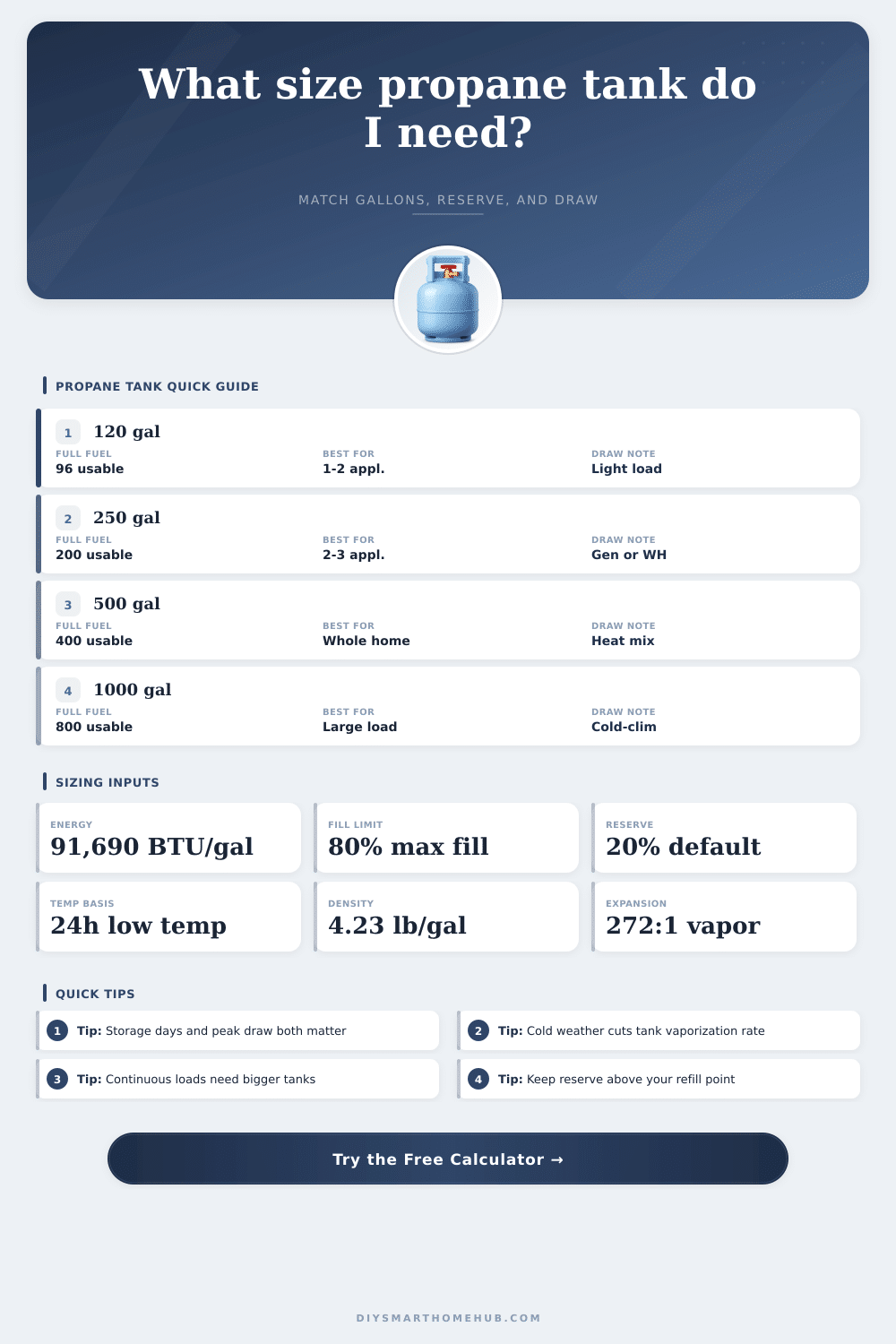
Energy content used to convert appliance load and runtime into daily and delivery-window propane consumption.
Liquid density helps translate delivery volume into stored fuel weight when you sanity-check tank inventory.
Residential propane tanks are not filled to 100% liquid level, so nominal tank gallons always overstate available fuel.
Propane expands sharply as it vaporizes, which is why tank surface area and ambient temperature matter during high draw.
PERC notes that continuous loading should be multiplied by 0.25 versus intermittent tank vaporization values.
The vaporization table is anchored to the lowest average outdoor temperature over 24 hours, not a brief hourly dip.
Many residential users avoid planning below a 20% gauge reading because delivery timing and colder weather can tighten supply fast.
The PERC vaporization table used here assumes the aboveground ASME tank is about half full and under intermittent load.
📊Tank Class Storage Window
This table shows nominal water capacity, propane available at 80% fill, and usable gallons remaining between 80% full and a 20% reserve point.
| Tank class | Propane at 80% | Usable to 20% | Best fit |
|---|
❄Cold-Weather Vaporization Snapshot
Intermittent withdrawal values below come from the PERC ASME rule-of-thumb table for aboveground tanks that are half full. The calculator applies the continuous-load reduction only in the result check, not in this reference table.
| Tank class | 20 F | 0 F | -20 F | Best use case |
|---|
📝Load Profile Benchmarks
These benchmark rows help compare typical propane bundles by peak load and by the gallons they need over one week and three weeks.
| Profile | Peak load | 7 days | 21 days | Notes |
|---|
📈Preset Scenario Summary
Each preset below is solved with its own default delivery window, reserve, and outdoor temperature so you can compare how quickly storage and vaporization constraints move the tank class.
| Scenario | Target days | Required fuel | Recommended class | Peak check |
|---|
A tank may hold enough gallons for a month yet still come up short on a bitter day if the connected appliances ask for vapor faster than the tank can boil it off.
Planning to refill at 20% or 25% instead of nearly empty gives more room for delayed deliveries, colder weeks, and real gauge variation.
When choosing a propane tank for your home, there are two separate requirement that you should consider. Those requirements are the total volume of propane that the tank should be able to hold, and the rate at which that propane vaporize. Many people consider only the volume of propane that a propane tank can hold between deliveries.
However, propane tanks must also be able to supply enough gas to meet the demand of the appliances in the home during periods of extreme cold weather. If the propane tank cannot vaporize the propane in the tank fast enough, then the appliances wont recieve enough fuel to function. The propane that is stored in the tank exist in liquid form.
How to Choose the Right Propane Tank for Your Home
In order for appliances in the home to use the propane, the liquid propane must boil into a gas. The rate at which the propane boils into a gas is referred to as the vaporization rate of the propane tank. The vaporization rate of propane tanks decrease as the outside air temperature decreases.
For instance, the vaporization rate of propane will be much lower at zero degrees above water temperature than it will be at twenty degrees above water temperature. Consequently, propane tanks that are able to handle the demands of relatively warm weather may fail to providing enough propane gas to those appliances during the winter months. The propane tank that is purchased must be able to handle the peak demand of those appliances when the outside temperature is at it’s lowest.
In order to calculate the storage requirement of a propane tank, you must first calculate the daily propane usage of the appliances in the home. The appliances in the home can use a number of gallons of propane that can be calculated by dividing the total BTU output of the appliances by 91,690 BTUs per gallon of propane. Once the number of gallons that the appliances in the home use each day is known, that number should be multiplied by the number of days between deliveries of propane to the home.
Additionally, a reserve propane tank volume should be provided for these calculations; 20 percent of the total gallons of propane that are stored in the tank is a common recommendation to provide for potential delay in the delivery of propane. Thus, the total storage requirement is calculated as the daily propane usage multiplied by the number of days between propane deliveries plus 20 percent of that number. In order to calculate the vaporization requirement for the propane tank, you should calculate the peak BTU output of all appliances that may be running simultaneously.
For instance, appliances may include a furnace that has a peak output of 135,000 BTUs per hour, or a tankless water heater that has a peak output of 100,000 BTUs per hour. If the tankless water heater and the furnace are both in operation simultaneously, the total output of the appliances would be 235,000 BTUs per hour. That figure can then be compared to the vaporization rate of the propane tank at the lowest expected outside temperature.
If the peak BTU requirement of the appliances is higher then the vaporization rate of the propane tank, then either the propane tank must be larger or of a different class altogether. Additionally, the runtime of the appliances should be considered in the calculations; appliances that are required to run continuously will have higher demand on the vaporization rate of the propane tank than appliances that are used intermittently. Many people make the mistake of ignoring the runtime of their propane appliances, and many people make the mistake of purchasing propane tanks with insufficient reserve of propane fuel.
For instance, appliances like furnaces may only be required to run intermittently, whereas appliances like electric generators may have to run continuously. Thus, people should consider the requirements for each appliance to ensure that the propane tank will remain functional during the coldest months of the year. Furthermore, people should not use a guess as to the lowest temperature at which the tanks will have to function; instead, people should use the lowest expected outside temperature.
By using the lowest expected temperature, people ensure that the propane tank will be able to supply enough gas to their appliances during the winter month. Finally, the location of the house may affect the type of propane tank that is required. For instance, if the house is located in a rural area, the propane deliveries may take longer to arrive.
Thus, the propane tank in that case may need to be larger to provide the necessary storage of propane. In contrast, if the home is located in an urban area, the propane deliveries may occur more frequently; thus, a smaller propane tank may be used in those cases. Finally, the cost of the propane tank is related to its size.
However, the amount of usable fuel isnt. For instance, 500 gallons of propane contains over four times as much usable fuel as a 150 gallon tank when both tanks are 80 percent full. Finally, people can also consult with a propane supplier to determine their needs based off the type of appliance in their home, and the seasonal weather in their area.