Propane BTU Calculator
Estimate peak heat demand, average propane draw, and cylinder runtime for connected heating zones, detached garages, and full-home backup propane comfort plans.
📌Quick Presets
⚙Project Inputs
Propane Demand Summary
Peak load, fuel draw, and reserve-aware runtime appear here after calculation.
📦Heating Profile Specs
Condensing Furnace
Standard Furnace
Vented Wall Heater
Garage Unit Heater
Hydronic Radiant
Vented Fireplace
Sunroom Heater
Greenhouse Guard
📊Coverage And Demand Benchmarks
| Space Profile | Tight Shell | Average Shell | Leaky Shell | Typical Burner |
|---|---|---|---|---|
| Bedroom Zone 150 ft² | 4k-5k BTU/h | 5k-7k BTU/h | 7k-9k BTU/h | 10k room heater |
| Open Living 400 ft² | 10k-13k BTU/h | 13k-17k BTU/h | 17k-22k BTU/h | 18k-30k burner |
| Two-Car Garage 480 ft² | 14k-18k BTU/h | 18k-24k BTU/h | 24k-30k BTU/h | 30k unit heater |
| Basement 900 ft² | 20k-27k BTU/h | 27k-34k BTU/h | 34k-42k BTU/h | 40k-50k furnace |
| Whole House 2000 ft² | 42k-50k BTU/h | 50k-65k BTU/h | 65k-82k BTU/h | 60k-80k furnace |
📋Appliance Comparison
| Profile | Efficiency | Envelope Base | Best For | Typical Output |
|---|---|---|---|---|
| Condensing Furnace | 96% | 0.34 | Tight whole-home shells | 40k-100k BTU/h |
| Standard Furnace | 82% | 0.40 | Legacy ducts and mixed zones | 45k-120k BTU/h |
| Vented Wall Heater | 78% | 0.46 | Single-room control | 10k-30k BTU/h |
| Garage Unit Heater | 80% | 0.52 | Work bays and door cycling | 30k-75k BTU/h |
| Hydronic Radiant | 92% | 0.31 | Steady slab comfort | 20k-80k BTU/h |
| Vented Fireplace | 74% | 0.48 | Supplemental lounge heat | 20k-45k BTU/h |
| Sunroom Comfort Heater | 84% | 0.56 | Glass-rich spaces | 20k-50k BTU/h |
| Greenhouse Frost Guard | 86% | 0.54 | Cold nights and venting | 30k-100k BTU/h |
📈Common Project Sizes
| Project | Area | Design Temp | Expected Load | Avg Draw |
|---|---|---|---|---|
| Primary Bedroom | 168 ft² | 70/20°F | 6k-8k BTU/h | 0.05-0.08 gal/h |
| Family Room | 600 ft² | 70/15°F | 18k-25k BTU/h | 0.14-0.22 gal/h |
| Detached Garage | 400 ft² | 60/10°F | 20k-28k BTU/h | 0.18-0.27 gal/h |
| Finished Basement | 900 ft² | 68/20°F | 25k-35k BTU/h | 0.22-0.31 gal/h |
| Whole Home Backup Heat | 2000 ft² | 70/5°F | 52k-72k BTU/h | 0.45-0.65 gal/h |
Tip: Use the coldest design temperature you expect the propane system to support, then keep at least a 10% reserve so regulators and vapor flow stay stable late in the tank cycle.
Tip: Compare the peak burner input against cylinder vaporization capacity. Small cylinders can deliver enough runtime on paper but still fall short during cold-weather high-fire operation.
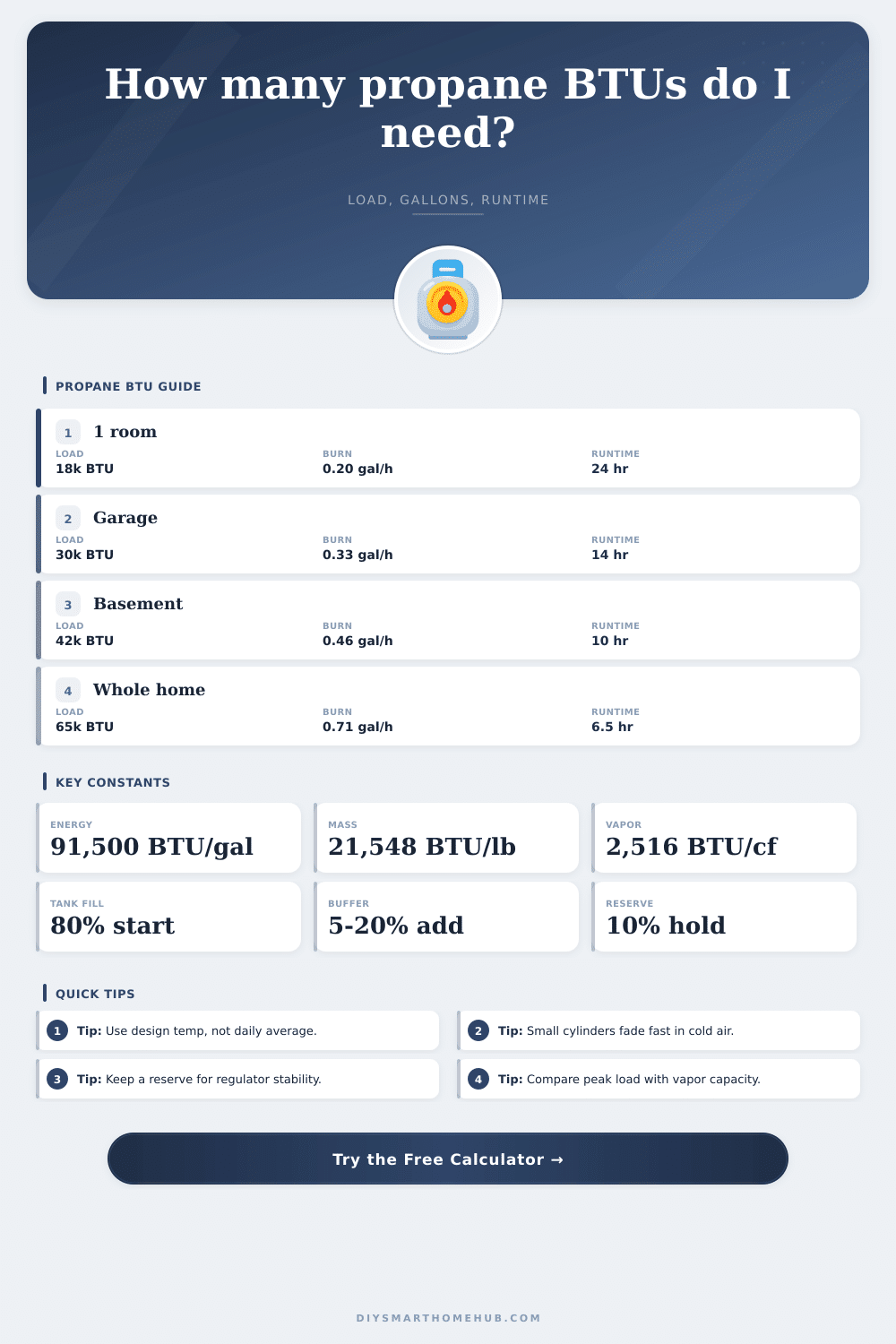
In order to determine the proper amount of propane tanks you need for your building, you must understand how much heat the space requires and how much propane the tank can provides. Propane contains approximately 91,500 BTUs per gallon, and propane can provide the energy necessary for various heating systems. In order to effectively heat the space that must be heated, the heat output of the propane heater must equal the heat loss of the building.
If the heat output of the heater do not equal the heat loss of the building, then either too much propane will be consumed to heat the space (costing too much money), or there wont be enough heat provided to the building. The heat loss of a building is dependent upon both the building envelope and the air infiltration of the building. The building envelope is the structural envelope of a building, including the walls, windows, and roof.
How to Size a Propane Tank for Your Building
If the building envelope has cracks or uses poor-quality windows, it will lose heat at a faster rate than a well-constructed building with proper windows and doors. Air infiltration is the process in which cold air enter the building through the cracks of the doors and windows. Air infiltration will increase the amount of propane required to heat the building.
Additionally, the depth of the insulation of the building will affect the heat loss of the building; the deeper the insulation, the less heat that will leave the building through the walls and roof. Finally, the volume of the building will impact the amount of propane that is required to heat that same building; buildings with high ceilings will contain more volume than buildings with lower ceilings. Buildings with more volume will require more propane to heating that space.
The type of propane appliance that you use will also affect the amount of propane that is used to heat the building. Condensing furnaces recapture some of the heat that exits the appliance to heat the surrounding area, and condensing furnaces are useful for heating whole homes. Gas heater units for garages provide quick heat recovery, and can be useful for heating spaces where the temperature rapidly change.
Radiant heating systems are useful for heating basements and areas where people stay for long periods of time. Radiant heat systems may not be sufficient to heat areas with many windows, such as sunrooms. To calculate the heating requirements of the building, you will need to determine the design temperature of the area.
The design temperature is the lowest temperature that will be experienced in the area; the average temperature should not be used. You will also need to determine the indoor setpoint, or the temperature that is desired within the building. The difference between the design temperature and the indoor setpoint will establish the peak load of the building; the peak load will determine the BTUs of propane that will be required to heat the building.
Finally, the duty cycle of the heat pump will determine the percentage of time the heater will need to be running to maintain the indoor setpoint. Propane tank sizing is important for various reasons. Small propane tanks are useful for small areas.
However, small propane tanks will emit less vapor than larger propane tanks. Additionally, the propane tank should never be filled to 100% of its capacity; it is recommended to fill the tank to 80% of its capacity. This 20% propane reserve will ensure that the propane regulator of the tank does not become overwhelmed by the amount of propane in the tank.
The runtime of the heater will determine how long the propane tank will run the heater before the tank is emptied of propane. To calculate the runtime of the heater, divide the total BTUs of the propane tank by the BTUs of the heater that are emitted per hour. This will allow the homeowner to determine if the tank will last the duration of the cold period.
Additionally, you can determine the flow rate of the propane tanks to ensure that the propane lines are large enough to supply the propane to the heater. For instance, an open floor plan may require between 18,000 and 30,000 BTUs. However, a home that contains 2,000 square feet of floor space may require more than 50,000 BTUs to heat the area.
Many people make mistakes when calculating the requirements for propane heating for a building. For instance, many people use a simple rule of thumb that the building requires 30 BTUs of heat for every square foot of area to be heated. However, this rule of thumb does not take into consideration the thermal efficiency of the building.
If you calculate the BTUs for the heating system without taking into consideration the efficiency of the building, it is possible that the propane tank will run out of fuel before the building is effectively heated. Additionally, propane tanks that are too cold may emit less vapor to heat the building, as well. If the propane tank is too cold, it is also possible that the propane heating tank will run out of fuel before the building is heated to the desired temperature.
To avoid these problems, ensure that you calculate the amount of heat that is required to heat the building correctly. Additionally, ensure that the propane tank is of the correct size relative to the size of the building, and that the heating system is able to meet the individual needs of the building.