Propane Orifice Size Calculator
Estimate exact propane burner orifice diameter, match the closest numbered drill bit, and review per-burner flow using regulated manifold pressure, burner count, and LP gas constants.
Sizes one propane orifice per burner from total BTU load, pressure, fuel properties, and discharge coefficient instead of guessing from a single chart row.
Switch between inches water column and kPa for pressure while the results always show both inch and millimeter diameter outputs for easy drill matching.
Review recommended diameter, nearest drill, per-burner input, propane draw, and how an existing drilled hole compares to the target capacity.
📌Scenario Presets
⚙Burner Inputs
Calculation breakdown
📊Propane Reference Grid
📋Low-Pressure LP Drill Capacity Table
| Drill Size | Diameter (in.) | LP BTU/hr at 11 in. W.C. | Typical Match |
|---|---|---|---|
| #70 | 0.0280 | 5,490 | Pilot scale burners |
| #67 | 0.0320 | 7,150 | Very small hob |
| #64 | 0.0360 | 9,050 | Compact cooktop |
| #61 | 0.0390 | 10,600 | Small furnace pilot main |
| #58 | 0.0420 | 12,300 | Utility burner |
| #56 | 0.0465 | 15,100 | Side burner |
| #54 | 0.0550 | 21,200 | Smoker burner |
| #52 | 0.0635 | 28,200 | Furnace burner |
| #50 | 0.0700 | 34,200 | Heater burner |
| #48 | 0.0760 | 40,400 | Tall patio heater |
| #46 | 0.0810 | 45,800 | Large fryer |
| #44 | 0.0860 | 51,600 | Fire pit ring |
| #42 | 0.0935 | 61,100 | High output ring |
| #38 | 0.1015 | 72,000 | Forge burner |
| #34 | 0.1110 | 86,200 | Large single burner |
| #30 | 0.1285 | 115,300 | Very high output |
🔍Appliance Comparison Table
| Appliance | Total Input | Burners | Common Drill Result |
|---|---|---|---|
| Range top burner | 9,500 BTU/hr | 1 | #64 to #61 |
| Smoker burner | 18,000 BTU/hr | 1 | #55 to #54 |
| 3-burner grill | 36,000 BTU/hr | 3 | #58 per burner |
| Side burner | 12,000 BTU/hr | 1 | #58 to #56 |
| RV furnace | 30,000 BTU/hr | 1 | #52 to #50 |
| Patio heater | 40,000 BTU/hr | 1 | #48 to #46 |
| Fire pit ring | 65,000 BTU/hr | 1 | #42 to #40 range |
| Dual wok station | 120,000 BTU/hr | 2 | #42 per burner |
📏Common Burner Load Table
| Scenario | Pressure | Primary Result | Secondary Result |
|---|---|---|---|
| Single range burner | 10 in. W.C. | 0.037 to 0.040 in. | 0.38 gal/hr per 100k |
| Smoker cabinet | 11 in. W.C. | 0.051 to 0.055 in. | 7.2 CFH at 18k |
| Three grill burners | 11 in. W.C. | 0.041 to 0.043 in. | 4.8 CFH each |
| RV furnace | 10.5 in. W.C. | 0.065 to 0.068 in. | 1.39 lb/hr total |
| Patio heater | 11 in. W.C. | 0.076 to 0.081 in. | 0.44 gal/hr total |
| Turkey fryer | 11 in. W.C. | 0.088 to 0.090 in. | 22 CFH at 55k |
| Fire pit ring | 11 in. W.C. | 0.096 to 0.100 in. | 0.71 gal/hr total |
| Forge burner pair | 11 in. W.C. | 0.101 to 0.104 in. | 20 CFH each |
💡Calculation Tips
A 36,000 BTU grill with three burners needs each orifice sized for about one-third of the load before you add any design margin.
The closest numbered drill may deliver a little more or less BTU than the ideal hole, so the variance output helps you see the likely shift.
Propane orifice sizing are the process of determining the proper diameter of a brass orifice given the heat output requirement of the appliance and the propane pressure. The orifice is a small hole in the manifold that controls the amount of propane that exit the appliance into the burner tube. If the orifice size is too small for the BTU output requirements of the appliance, then the propane will not be able to supply enough heat to the appliance.
If the orifice size is too large, then there will be a waste of propane gas as it will exit the appliance without being fully combust. Ensuring that the propane orifice size is set to the correct diameter will ensure that there is a proper flow of propane to create a blue flame. In order to size the orifice for propane appliances, you must first determine the total heat load of the appliance.
How to Size Propane Orifices
The total heat load is measured in British thermal unit (BTUs) per hour. To calculate the BTUs required for each burner, you can divide the total BTUs by the number of burners that the appliance include. For propane appliances, the heating value of propane is approximately 2,500 BTUs per cubic foot of vaporized propane.
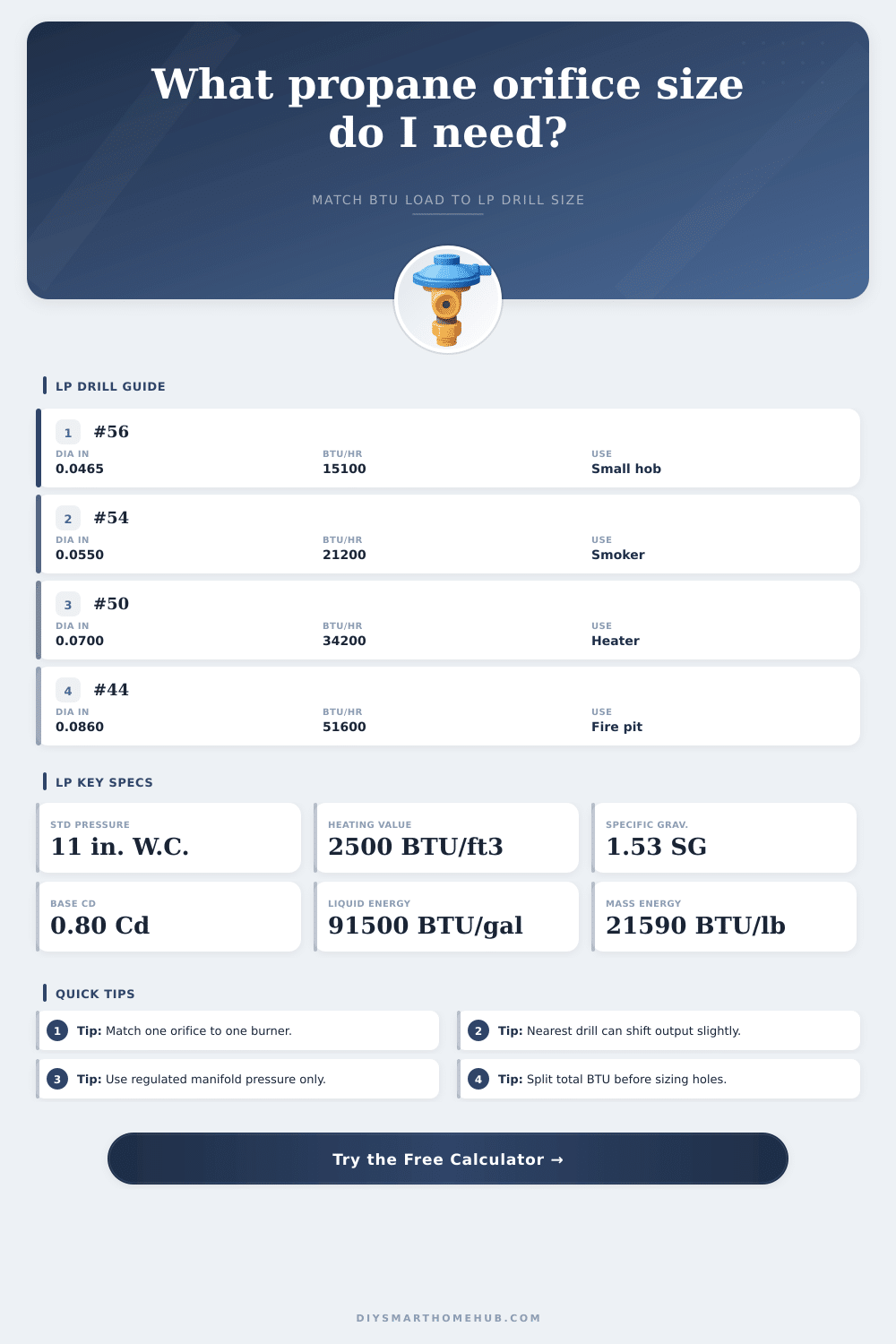
Additionally, the calculation of the size of the orifices must account for the pressure of the propane within the appliance. The standard propane pressure for appliances is 11 inch of water column. However, this standard may change with the output of the regulator on the propane tank or the altitude of the propane tank.
In order to size the orifices for propane appliances, many people use printed charts that show the sizes of drill bits for the orifices of different BTU output. These charts typically list BTU output for drill bits numbered #70, #44, and others. For example, a #56 drill bit may output 15,000 BTUs per hour, while a #44 drill bit may output 51,600 BTUs per hour.
These charts are printed with the assumption that the propane pressure within the appliance is 11 inches of water column, or standard propane pressure. Should the propane pressure within the appliance be lower than the standard 11 inches of water column, then the BTU output of the appliance will be lower than the BTU rating printed on these charts. As such, the calculations for propane orifices must be adjustable based off the actual propane pressure within the appliance.
For propane orifices to be sized correctly, you must measure the propane pressure within the appliance. A manometer can be used to determine the propane pressure within the test port of the propane manifold. The gauge that reads the propane pressure within the propane tank isnt an accurate gauge of the propane pressure within the appliance.
The regulator that is included with the propane tank is what sets the propane pressure within the appliance. In cold climate, a design margin of propane capacity of 10% may need to be provided for the design of propane appliances. As the temperature within the area where the appliance is to be used is lower, the propane will vaporize at a slower rate.
This extra 10% of propane capacity is provided to ensure that the appliance will have an adequate supply of propane even in cold climates. In order to drill propane orifices, you must use brass tubing. Brass tubing is the best material for the orifices in propane appliances due to its durability.
To drill the orifices, you can use the numbered twist bits as they allow for precision in thousandths of an inch. Once you have drilled the orifices, the fire must be tested to ensure that the orifices are of the proper size. If the appliance flame is of a steady blue color, the orifices are sized correctly.
If the flame has yellow tips, the orifices are too small for the propane pressure. If the flame lift away from the burner tubes, then the orifices are too large for the propane pressure. The requirements of different appliances will vary in the sizing of the orifices for the propane gas.
Appliances that require low BTUs, such as smokers, may have only one orifice providing 18,000 BTUs per hour. Fire pits, however, may have many large orifices to allow for a large ring of flame to exit the appliance. Areas with high altitudes have thinner air; thus, the propane pressure may be lower in these areas.
Additionally, each orifice in a propane manifold must be the same size to allow for even heat distribution from each burner of the appliance. In order to properly size the propane orifices, there are some mistakes that must be avoided. For example, failing to divide the total BTUs by the number of burners will result in undersized orifices.
Another example of a common mistake is to ignore the discharge coefficient. The discharge coefficient accounts for imperfections in the orifices. Any rough edge to the orifices will lower the coefficient and the BTUs that will exit the appliance.
Additionally, another mistake to avoid is failing to ensure that the area is well ventilated. Since propane gas is heavier than air, it can pool in low areas if there is a propane leak. Properly sizing the propane orifices will ensure that propane gas will exit the appliance at the proper rate to provide heat to the appliances according to the propane pressure.