Natural Gas Line Pack Calculator
Estimate how much standard natural gas volume sits inside a pipeline section, how much working pack remains above a delivery floor, and how long that pressure swing can support a withdrawal event.
📍Preset Line Pack Cases
Preset cases update the pipe profile, geometry, operating pressure band, base assumptions, and withdrawal rate so you can benchmark a pack calculation before entering a custom segment.
📏Segment Inputs
Line Pack Results
Calculated pack summary appears here.
📊Pipe Profile Comparison Grid
📑Reference Tables
Common Pipe Profiles
| Profile | ID | MAOP | Typical duty |
|---|
Standard Volume Multipliers
| Avg psig | Factor | 4 in x 1000 ft | 8 in x 1000 ft |
|---|
Typical Segment Swing Examples
| Segment | Pressure band | Operating pack | Working pack | Support time |
|---|
Withdrawal Time Snapshot
| Demand | 1,000 scf | 5,000 scf | 20,000 scf | 100,000 scf |
|---|
💡Operator Notes
A segment can look like it gained or lost stored gas when the only change is a different base pressure or base temperature. Lock those assumptions before comparing one station, district, or shift against another.
Large line pack swings disappear quickly when the outlet minimum is tight. A section with high operating inventory may still offer very little usable pack if the downstream customer or regulator needs a narrow pressure window.
Line pack is an amount of natural gas that is store within the pipeline due to the higher pressure within the pipeline than the standard atmospheric pressure. Due to the fact that the pressure within the pipeline is higher than the standard atmospheric pressure, the gas within that segment of the pipeline occupy more space within the pipeline. The operator can calculate the line pack for a segment of the natural gas pipeline to determine the amount of usable natural gas that is contained within that segment, and for how long that gas will last before the pressure within the segment of the pipeline drop to the minimum required pressure for the gas to continue to meet the demands of the customers of that pipeline.
To calculate the line pack for a segment of the natural gas pipeline, you must determine the volume of the segment of the pipeline, the pressure within that segment of the pipeline, and the temperature of the gas within that segment of the pipeline. The operator multiplies the volume of the segment of the pipeline by the ratio of the pressure within the pipeline to the absolute pressure within the segment of the pipeline, as well as the ratio of the temperature within the segment of the natural gas pipeline to the standard temperature within the natural gas segment of the pipeline. Additionally, the calculation must account for the Z factor for the natural gas within that segment of the pipeline.
What is line pack in a natural gas pipeline
The Z factor is essentially the compressibility factor for the natural gas within that segment of the pipeline. If the Z factor for that segment of the natural gas pipeline is lower than 1, then more molecule of natural gas can fit within that segment of the pipeline; thus, increasing the amount of line pack that exist within that segment of the natural gas pipeline. In order to manage the line pack within a segment of a natural gas pipeline, the operator must manage the pressure within that segment of the natural gas pipeline to remain within a pressure band between the normal operating pressure and the minimum pressure at which the natural gas within that segment of the pipeline are to be met the demand of the customers.
The amount of usable line pack within that segment of the natural gas pipeline is the difference between the pressure within the segment at any given time and the minimum required pressure for that segment to meet the demand of its customers. For instance, if the pressure within the inlet of a segment of a natural gas pipeline is 220 psig, but the minimum required pressure for the segment to supply natural gas to its customers is 120 psig, the operator must calculate the amount of gas within that segment of the natural gas pipeline based off the pressure difference between those two pressure. Additionally, the operator can factor the withdrawal rate of the natural gas within that segment of the natural gas pipeline into the calculation; the endurance of that segment of the natural gas pipeline is the length of time that the line pack will last before the gas within that segment reach the minimum required pressure for that segment to meet the demands of its customers.
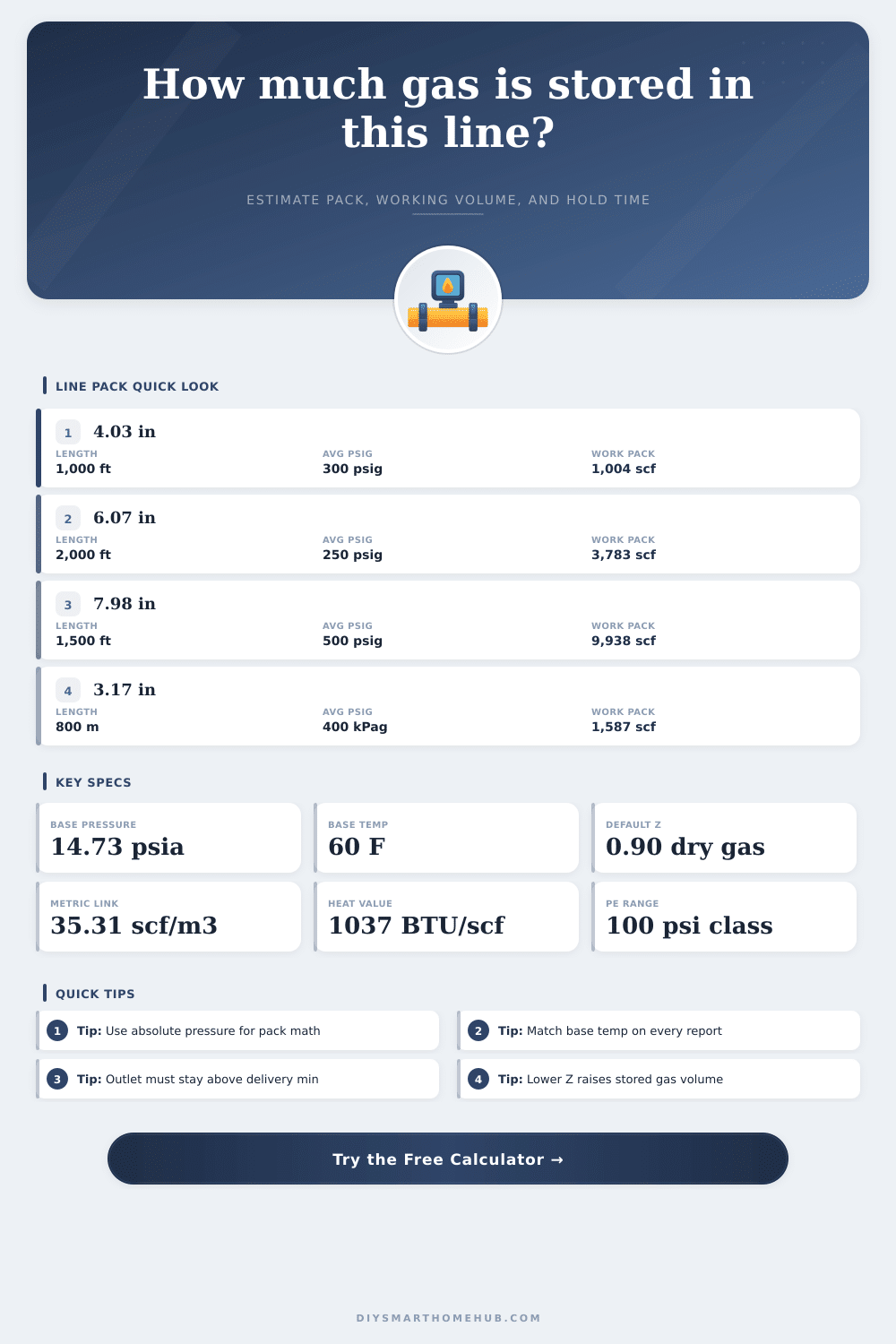
Thus, a higher rate of withdrawal of natural gas from that segment will reduce the endurance of that segment of the natural gas pipeline. The calculations of the amount of gas within a segment of a natural gas pipeline will require the use of standard conditions. In North America, standard conditions is 14.73 psia and 60 degrees Fahrenheit.
Using these standard conditions will allow all individuals to agree as to the amount of standard cubic feet of natural gas is contained within that segment of the natural gas pipeline. If these standard conditions are not used in the calculations, it is possible that the amount of natural gas within that segment of the natural gas pipeline will appear to change when in fact the actual amount of natural gas within that segment of the natural gas pipeline is the same. Additionally, the operator must use the actual temperature of the natural gas within that segment of the natural gas pipeline rather than the outside air temperature within the area in which that segment of the natural gas pipeline is located, because the temperature of the natural gas within the segment of that natural gas pipeline will not change at the same rate as the outside air temperature.
The line pack within a segment of the natural gas pipeline can be convert into thermal energy by utilizing the heating value of the natural gas within that segment of the natural gas pipeline. The heating value of natural gas is the amount of energy that is contained within the natural gas; dry natural gas have a heating value of 1,037 BTU per standard cubic foot of natural gas. This measurement can be used to compare the amount of natural gas within the line pack of that segment of the natural gas pipeline to the amount of energy requirements of some other component or system.
For instance, the heating value of the natural gas within that segment of the natural gas pipeline can be used to determine how many standard cubic foot of natural gas are required to power a certain boiler or generator. Additionally, it is important to ensure that the velocity of the natural gas within the segment of that natural gas pipeline is within an acceptable rate for that segment of that natural gas pipeline. If the velocity of the natural gas within that segment of the natural gas pipeline is too high, it can cause the natural gas to experience turbulence within that segment of the natural gas pipeline.
Excessive turbulence in that segment of that natural gas pipeline can lead to wear and erosion of the walls of that segment of the natural gas pipeline over time. There are several common error that an individual that is performing the calculations of the line pack within a segment of a natural gas pipeline can be made. One of the most common error is using gauge pressure instead of absolute pressure.
If you use gauge pressure in these calculations, the amount of gas within that segment of the natural gas pipeline will be calculated incorrectly. Another of the common error is ignoring the temperature ratio within the calculations; using this error will lead to the underestimation of the amount of natural gas within the segment of that natural gas pipeline. Additionally, it is important to ensure that the calculations account for any change to the diameter of that segment of the natural gas pipeline; a change to the inside diameter of that segment of the natural gas pipeline will change the cross-sectional area of that segment of the natural gas pipeline; thus changing the amount of natural gas that can exist within that segment of the natural gas pipeline.
Because the natural gas within a segment of a natural gas pipeline can be store within that segment of the natural gas pipeline, the line pack provides a means of storing the natural gas within the natural gas pipeline system. Furthermore, because the natural gas within the line pack can be store within the natural gas pipeline system, the line pack within that segment of that natural gas pipeline can act as a buffer to bridge the gap between high demands of natural gas from the customers and an increase in the supply of natural gas from the suppliers of that natural gas. Thus, if natural gas can be store within the line pack within the natural gas pipelines, there is a means of managing the demands of natural gas from the customers without having to construct additional tanks to store that natural gas.
However, the line pack should not be relied upon too much. If the operator continually withdraw from the natural gas within the line pack from that segment of the natural gas pipeline faster than it is supplied to that segment, that line pack will eventually run out of natural gas. It is important, therefore, to model the line pack within a segment of a natural gas pipeline in a conservative manner, and to always validate the calculation of the line pack within that segment of that natural gas pipeline by comparing those calculation to the data obtained from the SCADA system of that natural gas pipeline system.