Gas Line Pressure Drop Calculator
Estimate low-pressure natural gas or propane branch performance from developed length, pipe size, and connected load before you move deeper into final code-table sizing.
📌Preset Scenarios
📏Calculation Inputs
📈Pressure Drop Results
These results combine code-table capacity with gas-specific correction and the selected outlet-pressure target.
💡Quick Specs
📊Reference Tables
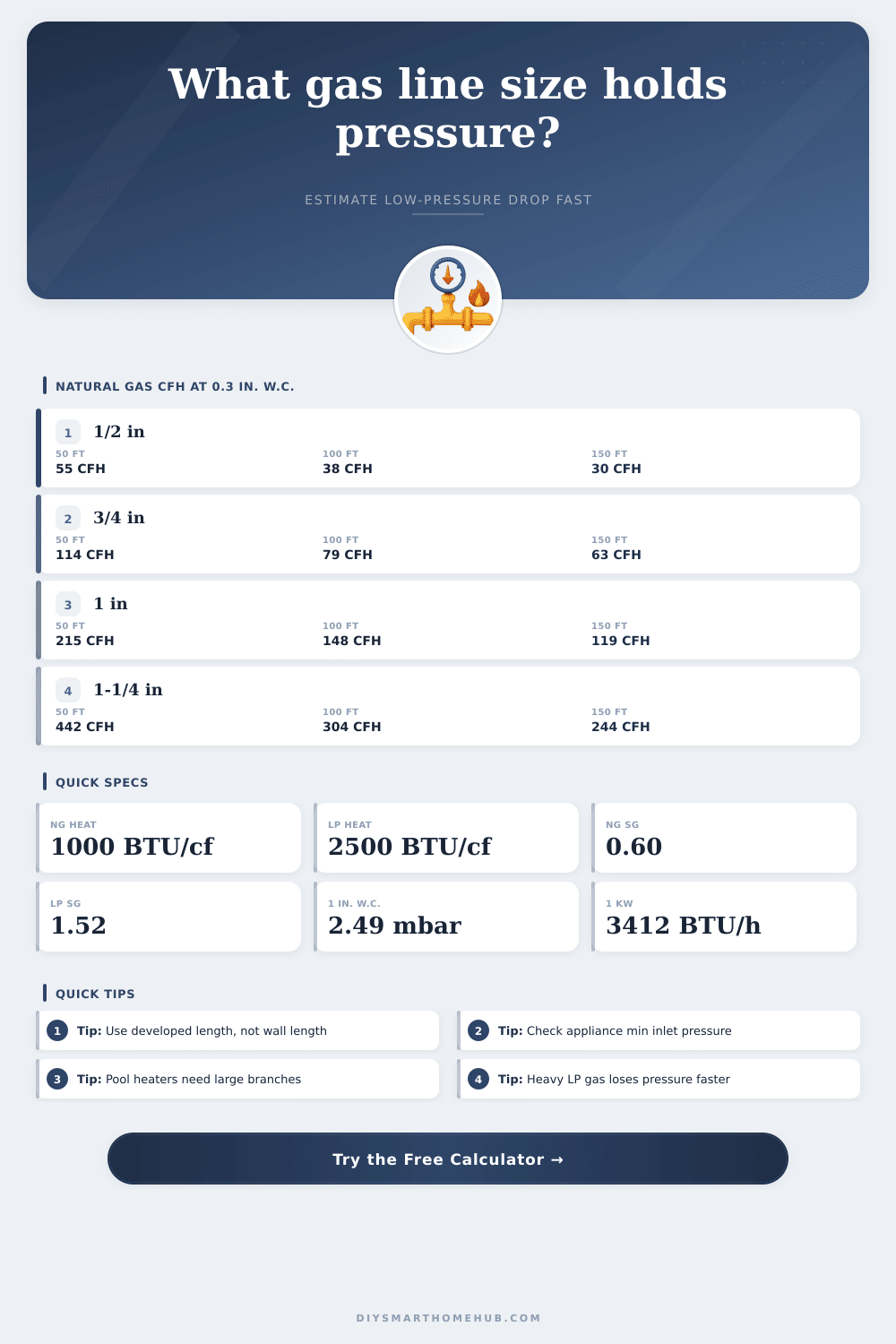
The first table updates with your gas type and allowable drop. The second table compares common appliance loads to a conservative minimum pipe size at the same drop target.
| Pipe size | 50 ft | 100 ft | 150 ft |
|---|
| Project | Load | Length | Min size |
|---|
| Appliance | Demand | Approx. CFH | Pressure note |
|---|---|---|---|
| Gas range | 65,000 BTU/h | 65 CFH NG | Short 1/2 in. runs often work |
| Tank water heater | 40,000 BTU/h | 40 CFH NG | Branch drop adds up fast |
| 80k furnace | 80,000 BTU/h | 80 CFH NG | Watch long basement runs |
| Tankless heater | 199,000 BTU/h | 199 CFH NG | Often needs 3/4 in. or larger |
| Pool heater | 400,000 BTU/h | 400 CFH NG | Usually a large dedicated branch |
| Pipe size | Actual ID | 50 ft NG | 100 ft NG |
|---|---|---|---|
| 1/2 in. | 0.622 in. | 55 CFH | 38 CFH |
| 3/4 in. | 0.824 in. | 114 CFH | 79 CFH |
| 1 in. | 1.049 in. | 215 CFH | 148 CFH |
| 1-1/4 in. | 1.380 in. | 442 CFH | 304 CFH |
| 1-1/2 in. | 1.610 in. | 662 CFH | 455 CFH |
Stay conservative with developed length. If you are between table rows, use the next longer published row so pressure drop does not get understated.
Pressure drop is only half the check. The selected branch still needs enough inlet pressure left over to satisfy the appliance minimum listed by the manufacturer.
Reference basis: Philadelphia Gas Works Schedule 40 metallic-pipe table for natural gas below 2 psi with 0.3 in. w.c. drop, plus federal manufactured-home gas table values for common low-pressure capacities and 1000 BTU per cubic foot natural gas assumptions.
Gas pipe sizing are a process that determine the diameter and length of the gas lines that will goes to the gas appliances. Appliances requires a specific amount of pressure to operate corectly. If the pressure is too low at the appliance, the appliance will not work corectly.
As the gas travel through the pipe, the friction between the gas and the insides of the pipe creates a drop in the pressure of the gas. To ensure that the appliances receives enough pressure to work correctly, the drop in the pressure of the gas must be calculated. The pressure drop of the gas depends on a few different factor.
How to Size Gas Pipes
One of these is the length of the pipe. Another of these factor is the diameter of the pipe. Lastly, the type of gas that are used is one of the factors that must be considered in the calculation of the gas pressure drop.
If propane is used rather than natural gas, then the pressure drop will be higher due to the difference in the density of the propane and the natural gas. Additionally, if the diameter of the pipe is too small, the pressure drop will be high due to the friction between the gas and the pipe. Using a pipe that is too small for the appliance will cause a large drop in the pressure of the gas to the appliance.
When calculating the length of the gas line, the developed length of the pipe should be use. The developed length of the pipe is the length of the pipe plus the equivalent length of all of the fittings in the line. Each fitting in the line will create a certain amount of friction to the movement of the gas through the line.
This friction is equivalent to a certain length of the pipe. For example, if the gas line contains a series of elbows, each of these elbow will add to the length of the gas line. This additional length create by the elbow is visible on the manufacturers specification for that fitting.
If this length is not accounted for in the length of the gas line calculation, the calculation will be incorrect. The load of the gas appliance must be compare with the capacity of the gas line. The load of the appliance is in BTUs/hour.
However, capacity is measured in CFH. To convert the BTU load to CFH, divide the BTU rating of the appliance by 1,000 for natural gas appliances or divide by 2,500 for propane appliances. After finding the CFH rating for the appliance, refer to the capacity of the different size of gas line.
If the capacity of the gas line is lower than the CFH output of the appliance, a larger gas line must be used. Appliances can have different requirement for the pressure of the gas that is delivered to the appliance. For example, natural gas appliances may require a minimum of 5 inches of water column to function corect.
Propane appliances may have a different requirement. If the determined pressure for the appliance is less than the minimum required for that appliance, then the installer must increase the diameter of the gas line or the length of the line. Appliances that require a high amount of BTUs may have a higher requirement for the diameter of the gas line that is provide to the appliance.
This is because high-demand appliances requires a large volume of gas to come out of the appliance quick. If a small pipe is used for such appliances, the velocity of the gas will be high. High velocities of gas within a gas line will create high rate of pressure drop.
Finally, the gas line should be tested to make sure that it provide enough pressure to the appliance. Gas line pressure can be tested with a manometer. A manometer is a device that measure the pressure of the gas in inches of water column.
If the measurement of the gas pressure is found to be below the minimum required pressure for the appliance, then the gas line are undersized. It is important to make sure that the gas line provides enough pressure for the appliance to function correct. Proper sizing of the gas line will ensure that there are no drop in the gas lines pressure.
Proper sizing of the gas line will ensure that each gas appliance receive the gas that it needs to function.