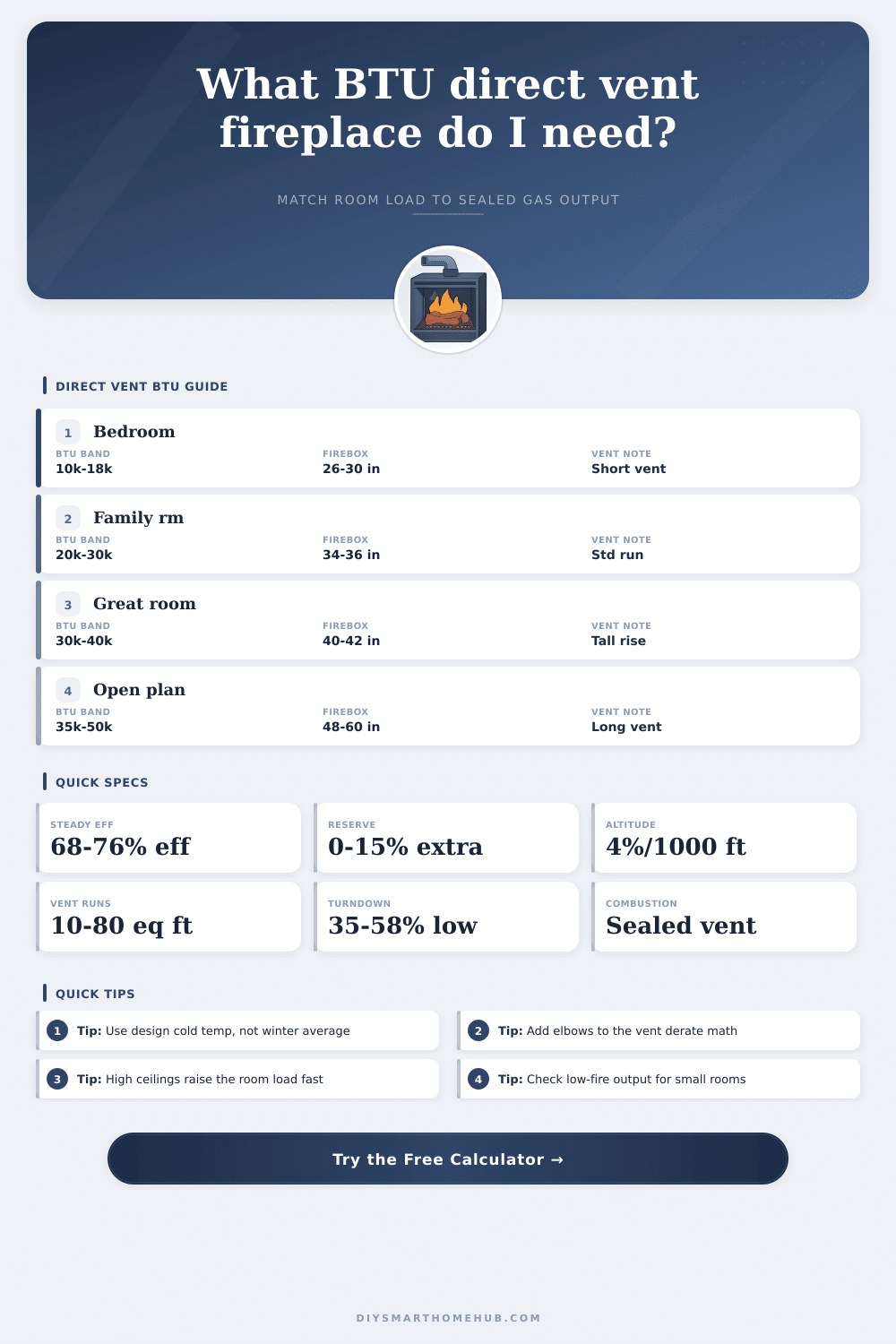
Direct Vent Fireplace BTU Calculator
Estimate room heat loss, adjust for vent geometry and altitude, and compare direct vent fireplace families by usable output instead of raw brochure input alone.
Room And Fireplace Inputs
Fireplace Sizing Results
Direct Vent Family Specs
Reference Tables
| Fireplace family | Nominal input | Steady efficiency | Low-fire range | Typical vent path |
|---|---|---|---|---|
| Compact traditional 26-30 in | 16,000 BTU/h | 72% | 58% of high fire | Short horizontal or light vertical rise |
| Traditional 34 in | 26,000 BTU/h | 73% | 52% of high fire | Average family-room runs |
| Traditional 36 in | 32,000 BTU/h | 74% | 50% of high fire | Medium vent lengths and mixed layouts |
| Traditional 42 in | 38,000 BTU/h | 75% | 46% of high fire | Tall rise or larger open rooms |
| Linear 48 in | 34,000 BTU/h | 69% | 42% of high fire | Feature walls with moderate vent drag |
| Linear 60 in | 45,000 BTU/h | 68% | 38% of high fire | Large open plans and statement rooms |
| Insert retrofit | 26,000 BTU/h | 76% | 55% of high fire | Existing masonry cavity relines |
| Power-vent 42 in | 42,000 BTU/h | 71% | 40% of high fire | Long horizontal or routed venting |
| Vent variable | Calculator effect | Why it matters | Good sizing cue |
|---|---|---|---|
| Vertical rise | Small draft bonus | Rise helps balanced flow and supports longer runs | 6-12 ft rise often offsets one elbow |
| Horizontal run | Capacity penalty | Long lateral travel adds restriction and heat loss | Keep long runs for higher-output families |
| 90 degree elbow | Major penalty | Each turn cuts easy vent flow | Count every 90 in equivalent run planning |
| 45 degree elbow | Minor penalty | Softer turns still add drag | Two 45s usually cost less than one 90 |
| Vertical roof cap | Small bonus | Supports stronger natural vent pull | Helpful in tall rooms and cold climates |
| Snorkel or high-wind cap | Small penalty | Extra geometry trims free-flow capacity | Leave more sizing margin when exposed |
| Exterior chase | Output penalty | More heat is lost before it reaches the room | Step up a family if the chase is cold |
| High altitude | Gas derate | Less dense air means less usable burner input | Add a kit above 2,000 ft when allowed |
| Room scenario | Approx area | Target output | Common fit | Low-fire note |
|---|---|---|---|---|
| Quiet bedroom or den | 140-220 ft2 | 8,000-13,000 BTU/h | Compact traditional | Watch overheating on mild evenings |
| Average family room | 280-420 ft2 | 15,000-24,000 BTU/h | 34 or 36 inch traditional | Balanced output across most seasons |
| Large vaulted room | 450-700 ft2 | 24,000-34,000 BTU/h | 42 inch traditional | Needed when ceiling height climbs |
| Wide feature wall room | 350-650 ft2 | 20,000-30,000 BTU/h | 48 inch linear | Lower efficiency but wide glass appeal |
| Open plan living zone | 700-1,200 ft2 | 26,000-36,000 BTU/h | 60 inch linear or 42 inch traditional | Choose by heat goal, not width alone |
| Retrofit masonry opening | 250-400 ft2 | 15,000-22,000 BTU/h | Insert retrofit | Higher steady efficiency helps |
| Long routed vent path | 400-700 ft2 | 22,000-32,000 BTU/h | Power-vent 42 inch | Useful when elbows pile up |
Sizing Notes
The design temperature should reflect your cold-weather sizing condition, not a comfortable average day. Using a warmer number can undersize the fireplace by several thousand BTU/h.
Small rooms can overheat if the fireplace cannot turn down far enough. Compare low-fire usable output to mild-day demand so the flame can run longer without overshooting comfort.
Direct output of gaseous fire gives excellent secondary source of heat. It does not taint the quality of the internal air because operate by means of hermetical system. That system bans that dangerous by-products enter the house.
The fire draws burning air from the outside and cast the used gases through closed pipe. Like this stays the domestic air pure while it delivers stable and strong heat.
How Direct Vent Gas Fireplaces Work
System with directional output uses two tubes. One from them introduce air from the outside for back the burnin. The second casts the burn-by-products back outside.
Commonly they are concentric so the tube reclines inside the broader tube. When the gaseous fire lights the used gases pass through the internal tube to the outside. Simultaneously the exterior tube introduces fresh air for the burno.
It leads that air directly to the bottom part of the closed burnujo where it flares the gas unit. Moreover the exterior tube isolates the surrounding objects against the heat that flows through the system.
The unit is closed against the domestic interior by means of protective net and glass panel rezista to high temperatures. Dank to that glass the flames and burn-by-products stay entirely separated by the air. Those fires are very efficient.
They spread heat in the rooms without big loss to the material the chimney or the exterior air. Directional output of gas is the most efficient mode burn it. Comparatively to wooden fire it does not require much work.
You find various styles. Modern directional gas-fires show nice flames that dances above glass-embers or smooth river stones. Some models have style with artistic flames that hovers through crushed glass.
You can even install them horizontally through exterior wall. Exist also versions of directional output. Such introduction coincides with niche and connect to hermetical system that goes upward of existent chimney.
That forms closed burning system that improves the warming and security. For that require extra heat such fire can heat room of 600 until 900 square feet if it right dimension. It always value to combine with carbon monoxide detektor for security because carbon monoxide is by-product of gas burn.