Radiant Floor Heating Calculator
Estimate room heat load, active heated floor area, electric circuit demand, hydronic loop planning, and output density from one room-by-room radiant sizing tool.
📏Floor Geometry
🌡Load and Assembly Inputs
🔧Radiant System Inputs
📊Radiant Floor Results
🧱Radiant System Profiles
📑Reference Tables
| System Type | Typical Output | Voltage or SWT | Best Fit |
|---|
| Floor Finish | R-Value | Delivery Factor | Radiant Note |
|---|
| Project | Gross Area | System | Main Result | Secondary Result |
|---|
💡Radiant Planning Notes
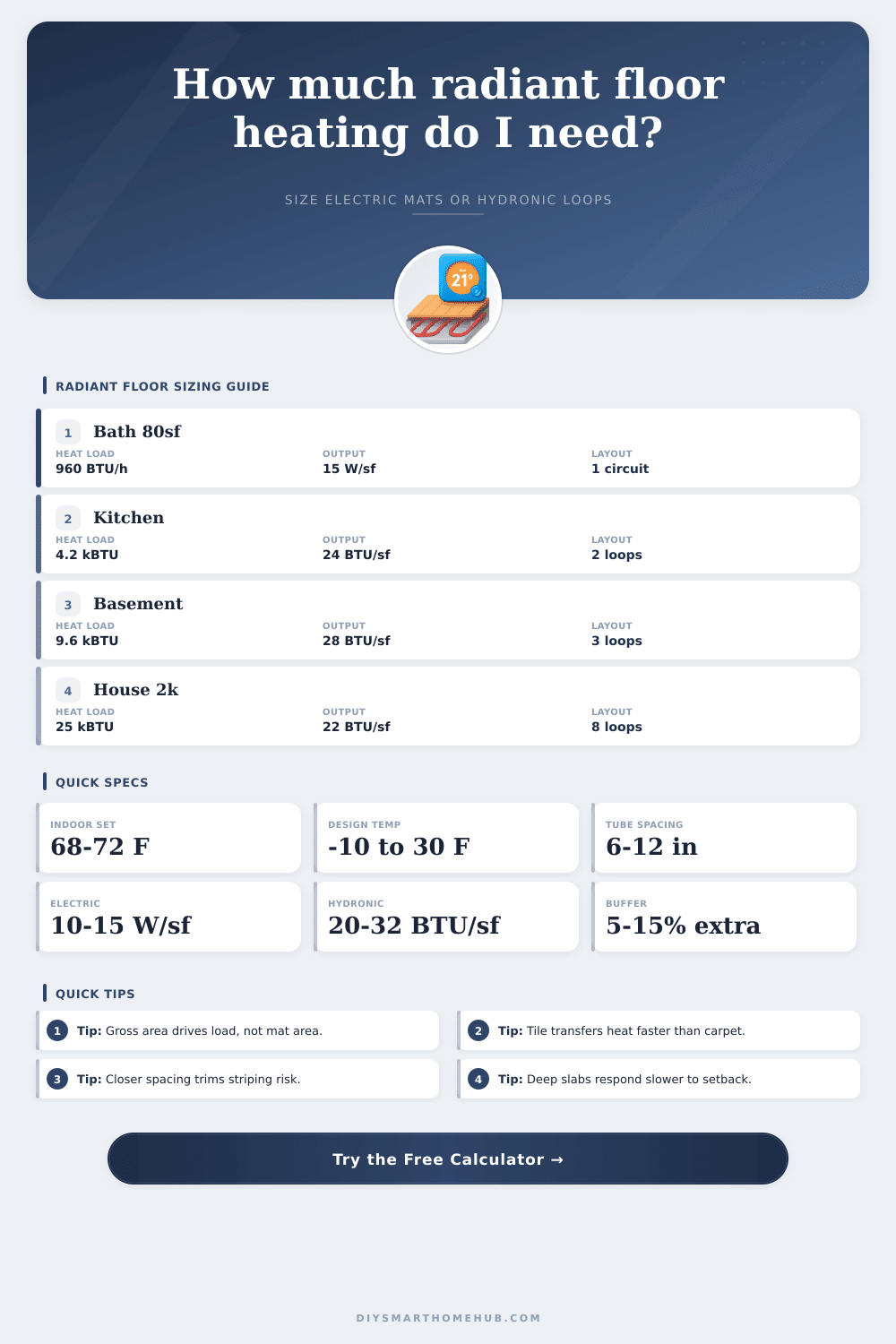
Low-resistance finishes such as tile or polished concrete help a radiant floor deliver design output with lower water temperatures or lower cable density than carpeted rooms.
If only part of a room can accept tubing or mats, the radiant layer has to deliver the same room load through less active area, which often pushes larger zones toward hydronic assemblies.
Radiant heatings deliver heat directly to the floor or to panels in walls and ceilings. They operate chiefly by means of radiant heat transfer that bears heat of warm surfaces to folks and stuff. Traditional heating systems require fans and heat the air in the room but floor heating use radiant technique for heat you and objects directly of below.
Like this it is more efficient because the heat attains yourself and the humidity stays natural It likes sun warm: from shade in sun and you feel the difference.
How Radiant Floor Heating Works
Trispecaj radiantoj exist for floor warming. Ephemeral radiant floors use air as heat carrier electrical have wires and hidroniaj aquatic tuboajn nets. Electrical knit wires in zones as bathroom and control by means of thermostat.
Those elements consume around 15 watts each square foot. In 35-square pieda bathroom during 8 hours daily that only requires 4,2 kWh day. Under ceramic floor you can install them in low cost with some watts each foot.
Hidroniaj nets have little drains knitted through the whole floor. You installs them under wooden subplanko or in betona verŝuto up. In kelroj and garages they go in concrete plates.
They coincide with gaseous fornilo or geotermaj pumps for low temperatures. Miksvalvo operate the akvotemperaturon to the tubes. Forna water must be 160, 180 grades but the nets work at around 100 grades.
Aluminium well leads heat. Aluminum varmtransigaj plates allow efficient implementation of radiant systems when concrete up it is possible not. You uses floor heating also outside for inhibit ice on ways pavements and roofs.
Malpluso are that old floors must remove for new gate below. Radiantoj react slowly to aerŝanĝoj so the warming climbs a bit of time.