Geothermal Gradient Calculator
Estimate undisturbed ground temperature, seasonal damping, loop-source temperature band, and field-area adequacy from depth, geology, surface condition, and heating load assumptions.
âš¡Preset project snapshots
Each preset fills the form and recalculates so you can compare how geology, depth, and land shift the source temperature band.
ðŸ§Current profile
Sedimentary sandstone favors stable vertical bores with moderate gradient lift and solid conductivity for closed-loop exchange.
ðŸ"Model assumptions
- Depth temperature = adjusted mean surface temperature + geothermal lift.
- Seasonal swing decays exponentially with geology, loop style, and cover.
- Heating and cooling bands include loop approach penalties.
- Area adequacy compares site land to typical loading density.
🛠ï¸Calculator inputs
Use the buffer for uncertainty, future growth, or conservative land planning.
ðŸ"ŠGeothermal gradient results
🪨Geology and site reference grid
Coastal plain soils
24 C/km, 1.6 W/m K, 3.2 m damping. Better for wider horizontal fields.Moist clay and loam
22 C/km, 1.5 W/m K, 3.8 m damping. Moisture helps shallow loops.Glacial till
25 C/km, 1.9 W/m K, 4.1 m damping. Balanced residential screening case.Sandstone basin
27 C/km, 2.4 W/m K, 4.8 m damping. Good for compact vertical bores.Limestone and karst
26 C/km, 2.7 W/m K, 5.0 m damping. Strong transfer, watch groundwater.Crystalline granite
30 C/km, 3.0 W/m K, 5.6 m damping. Deep stable bore fields.Basalt or volcanic rock
32 C/km, 2.2 W/m K, 4.6 m damping. Faster gain if fractures stay moist.High heat-flow basin
38 C/km, 2.5 W/m K, 4.4 m damping. Rapid deep temperature gain.These are screening assumptions for planning. Final geothermal design still needs local conductivity testing, groundwater review, and load matching.
ðŸ"Depth benchmark table
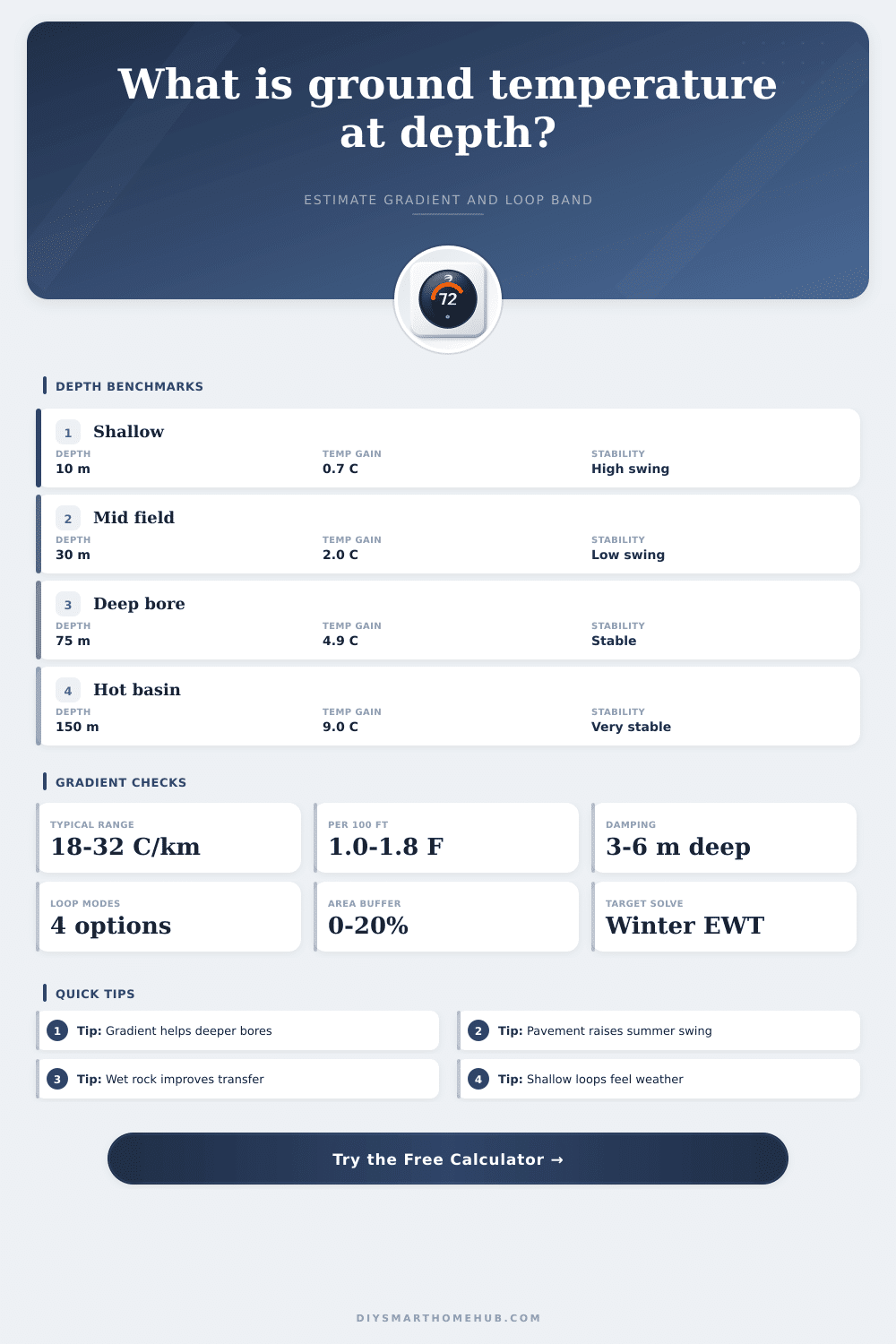
| Depth | Lift at 22 C/km | Lift at 30 C/km | Typical use |
|---|---|---|---|
| 10 m / 33 ft | 0.22 C / 0.40 F | 0.30 C / 0.54 F | Shallow horizontal screening |
| 30 m / 98 ft | 0.66 C / 1.19 F | 0.90 C / 1.62 F | Short bores and piles |
| 75 m / 246 ft | 1.65 C / 2.97 F | 2.25 C / 4.05 F | Residential vertical bores |
| 150 m / 492 ft | 3.30 C / 5.94 F | 4.50 C / 8.10 F | Deep commercial bores |
ðŸ"Loop style comparison
| Loop style | Seasonal exposure | Typical density guide | Best fit |
|---|---|---|---|
| Vertical bore | Lowest surface influence | 5.0 to 7.2 tons per 1000 ft2 | Compact lots and deeper stable temperatures |
| Horizontal trench | Highest weather sensitivity | 0.9 to 1.3 tons per 1000 ft2 | Large yards with lower drilling scope |
| Slinky trench | Moderate to high | 1.1 to 1.5 tons per 1000 ft2 | Tighter land width with trench access |
| Energy piles | Moderate | 6.0 to 8.0 tons per 1000 ft2 | New foundations with thermal exchange |
ðŸ Common project sizes
| Project profile | Field area | Depth | Screening outcome |
|---|---|---|---|
| Passive house compact lot | 2,500 ft2 | 250 ft bore | Low load density can hold a stable winter source band. |
| Suburban 4 ton retrofit | 5,400 ft2 | 300 ft bore | Granite and lawn cover often support comfortable heating range. |
| Large ranch horizontal loop | 12,000 ft2 | 8 ft trench | Horizontal fields need more land because weather reaches the loop zone. |
| Urban energy pile system | 3,800 ft2 | 100 ft piles | Foundation exchange improves footprint efficiency but uses shallower thermal lift. |
ðŸ'¡Practical design reminders
The geothermal gradient starts from the site's long-term ground-coupled surface baseline. Comfort targets size the heat pump, but they do not define the natural undisturbed temperature at depth.
More depth raises steady temperature slowly, while better conductivity improves the transfer rate between the loop and the surrounding ground. Strong geothermal design needs both.
Screening outputs are for planning and comparison. Bore length, grout, pipe sizing, groundwater behavior, and hourly load modeling should still be confirmed during final geothermal engineering.
Geothermal gradient calculator means fast and precise calculations. This free online tool gives quick results when you enter the needed values. You find the geothermal gradient observing the temperature change according to certain distance.
For geothermal uses, everything deals with the temperature change according to depth. The gradient receives value sharing the temperature change by means of the depth change. For that, you need two depth points and two temperature values.
How to Calculate Geothermal Gradient
For instance, if the temperature changes in 400 degrees Celsius during 100 km, you share the whole temperature change of 400 by means of the whole depth change of 100. That gives geothermal gradient in 4 degrees Celsius per km.
The geothermal gradient shows itself in various units. Between them are degrees Celsius per kilometer, kelvins per kilometer or millikelvins per metre. All they match each other.
You can figure it from the temperature difference between bottom hole temperature and the average yearly ground surface temperature at a well site, divided by the well depth. Such calculations help to estimate subsurface formation temperatures in Fahrenheit or Celsius by means of the geothermal gradient and depth. You use them for analyse reservoirs, optimize tools and ensure drilling safety.
The temperature gradient through any layer is inversely proportional to the R-value of that layer. Because of that, most of the heat loss through a wall happens fairly inside the insulation itself. The gradient sign depend on the chosen positive direction.
If you define the motion away of the Earths surface as positive, the geothermal gradient becomes negative because temperature decreases outside. The geothermal gradient matters for geothermal energy, oil and gas industries. Downhole tools require special hardening for operate in oil and gas wells of regions with high gradient.
Moreover, rebuilding passing geothermal gradients from geological history are important for create hydrocarbon generation in sediment basins. By means of including thermal conductivity and heat flow, you count the gradient very exactly. That makes it important utility for researchers, geologists and geophysicists, that studies thermal systems.
You can also barely estimate the heat flow using the thermal.