Geothermal Loop Sizing Calculator
Estimate total loop footage, circuit count, bore count, fluid volume, and field fit before you sketch trenches or drill bores. Switch between imperial and metric units, compare four loop layouts, and test how soil, depth, and load balance change the required ground heat exchanger size.
Preset projects are meant to be sanity checks. They auto-fill real-world style starting points, but the results still depend on the exact load study and local drilling or trenching practice.
These results are first-pass closed-loop estimates. Final design should still reconcile entering water temperature targets, pump head, grout spec, antifreeze concentration, and the exact heat pump model data.
Better thermal conductivity reduces required loop footage. Wet clay, competent rock, and well-grouted bores often outperform dry sand or disturbed backfill.
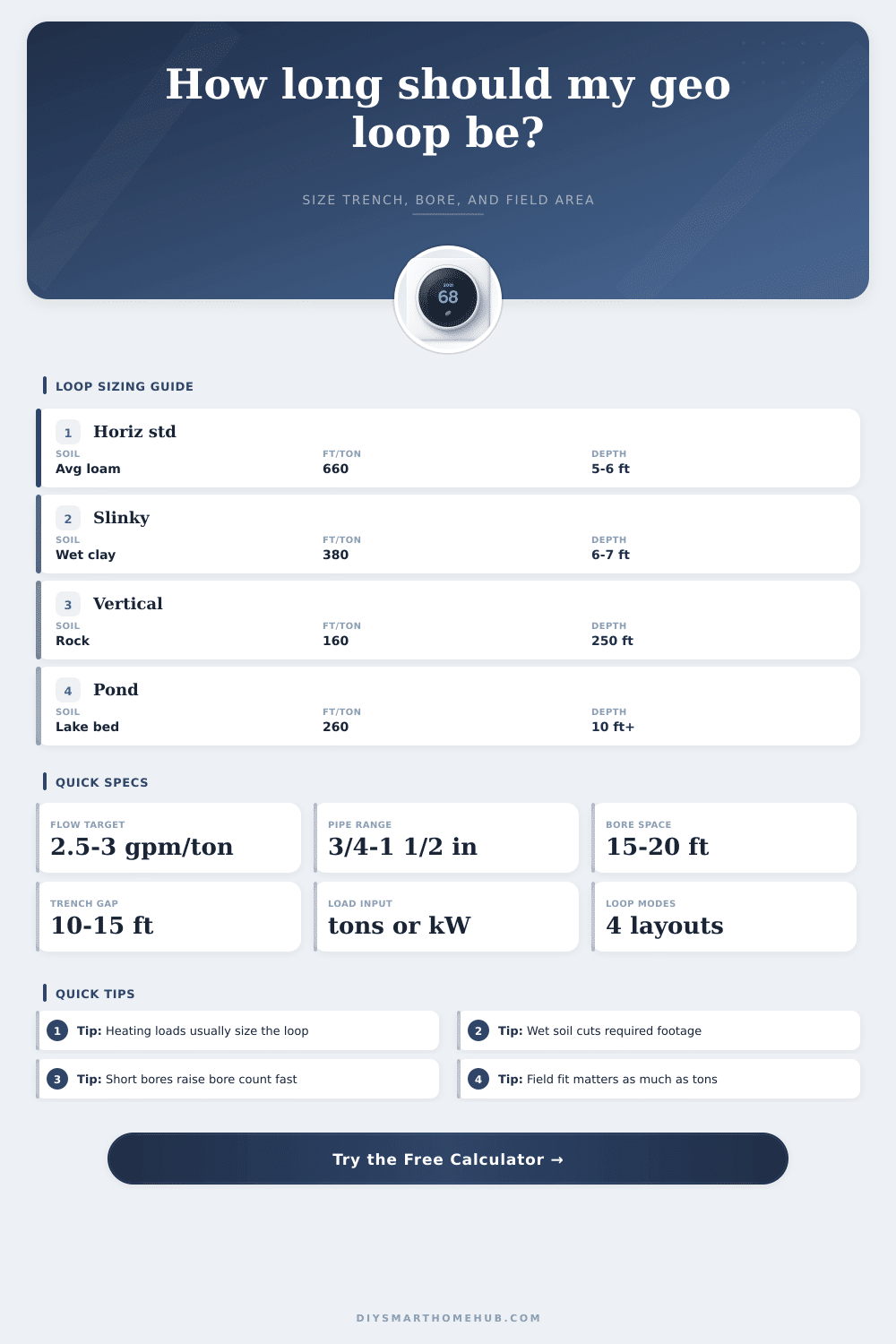
| Loop layout | Typical footage per ton | Depth or spacing | Flow target | Best fit |
|---|
| Layout | Site requirement | Primary advantage | Main constraint | Recommendation |
|---|---|---|---|---|
| Horizontal straight trench | Large open yard with easy trench access | Simple piping and predictable trench spacing | High land use and more excavation | Good when trenching is cheap and land is available |
| Horizontal slinky trench | Moderate yard with tighter trench corridors | Less land than straight trenches | Coil spacing must stay consistent to avoid crowding | Useful where land is limited but drilling is not ideal |
| Vertical borefield | Compact footprint with drill access | Small land requirement and stable deep ground temperatures | Higher drilling coordination and grout detail | Best for retrofit lots, urban sites, and premium envelopes |
| Pond or lake loop | Reliable water body with enough depth and clean bottom | Can shorten footage and reduce yard disruption | Needs water depth, anchoring, and code review | Strong option when a permanent pond or lake is on site |
| Project | Load | Suggested loop | Field need | Secondary metric |
|---|
It is easy to hit the right total pipe length on paper but miss the trench or bore spacing needed to keep the loop from thermally crowding itself over time.
Water-only loops can look shorter, but antifreeze protection is often the safer assumption in colder climates or heating-led projects with lower winter entering water temperatures.
The right size of geothermal heat pump is key stage. Do not just bury some tubes and connect them to geothermal heat pump. You must adapt the earth loop to the house and to the particular geothermal heat pump with that it connects.
For start sizing the earth loop, you need do precise calculation of heat loss and heat gain according to Manual J. Geothermal installers must do that Manual J load calculation. This helps them estimate the size of the heat pump according to the load. Also they must choose the configuration of the earth loop that will provide the yearly BTU amount that the house requires according to its climate.
How to Size a Ground Loop for a Geothermal Heat Pump
The loop should be designed for minimize the pump power.
You usually design the loop like this that the lowest and highest entering water temperature stay between 30 and 90 degrees Fahrenheit. The usable equation finds the right length of geothermal borehole so that the water in the earth loop does not cool under 30F or warm above 90F. Many elements influence how much earth loop needed for stay in that temperature range. Here also the amount of heating and cooling that the house requires.
That depends of the house size shape and insulation. The local weather matters because cold climates require more heat. You consider also the soil conditions during design of the earth loop.
For instance sandy soil keeps fewer water. Water is good for geothermal because it preserves the heat.
Various types of loops exist. Horizontal loops stay closely to the ground and run forward-backwards parallel to it. The horizontal loop is the most used when enough area of soil is available.
The house should sit on at least half of acre. Horizontal loops require until 1200 until 1800 feet of underground space for mid-sized house. Some use spiraling system if they have big area to start.
Rule thumb for horizontal loops is 500 feet of pipes each ton. Other viewpoint about 1 ton of geo pipes for 1300 square feet of house. If the house is fancy log cabin maybe needs more pipes because such houses commonly poorly insulated.