Heat Pump vs Oil Furnace Calculator
Compare house heat loss, low-temperature heat pump capacity, seasonal electricity, seasonal oil gallons, and dual-fuel switchover behavior for realistic retrofit screening.
🏠Heated Geometry
🌬Climate and Envelope
⚙Equipment and Switchover
Formula basis: total UA is derived from floor area, ceiling height, envelope, duct, leakage, and exposure factors. Design load uses indoor setpoint minus outdoor design temperature, while seasonal results use HDD-weighted heat demand split across temperature bins for heat pump and oil service.
📊Comparison Results
💡Live System Snapshot
📋Reference Tables
Heat Pump Low-Temperature Profiles
| Profile | COP 47 F | Cap 17 F | Min Temp | Best Fit |
|---|
Oil Furnace Output Reference
| Nozzle | Gross Input | Delivered | Design-Day Gallons | Fit |
|---|
Common Project Benchmarks
| Scenario | Area | Design Load | Heat Pump | Hybrid Oil | Lockout |
|---|
Climate and Envelope Benchmarks
| Climate | Design Temp | HDD65 | Average UA Range | Typical Note |
|---|
The heat pump table reflects the model curves stored in the calculator. The oil reference table updates delivered output using the AFUE tier you selected above.
🛠Planning Notes
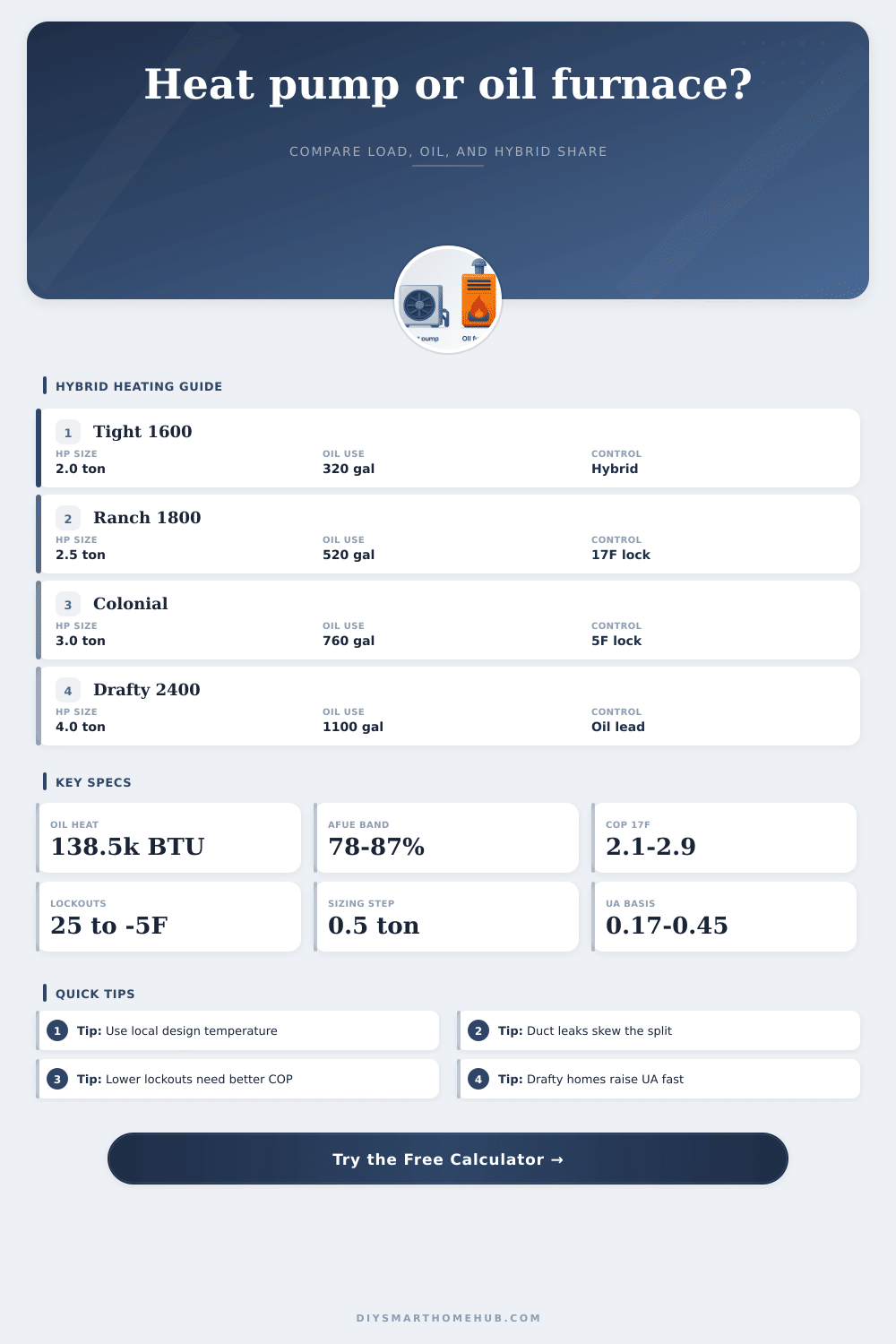
A cold-climate inverter can support a 5 F or even -5 F switchover in the right shell, but the same strategy can overload a standard split if envelope leakage or attic ducts push the balance point back upward.
The same 0.75 gph nozzle delivers very different usable BTU per hour at 78 percent AFUE versus 87 percent AFUE, so the furnace tier matters whenever you compare retrofit paths.
Heat pumps and boilers both heat the inside air of the house, but they have entirely different skills about heating. They differ also about energy use, needs of attention, usage of space and price. Heat pump shows efficient alternative to boilers and air conditioners for every type of climate.
Those high-effect electrical devices for heating and cooling use the already existing ductwork in the home. Because they simply move heat instead of create it, they do not burn fossil fuels and consume much less of energy. Like this they naturally surpass the boilers in almost all situations.
How Heat Pumps and Boilers Are Different
The biggest difference between them is the mode as they generate heat. Boiler burns fuel as natural gas, oil or propane for produce hot air. Rather, heat pump uses electricity for switch heat from one place to another.
It operates similarly to refrigerator, that dumps heat from cold zone to warm. During cooling fashion, it casts heat from the interior and exhibit it outside. In heating fashion, it extracts heat from the exterior air even during low outdoor temperatures.
Heat pump does not incline carbon, because it works alone by means of electricity. Even so, its impact malats when the air becomes very cold. The temperature, at who heat pump well operates, usually limit to the low 20th grades, so it requires more time for warm the whole house.
Many folks choose dual fuel or hybrid system. That combines efficient heat pump with strong gas boiler. The pump cares about cooling during the warm summers, but it can also invers the cycle for heat during autumn and early winter.
The exterior unit of heat pump commonly substitutes the old air conditioning unit and connects to the old spiro. That well helps in regions with freezing winters. Some new reverse heat pumps fit to go down until at least 0 grades.
If the temperature falls under 70°F, almost each requires some heating domestic system for comfort.
Are various kinds, for instance air font warm pumps and mini-split warm pumps. Mini-split ideal for houses without channels. Air font warm pump you commonly call ASHP.
If ASHP requires to work under 30°F, you usually says that it is for cold climates. Use heat pump can depress your invoices. Although they work, bigger efficiency no always means lower cost for run.
It depends of your location and current fuel usaĝo. In some areas heat pump cold cost more, if you now use propane, oil or resistance electrical heating.