Heat Pump vs Gas Furnace Calculator
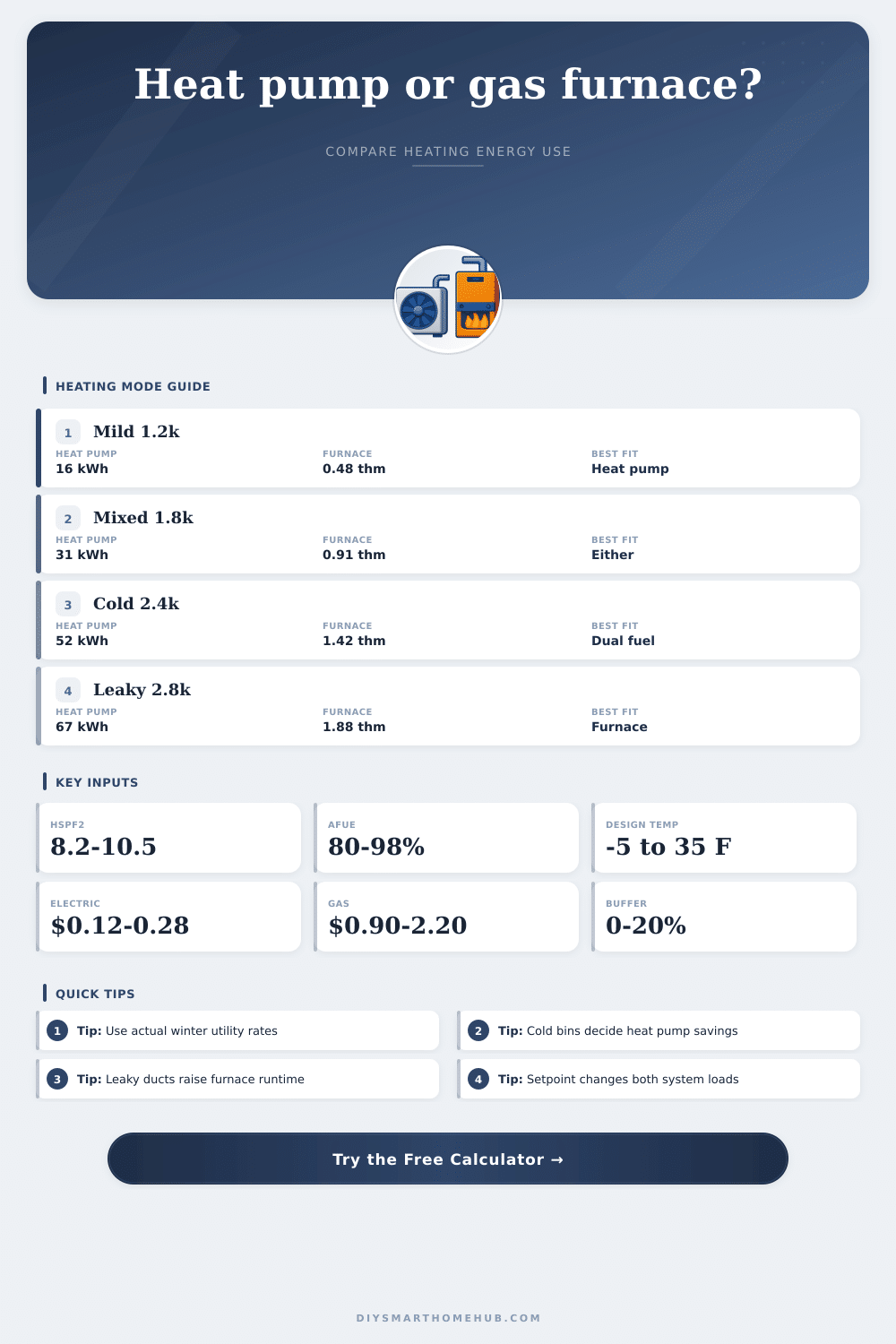
Compare annual space-heating demand, design-day capacity, and seasonal operating energy between a heat pump system and a gas furnace using climate bins, shell quality, and utility rates.
📌Presets and Units
Preset note: Mixed Townhome starts with a balanced central comparison where both systems are reasonably matched to the shell and climate.
🏠Home and Climate Inputs
⚡Equipment and Rate Inputs
Formula basis: area and shell assumptions create an adjusted UA. Each climate bin then drives delivered heating load, heat pump runtime, strip heat share, furnace therms, and blower electricity.
📊Comparison Results
📈Selected System Snapshot
🧮Climate Bin Heating Table
| Outdoor Bin | Hours | Heating Load | HP Coverage | Aux Share | COP |
|---|
This table shows how colder bins can drive strip heat share even when average winter temperatures look favorable.
📑Equipment Reference Tables
| Heat Pump | HSPF2 | 47 F Cap | 17 F Cap | Min Temp |
|---|
| Furnace | AFUE | Output | Blower | Application |
|---|
📋Scenario Benchmarks
| Scenario | Area | Climate | Winner | Gap | Design Load |
|---|
💡Practical Notes
Use realistic winter rates
Small electric or gas rate changes move the winner quickly, especially when the selected heat pump still covers most of the load without much strip heat.
Design load still matters
An annual heat pump savings win can still hide a cold-weather capacity shortfall. Check the design-day coverage line before assuming one system fits the whole heating profile.
Boilers and heat pumps both push warm indoor air upward, but they differ about warm skill, energy effeciency, maintenance needs, space cost and price. If the temperature falls under 70°F, probably you require home heating system for stay comfortable. Commonly used are air-source heat pumps and gas furnaces as central residential heating systems.
Well installed and functional, they keep the house warm even when exterior temperature falls.
How Boilers and Heat Pumps Are Different
The main difference between them is the mode produce heat. A boiler burns fuel for generate heat. It uses fossil fuels as natural gas, oil either propane, for warm air, that later circulates through tubes.
A heat pump on the other hand move heat of one place to another by means of electricity. Because it does not create heat but only switch it, it escapes to burn fossil fuels and consumes fewer energy. Like this it is naturally more efficient than boilers in most conditions.
When it operates by means of electricity, a heat pump do not emanate carbon.
Heat pumps are high-effeciency electrical devices, that heats and cool using the domestic ductwork. They can replace old boiler and air conditioning, simultaneously depressing the invoices. When needed, they quite a lot cool.
Popular kinds are air-source heat pumps and mini split heat pumps, ideal for houses without tubes. An air-source heat pump one commonly calls ASHP. If it works well under around 30°F, one says furios climatic ASHP.
Central dual fuel heat pump with gas furnace split system combine efficient heat pump and strong gas furnace. The pump cools during summer heats, but can also reverse the cycle for heat during fall colds and early winter. One calls that dual fuel or hybrid system.
The exterior unit of the heat pump replace the old air conditioning and connect to the coil above the boiler. Some new inverter heat pumps operate until at least 0 degrees. Heat pumps well keep permanent temperature, but do not reach the power ofgas furnace.
In many parts of North America cost heat pump more, if you now heat by means of propane, oil either electric resistance.