Heat Pump Balance Point Calculator
Estimate when home heat loss catches your heat pump, when backup heat becomes cheaper, and how duct losses, controls, and envelope quality move the switch temperature.
📌Presets and Units
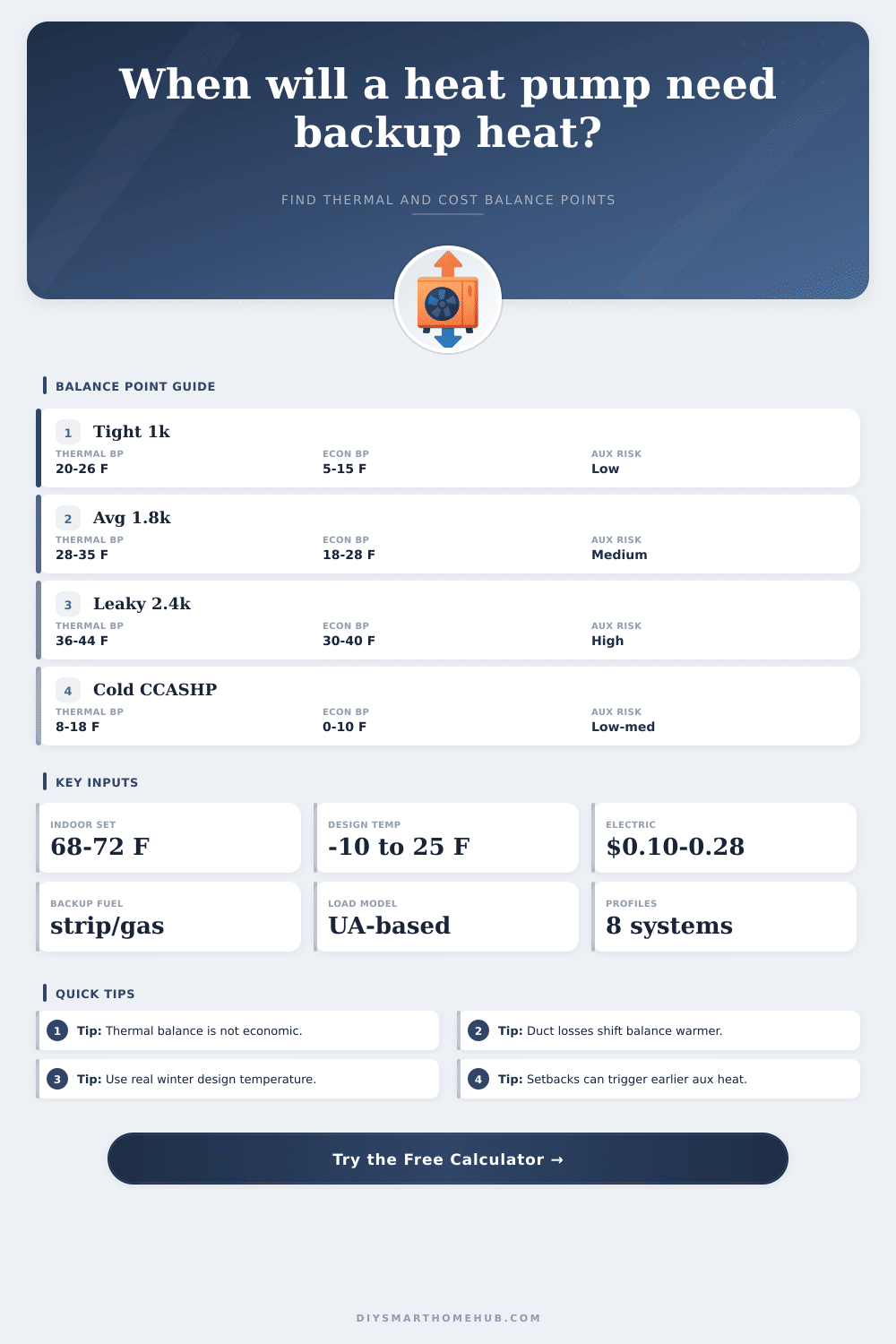
Preset note: Suburban Ranch starts with a common mixed-climate house where attic duct losses and a standard winter design temperature keep the balance point realistic.
🏠Home Load Inputs
⚡System and Backup Inputs
📊Balance Point Results
📈Current Balance Curve
| Outdoor | Load | HP Capacity | Margin | COP | HP Cost |
|---|
The balance curve uses the same UA model, capacity curve, and fuel assumptions as the results above.
🧮Balance Drivers
📑Reference Tables
| Heat Pump Profile | 47 F Cap | 17 F Cap | Min Temp |
|---|
| Envelope | Shell UA | ACH | Use Case |
|---|
📋Scenario Benchmarks
| Scenario | Area | System | Thermal BP | Economic BP |
|---|
💡Interpretation Notes
Thermal balance drives backup need
When thermal balance is warmer than your winter design temperature, auxiliary heat is not a rare event. Tightening the envelope or reducing duct loss can move the balance point colder faster than upsizing one equipment tier.
Economic balance depends on utility rates
Economic switching can sit much colder than thermal balance with low electric rates and cold-climate units, or much warmer when fossil backup is cheap and controls allow full compressor lockout.
Heat Pump Balance allows you pick the level of comfort and savings that you like. Pick more comfort, bigger savings or something between them. At Nest Thermostat go to settings, find Nest Sense and Heat Pump Balance.
Here you pick between Maximum Savings, Balanced or Maximum Comfort. Maximum comfort uses any heating, that needs, to reach the wanted temperature fast. The balanced option gets it slightly more slowly, because it does not use whole heating capacity.
Heat Pump Balance on Nest: Choose Comfort or Savings
Maximum savings is another chance. With Heat Pump Balance you do not need to care about the temperature of lockout. Nest Thermostat self sets the lockout temperature based on your pick.
If you want to set temperatures, turn Heat Pump Balance in Nest Sense. Later you put them in Equipment under Heat Pump. The balanced spot is the outdoor temperature, where heat pump no longer has enough skill heat the house.
It is also the temperature, where the pump no longer is the most efficient and cheap fix. At that spot the heating cost of the pump matches the heat loss of the home. On the chart blue line shows the heating capacity of heat pump.
When outdoor temperature drops, the capacity drops, because is fewer heat to get from the outside. The crosspoint of the two lines mark the balance. Here heating capacity matches heat loss.
Are upper and lower balanced spot. The upper is outdoor temperature, where starts need of extra heat. The lower spot is here, where running the pump costs more energy or future about upkeep, so more well turn it.
The balanced spot ranges based on heat loss of the building, efficiency of the unit and cost of extra heat. Lockout and balanced temperatures depend widely on insulation of the home and size of the system. If heat pump can keep the house warm until 30 degrees F, but balanced spot set switch to back-up heat in 40 degrees, you could spend too much for heat, especially if it is electrical back-up.