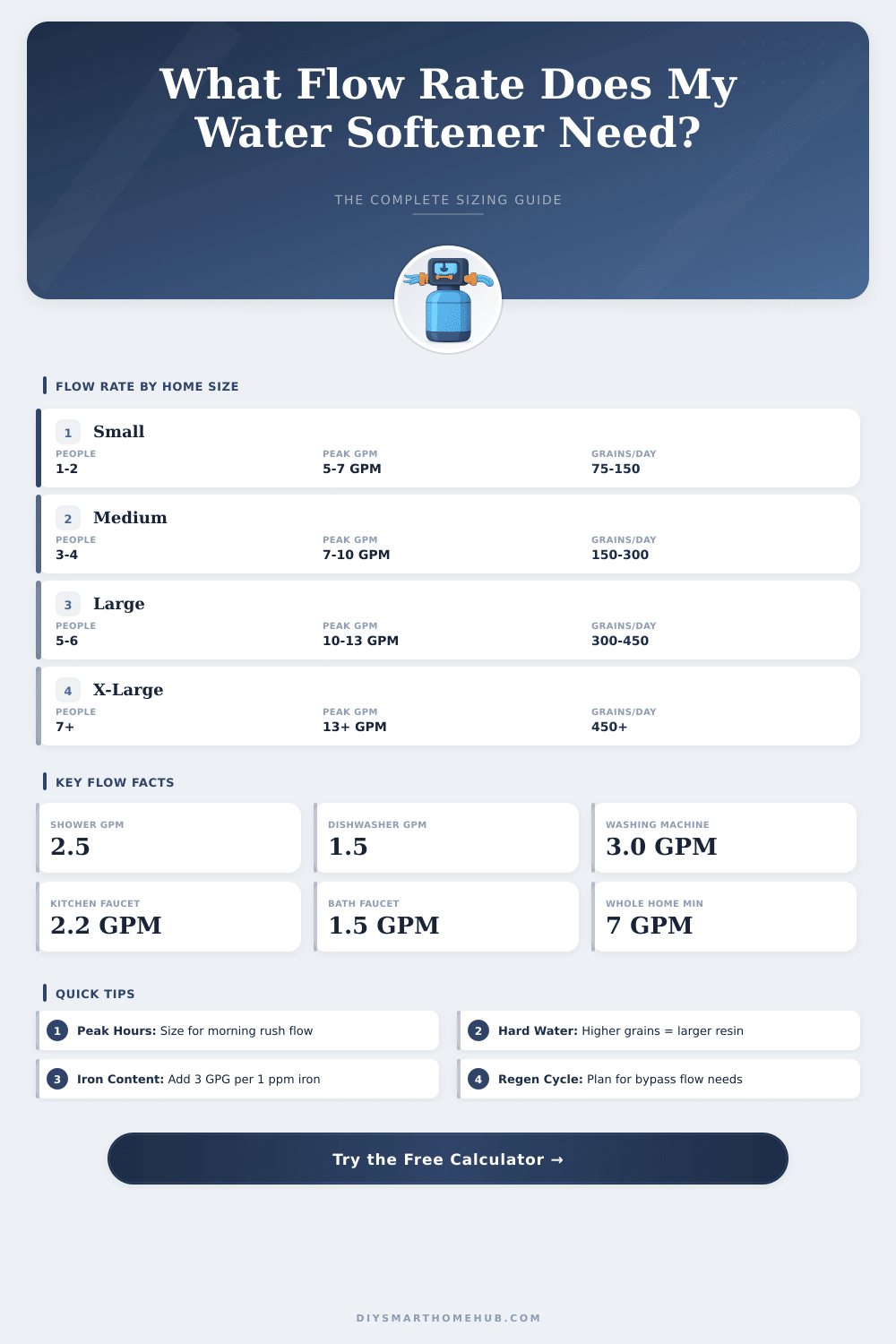
💧 Water Softener Flow Rate Calculator
Calculate the required GPM flow rate and grain capacity for your water softener system
| Hardness Level | Grains/Gallon (GPG) | mg/L (ppm) | Effect on System |
|---|---|---|---|
| Soft | 0 – 3.5 GPG | 0 – 60 mg/L | No softener typically needed |
| Slightly Hard | 3.5 – 7.0 GPG | 61 – 120 mg/L | Minor scale, softener optional |
| Moderately Hard | 7.0 – 10.5 GPG | 121 – 180 mg/L | Noticeable scale, recommend softener |
| Hard | 10.5 – 17.5 GPG | 181 – 300 mg/L | Significant scale buildup |
| Very Hard | 17.5 – 35 GPG | 301 – 600 mg/L | Severe scale, high-capacity resin needed |
| Extremely Hard | 35+ GPG | 600+ mg/L | Industrial-grade system required |
| Household Size | Avg GPD Used | Grains Removed/Day (15 GPG) | Recommended Capacity | Min Flow Rate |
|---|---|---|---|---|
| 1 Person | 75 gal | 1,125 gr/day | 24,000 grains | 5 – 7 GPM |
| 2 People | 150 gal | 2,250 gr/day | 32,000 grains | 7 – 9 GPM |
| 3 People | 225 gal | 3,375 gr/day | 40,000 grains | 8 – 10 GPM |
| 4 People | 300 gal | 4,500 gr/day | 48,000 grains | 10 – 12 GPM |
| 5 People | 375 gal | 5,625 gr/day | 64,000 grains | 11 – 13 GPM |
| 6 People | 450 gal | 6,750 gr/day | 64,000 grains | 13 – 15 GPM |
| 8+ People | 600+ gal | 9,000+ gr/day | 80,000+ grains | 15+ GPM |
| Resin Type | Best For | Capacity (gr/ft³) | Salt Efficiency | Lifespan |
|---|---|---|---|---|
| Standard Resin (8% DVB) | City water, average hardness | 20,000 – 32,000 | Good | 10 – 15 years |
| High-Efficiency (10% DVB) | Very hard water | 32,000 – 45,000 | Excellent | 12 – 20 years |
| Iron Fighter | Well water with iron | 20,000 – 28,000 | Moderate | 8 – 12 years |
| Fine Mesh | Turbid/well water | 20,000 – 30,000 | Good | 8 – 15 years |
| Salt-Free (TAC) | Scale prevention only | N/A (no regeneration) | No salt | 3 – 5 years (media) |
| Dual-Tank | Continuous soft water | 2x single tank | Good | 10 – 15 years |
| Iron Level (ppm) | Hardness Equivalent Added | Adjustment Needed | Resin Recommendation |
|---|---|---|---|
| 0 – 0.3 ppm | +0 – 2 GPG | Minimal | Standard resin OK |
| 0.3 – 1.0 ppm | +2 – 5 GPG | Moderate | Standard or Iron Fighter |
| 1.0 – 3.0 ppm | +5 – 15 GPG | Significant | Iron Fighter resin required |
| 3.0 – 5.0 ppm | +15 – 25 GPG | High | Iron filter + softener combo |
| 5.0+ ppm | +25+ GPG | Very High | Dedicated iron removal first |
Water softeners work by means of ion change. They remove calcium and magnesium from the water, replacing them by means of sodium ion, to give soft water. Hard water flows through mineral tank with bed from spherical resin beads from polystyrene, that you charge with sodium.
Those beads exchange calcium and magnesium against sodium, what softens the water well. Water goes upward by means of central tube in the tank and later pass through the valve head.
How Water Softeners Work and Why Flow Rate Is Important
Water softeners can be upflow or downflow. Downflow systems leave water go down; the service phase, when you actively soften, usually operate like this. Upflow systems push water upward, what helps during regeneration.
Then brine enter of the bottom part of the resin tank and flow upward through the bed. That type removes pollutants in the same direction as they arrived, so do not pollute the pure resin. Hard water then pushed of below through the resin bed upward.
The flow rate matter a lot. Home softeners for 7-10 GPM keeps the water pressure during peak usage times. You well choose one model with flow above the maximum family demand, commonly 10-12 GPM for big families.
The SpringWell SS reaches 20 GPM, during the Kenmore 350 with 32 000 grains preserve soft water and good pressure. Even so all softeners depress pressure according to the flow rate. Pipe diameter, for instance 3/4-inch against 1-inch, confine the maximum flow independently of capacity.
Water rich in minerals can create deposits in pipes, what slows flow and cause problem over time. Scale from hard water likewise reduces the flow.
The measure of water softener show flow in gallons each minute (GPM) during usage. It usually marks 2 until 4 GPM. Kitchen tap has type of around 2,2 GPM in 60 psi.
Some softeners show even under 1 GPM. A meter for water amount do not find very low flows, as those of RO units. RO systems have only 2-4 gallons each hour.