Heat Pump SEER Calculator
Estimate cooling load, watts per ton, full-load compressor draw, and seasonal energy use from either a recommended size or your installed heat pump capacity. Compare current and upgraded SEER or SEER2 ratings using climate, exposure, duct, and compressor profile adjustments.
Presets change the footprint, load intensity, climate hours, duct factor, and compressor profiles so you can test realistic SEER tradeoffs rather than a single static tonnage assumption.
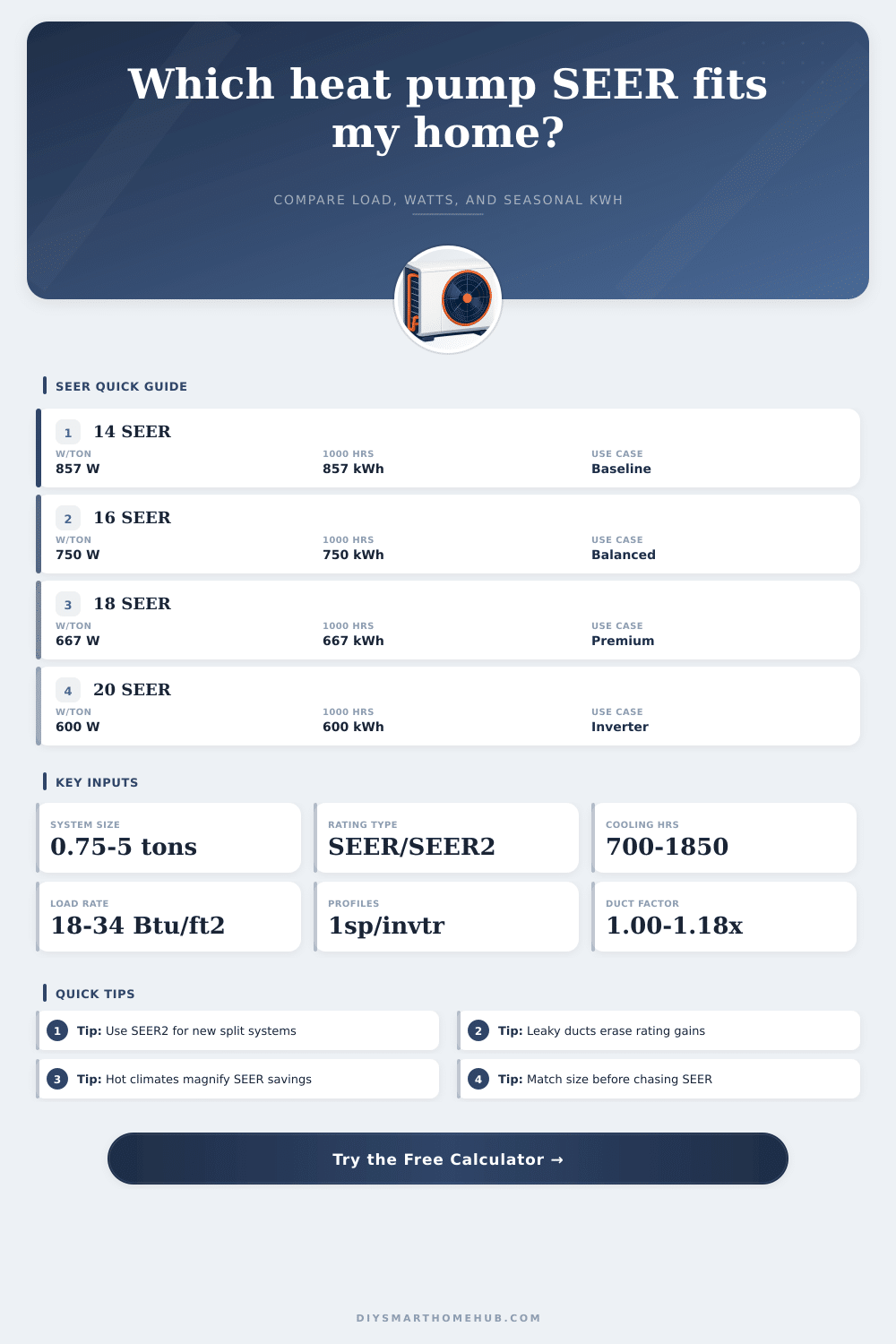
14 SEER
Common baseline for older replacements and minimum-efficiency comparisons in mild cooling markets.
16 SEER
A balanced upgrade band that trims energy use without jumping straight to premium variable-speed equipment.
18 SEER
Premium whole-home efficiency tier that often pairs with stronger humidity control and quieter part-load operation.
20 SEER
High-end inverter territory where longer runtime and reduced cycling can protect comfort in high-hour climates.
SEER2 Conversion
This calculator normalizes SEER2 back to an approximate legacy SEER basis so mixed-input comparisons stay consistent.
Duct Penalty
Leaky or hot ducts raise delivered load, so a strong SEER label cannot recover performance lost before air reaches rooms.
Profile Factor
Variable-speed systems usually hold lower seasonal kWh than same-rating single-stage units because they avoid hard cycling.
Cooling Hours
Equivalent full-load hours compress a season into one number, making climate-driven energy comparisons easier to test quickly.
| Rating Band | Approx W per Ton | 1000 Cooling Hours | Typical Fit |
|---|---|---|---|
| 14 SEER | 857 W | 857 kWh per ton | Baseline replacement or mild-climate comparison point |
| 15 to 16 SEER | 800 to 750 W | 800 to 750 kWh | Balanced efficiency step for average homes |
| 17 to 18 SEER | 706 to 667 W | 706 to 667 kWh | Premium ducted systems and stronger humidity control |
| 19 to 20 SEER | 632 to 600 W | 632 to 600 kWh | High-hour climates and variable-speed upgrades |
| Climate Profile | EFLH | Load Multiplier | Cooling Pattern |
|---|---|---|---|
| Mild coastal | 700 | 0.90x | Short cooling season with softer peak afternoons |
| Mixed suburban | 950 | 1.00x | Balanced spring-through-fall cooling demand |
| Warm humid | 1200 | 1.08x | Longer run time and stronger latent load |
| Hot inland | 1450 | 1.15x | Higher design load and sustained peak days |
| Desert sunbelt | 1650 | 1.12x | Very long cooling season with dry solar-heavy peaks |
| Tropical | 1850 | 1.18x | Nearly year-round cooling and humidity management |
| Scenario | Area | Estimated Load | Comfort-Oriented Upgrade Target |
|---|---|---|---|
| Condo or townhome | 700 to 1100 sq ft | 1.0 to 1.8 tons | 15 to 17 SEER for moderate-hour zones |
| Average ranch | 1500 to 2100 sq ft | 2.5 to 3.5 tons | 16 to 18 SEER with sealed ducts |
| Two-story sunny home | 2200 to 3000 sq ft | 3.5 to 5.0 tons | 18+ SEER where runtime is long |
| Room addition or zone | 250 to 600 sq ft | 0.75 to 1.5 tons | 18 to 22 SEER mini-split range |
If the installed tonnage is far above the estimated load, cycling losses can shrink real-world gains. The size check in the breakdown helps keep the SEER comparison honest.
In hot climates, every extra load multiplier compounds over more cooling hours. That is why sealing attic ducts often improves seasonal performance as much as chasing a slightly higher rating.
Approximation note: SEER2 normalization uses a simple 0.95 conversion. Exact field performance still depends on airflow, charge, duct static, and thermostat behavior.
SEER rates help to guess the yearly energy efficiency. You use them to compare efficiency between different items. SEER counts the cooling skill of heat pumps with air-source and central air conditioners.
In heat pumps higher SEER number shows better efficiency of the item. The rate matches the cooling energy of a heat pump during typical summer season, divided by the total electricity used then. Even if you replace a gas heater by means of a heat pump mainly for heating, the SEER rating stays important.
What SEER and SEER2 Tell You About Heat Pump Efficiency
Because heat pumps usually fan warm air, SEER directly guesses electrical costs.
The SEER2 is a little other measure. It takes the total heat removed from tested room during yearly cooling season, in Btu, divided by the used electricity in watt-hours. The new SEER2 uses fresh M1 procedure for the blower.
This last change copies real conditions more well, because it raises the static pressure in the laboratory from 0.1” w.g. To 0.5” w.g., at least five times more a lot. New test methods so raises the lowest efficiency that you require for coolers and heaters.
Efficiency does not limit to SEER. HSPF rates value the yearly heat efficiency. SEER takes the share of cooling energy to electricity input, HSPF likewise for heating energy.
In warm areas matters high SEER, while in cold areas better high HSPF. For good efficiency choose items with ENERGY STAR® approval. Your conditions sometimes vary from official tests, so real impact can go over, fall under or match the guessed SEER2 or HSPF2 values.
Here is the cause: heat pumps are made of modular parts inside and outside.
In United States the lowest installable SEER today is 13. From 2023 DOE will need minimum of 14-15 SEER. Heat pumps will not be touched, but after 2023 will limit choices for refill.
Heat pumps go over gas heating well until outside temperature of 35°F. Under that limit the pump usually stops to heat or fail, this way running a gas heater. Some models have outside sensor, that turns the compressor and start the furnace, if the heat falls a lot under thermostat value. It repeats that until three times, then lock the heat pump.