💧 Water Softener Flow Rate Calculator
Calculate the required GPM flow rate and grain capacity for your water softener system
| Classification | Grains/Gallon (GPG) | mg/L (ppm) | Recommended Softener |
|---|---|---|---|
| Soft | 0 – 1 GPG | 0 – 17 mg/L | Not required |
| Slightly Hard | 1 – 3.5 GPG | 17 – 60 mg/L | Optional |
| Moderately Hard | 3.5 – 7 GPG | 60 – 120 mg/L | Recommended |
| Hard | 7 – 10.5 GPG | 120 – 180 mg/L | Strongly Recommended |
| Very Hard | 10.5 – 14 GPG | 180 – 240 mg/L | Required |
| Extremely Hard | 14+ GPG | 240+ mg/L | High-capacity Required |
| Household Size | Peak GPM Needed | Min. Capacity (grains) | Recommended Tank |
|---|---|---|---|
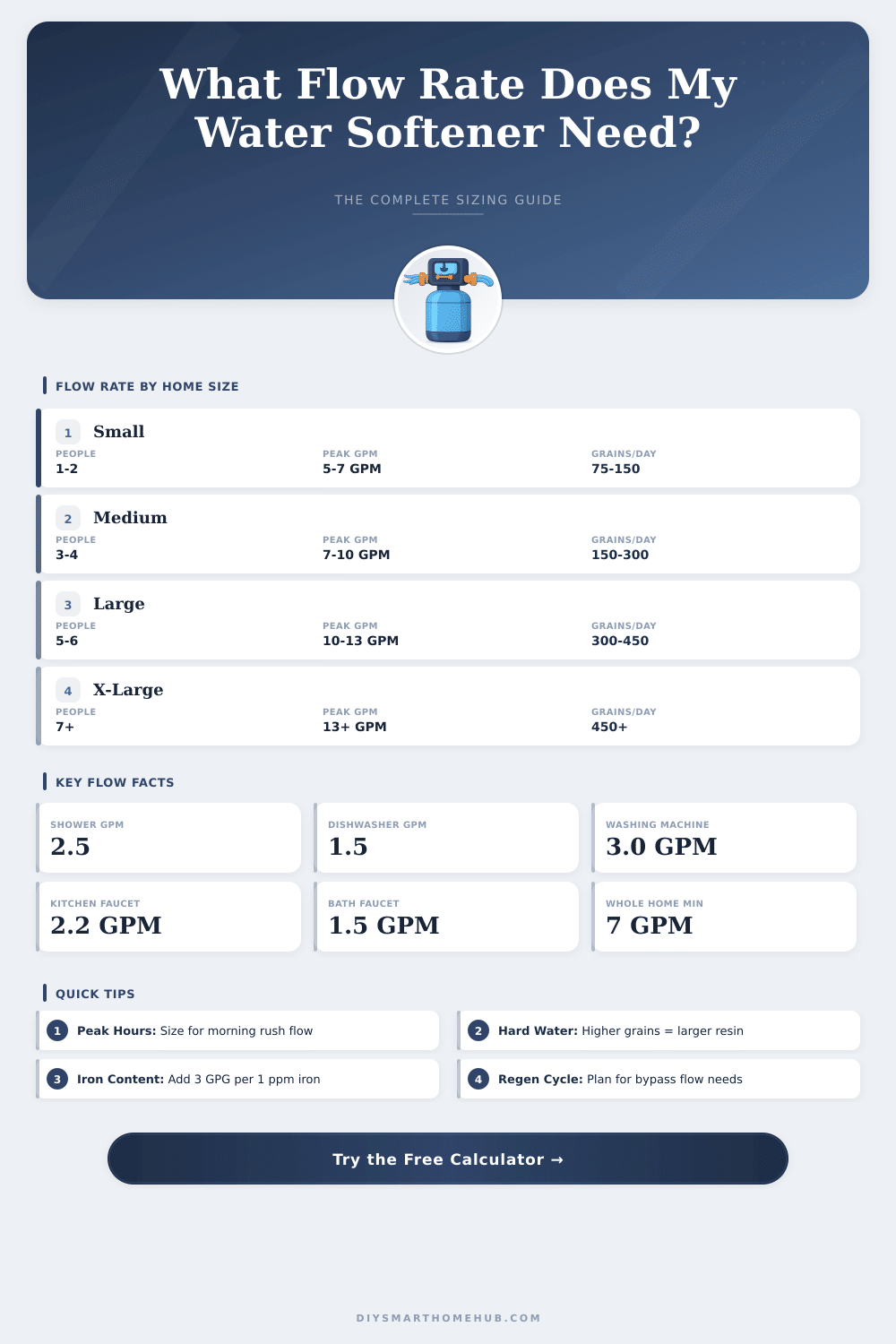
| 1 – 2 people | 5 – 7 GPM | 24,000 grains | 0.75 cu ft resin |
| 3 – 4 people | 7 – 10 GPM | 32,000 grains | 1.0 cu ft resin |
| 5 – 6 people | 10 – 13 GPM | 48,000 grains | 1.5 cu ft resin |
| 7 – 8 people | 12 – 15 GPM | 64,000 grains | 2.0 cu ft resin |
| 9+ / Commercial | 15+ GPM | 80,000+ grains | 2.5+ cu ft resin |
| Resin Volume | Grain Capacity | Salt Per Regen (lbs) | Salt Per Regen (kg) |
|---|---|---|---|
| 0.75 cu ft | ~24,000 grains | 6 – 8 lbs | 2.7 – 3.6 kg |
| 1.0 cu ft | ~32,000 grains | 8 – 10 lbs | 3.6 – 4.5 kg |
| 1.5 cu ft | ~48,000 grains | 12 – 15 lbs | 5.4 – 6.8 kg |
| 2.0 cu ft | ~64,000 grains | 16 – 20 lbs | 7.3 – 9.1 kg |
| 2.5 cu ft | ~80,000 grains | 20 – 25 lbs | 9.1 – 11.3 kg |
Water softeners work by stopping mineral buildup in plumbing systems. They do that by means of ion exchange. Minerals like calcium and magnesium exchange themselves with sodium what results in soft water.
Water rich in minerals can cause buildup in tubes. That accumulation slows the water flow and lowers the pressure over time. Deposits from hard water also reduce the flow expand the energy use and grow the need for repair.
How Water Softeners Work
They create scale on taps showerheads tubes and devices.
When hard water enters the mineral tank it passes through a bed from spherical resin beads. Those plastic beads usually are made up of polystyrene and bear sodium ions. They exchange calcium and magnesium against sodium.
During the service cycle when the device actively softens water the process happens downflow. Then water flows down. In upflow systems water is pushed upward.
During regeneration upflow advantages show. Brine enters of the bottom of the resin tank and passes upward through the resin bed. This regeneration method drives pollutants in the same direction as they arrived so that they do not pollute the pure resin.
Flow rate is important element. Most many households that superbly handles 7-10 GPM preserve the water pressure during peak use hours. For bigger families maybe require flow rate over the maximum need usually 10-12 GPM.
That ensures permanent softness of water during periods of high demand for instance while showering. SpringWellSS devices reach 20 GPM flow rate. Kitchen faucet normally has around 2.2 GPM in 60 psi.
Troubles do cause pressure drop regarding the flow rate. The diameter of the piping as 3/4″ or 1″ limits the maximum flow regardless of the capacity of the softener.
Many softeners carry bypass valve. It leaves water access to taps during the system refresh its resin beads by means of salt. Without backup stored soft water for usage during regeneration hard water passes through the bypass in the household water network until the process end and the unit reconnects.
Some portable water softeners operate similarly leaving water flow over resin beads. RV softener use average hose connections for fast installation between the water supply and the city water inlet of the vehicle. Water passes through ion exchange that substitutes magnesium and calcium ions by means of sodium ions.