💧 Heat Pump Water Heater Calculator
Find the right tank size & first hour rating for your household
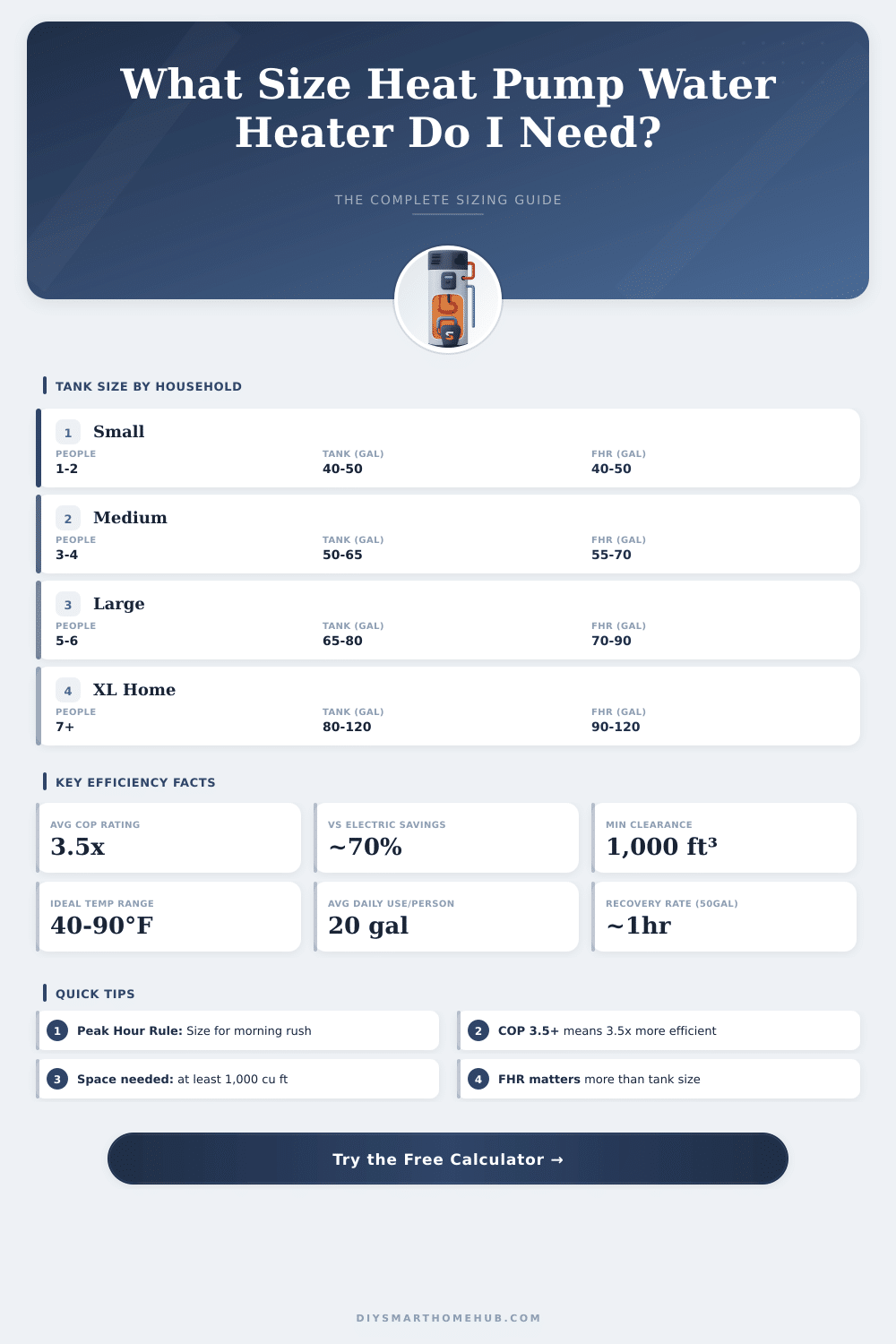
| Household Size | People | Rec. Tank (gal) | Rec. Tank (L) | Min FHR (gal) | UEF Range |
|---|---|---|---|---|---|
| Studio / Solo | 1 | 40 gal | 151 L | 40 | 3.5–4.0 |
| Couple | 2 | 40–50 gal | 151–189 L | 50 | 3.5–4.0 |
| Small Family | 3–4 | 50–65 gal | 189–246 L | 60 | 3.3–3.8 |
| Family | 4–5 | 65–80 gal | 246–303 L | 75 | 3.2–3.7 |
| Large Family | 5–6 | 80 gal | 303 L | 90 | 3.1–3.5 |
| Extra Large | 6+ | 80+ gal / 2 units | 303+ L | 100+ | 3.0–3.5 |
| Fixture / Activity | Gal per Use (US) | Liters per Use | Gal per Day (avg) | FHR Contribution |
|---|---|---|---|---|
| Standard Shower (8 min) | 16 gal | 60 L | 16 gal | High |
| Low-Flow Shower (8 min) | 10 gal | 38 L | 10 gal | Moderate |
| Standard Bathtub Fill | 36 gal | 136 L | varies | Very High |
| Soaking Tub Fill | 60 gal | 227 L | varies | Extreme |
| Dishwasher (per cycle) | 6 gal | 23 L | 6 gal | Low–Moderate |
| Clothes Washer (hot) | 25 gal | 95 L | varies | High |
| Hand Washing (per min) | 2 gal | 7.5 L | 4–6 gal | Low |
| Kitchen Sink (per min) | 2 gal | 7.5 L | 3–5 gal | Low |
| Ambient Temp (°F) | Ambient Temp (°C) | Typical COP | Efficiency vs. Resistance | Notes |
|---|---|---|---|---|
| 40°F | 4°C | 1.5–2.0 | ~150–200% | Near lower limit; aux heat kicks in |
| 50°F | 10°C | 2.0–2.5 | ~200–250% | Below optimal; still efficient |
| 60°F | 16°C | 2.8–3.2 | ~280–320% | Good efficiency range |
| 70°F | 21°C | 3.3–3.7 | ~330–370% | Optimal operating temp |
| 80°F | 27°C | 3.5–4.0 | ~350–400% | Peak efficiency; ideal |
| 90°F | 32°C | 3.5–4.0 | ~350–400% | Near upper limit; still efficient |
| 95°F+ | 35°C+ | Drops | Reduced | Above recommended max |
| Project Scenario | People | Tank Size | FHR Needed | Recommended Mode |
|---|---|---|---|---|
| Studio Apartment | 1 | 40 gal / 151 L | 40 gal | Heat Pump Only |
| 2-BR Apartment / ADU | 2 | 40–50 gal | 50 gal | Heat Pump Only |
| 3-BR Family Home | 3–4 | 50–65 gal | 60–65 gal | Hybrid / Auto |
| 4-BR Family Home | 4–5 | 65–80 gal | 75 gal | Hybrid / Auto |
| 5-BR / Large Home | 5–6 | 80 gal | 85–90 gal | Hybrid / Auto |
| Very Large Home / Tub | 6+ | 80 gal + aux or 2 units | 100+ gal | Electric Backup |
| Vacation Cabin | 2–4 | 40–50 gal | 50 gal | Heat Pump Only |
Heat pump water heaters are often called Hybrid Electric water heaters. They have the same high efficiency although the name is different. These units look like average water heaters but they draw heat from the surrounding air.
Like this they use fewer energy for heat. Heat pumps operate like refrigerators in reverse. A refrigerator draws heat from the inside and sends it into the room while a stand-alone air-source heat pump water heater pulls heat from the surrounding air.
How Heat Pump Water Heaters Work
It then transfers that heat at a higher temperature to heat the water in the reservoir.
You can buy a stand-alone heat pump water heating system as a single device. Such units have a built-in water reservoir and back-up resistance heating elements. Most heat pump water heaters are hybrids with a traditional mode.
You can set the device to operate as a regular electric water heater. In that mode it does not draw heat from the room so it is less efficient but more comfortable during cool weather. The electrical elements can also work together with the pump in hybrid mode.
Here the pump works until a certain amount of hot water is used.
Many models are available for find energy efficiency. You can explore variants with WiFi-connection leak detection and glass-lined reservoirs. Some units as the A.O.
Smith Signature Series heat water extremely effectively. Other brands as Rheem offer advanced environmental solutions. The upfront cost depends on several factors also the unit you buy the brand the size how long installation takes and potential supports you qualify for.
Heat pump water heaters cost between $1,200 for 50-gallon reservoirs and $2,500 for 80-gallon reservoirs from sophisticated manufacturers. They have up to four times more efficiency than standard water heaters. They emit none locally and generate fewer greenhouse gases.
Using a heat pump can give free cooling in the summer and dehumidification during the whole year.
One side-effect of these systems is condensate. Because of that you need a drain line to a floor drain or to the outside. A condensate pump helps if there is no sump.
It is important to know that a heat pump requires enough free air at temperatures above freezing to operate. If it gets too cold the device does not work well. Under 45 degrees the pump can not work.
Some folks even find that if the unit runs always and only to keep the air warm it consumes more energy.