Heat Pump Water Heater Calculator
Estimate peak-hour demand, compare it with first-hour rating, check bedroom-and-bathroom tank guidance, and model daily heat pump water heater energy use from real inlet and room temperatures.
📌Preset Homes
Loaded preset: 4-Bed Busy Household with four peak-hour showers, one dishwasher cycle, and a 66-gallon family hybrid profile.
⚙Household and HPWH Inputs
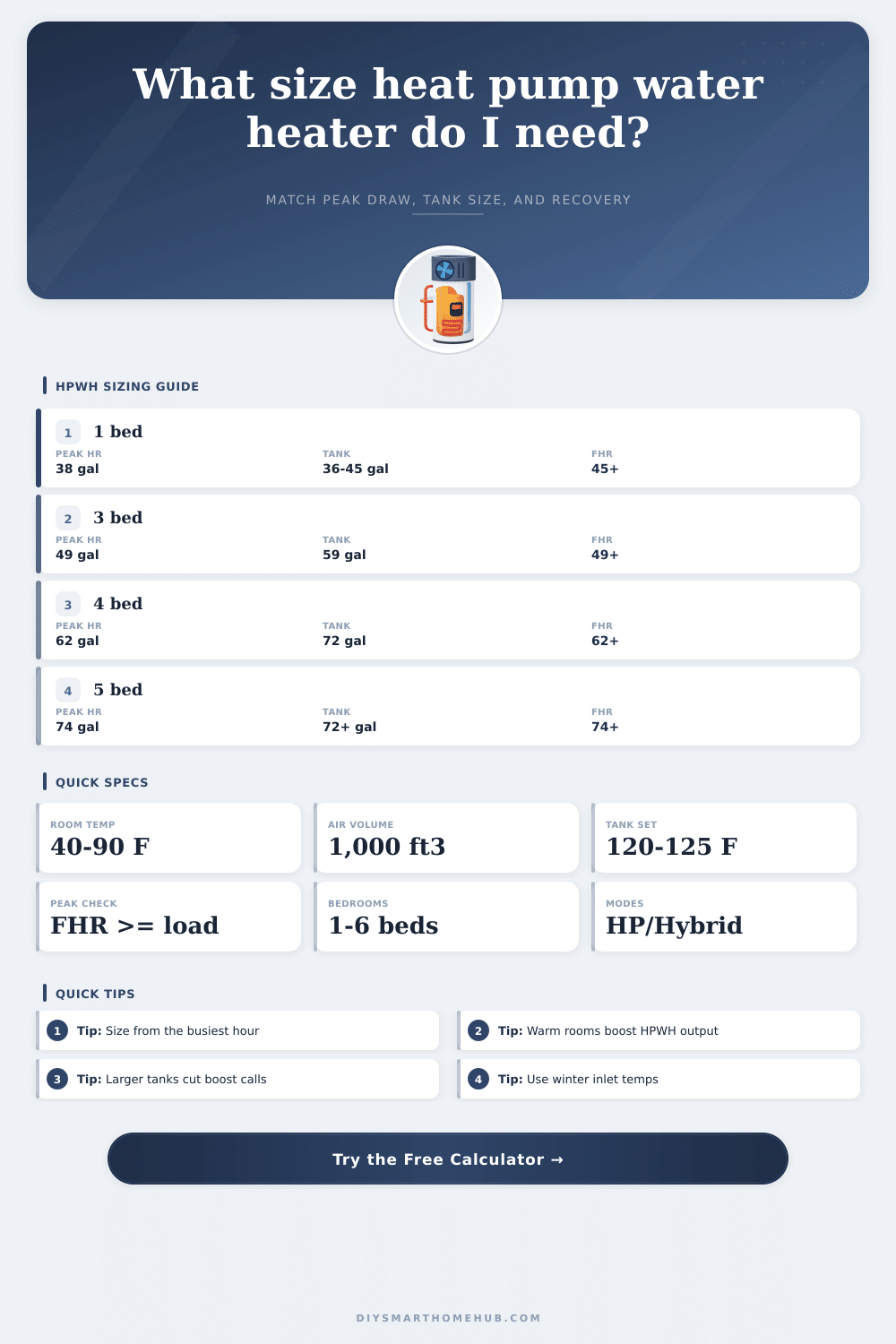
Sizing logic follows DOE guidance: the selected heat pump water heater should have a first-hour rating at least as high as your busiest one-hour draw, while tank volume is cross-checked against bedroom-and-bathroom guidance published for ENERGY STAR NextGen homes.
📊Heat Pump Water Heater Results
🔧Reference Model Classes
📋Tank, Ambient, and Mode References
| Home layout | Bedrooms | Min tank | Target FHR |
|---|---|---|---|
| 1 to 1.5 baths | 1 / 2 / 3 | 36 / 45 / 59 gal | 38 / 49 / 49 gal |
| 2 to 2.5 baths | 2 / 3 / 4 / 5 | 45 / 59 / 72 / 72 gal | 49 / 62 / 62 / 74 gal |
| 3 to 3.5 baths | 3 / 4 / 5 / 6 | 59 / 72 / 72 / 72 gal | 62 / 74 / 74 / 74 gal |
| High-draw note | Any | Upsize one class | Teen showers or baths |
| Room band | Effect | UEF factor | Use case |
|---|---|---|---|
| Below 40°F | Compressor risk | 0.70 | Expect boost or lockout |
| 40 to 49°F | Cold room | 0.78 | Garage winter edge |
| 50 to 59°F | Cool utility | 0.88 | Basement shoulder season |
| 60 to 79°F | Best operating zone | 0.96 to 1.00 | Conditioned or mild space |
| 80 to 90°F | Warm room | 0.97 | Good output, watch comfort |
| Mode | FHR factor | UEF factor | Best fit |
|---|---|---|---|
| Heat Pump Only | 0.92 | 1.00 | Low to moderate peaks with maximum efficiency |
| Hybrid | 1.00 | 0.94 | Balanced mode for most households |
| High Demand | 1.10 | 0.82 | Back-to-back showers and tub events |
| Efficiency Priority | 0.96 | 1.03 | Best when larger storage already covers peaks |
📊Common Home Scenarios
| Scenario | Peak hr | Suggested tank | Typical class |
|---|---|---|---|
| 1-bed condo | 38 gal | 36 to 45 gal | 50-gal plug-in |
| 3-bed family | 49 to 62 gal | 59 gal | 53 or 66-gal hybrid |
| 4-bed busy home | 62 gal | 72 gal | 66-gal family hybrid |
| Teen shower stack | 74+ gal | 72 to 80 gal | 80-gal storage class |
| Cold basement split | 46 to 60 gal | 65 gal | Low-ambient split |
💡HPWH Planning Notes
Tip 1: size the busiest hour first
A heat pump water heater can look efficient on daily gallons but still feel undersized if the first-hour rating falls below the real shower-and-dish peak.
Tip 2: bigger storage can beat higher mode
Moving from a 59-gallon class to a 72- or 80-gallon class often reduces resistance boost events more effectively than running High Demand every day.
Heat pump water heaters are also commonly called hybrid electric water heaters. They are just different names for the same ultra-efficient device. Normal water heaters make heat self but these units do not.
Instead a stand-alone air-source heat pump water heater takes heat from the air around it and changes it at a higher temperature to heat water in the tank. The process works like a refrigerator in reverse. So the technology gets up to four times bigger efficiency than standard water heaters.
How a Heat Pump Water Heater Works
As a group they are two to three times more energy-saving than common electric models.
You can buy heat pump water heaters as complete units with built-in tanks and helpful resistance heating elements. Those electric parts let you use the device as a normal electric water heater. They also work with the heat pump in hybrid rule.
Here the pump works until some amount of warm water is used. Most of those water heaters are hybrids with traditional rule. So you can set it so that it heats as a usual electric model without take heat from the room.
That mode works less but feels better while very cold days.
The first cost of a heat pump water heater depends on several reasons as the bought unit how long installation takes and available help. Size and brand affects the price. They cost $1,200 for 50-gallon tanks to $2,500 for 80-gallon models of biggest producers.
You find models with energy-saving features included WiFi connection leak detection and glass-lined tanks.
Install the unit needs a bit of work because warm and cold lines must separate vertically. It produces condensate so a drain line to a floor drain or the outside is needed. A condensate pump helps if there is no cellar.
In some climates the heat pump is useful because it gives warm water for wash and cool air for helpful natural cooling. Also it dehumidifies during the whole year and cools freely sumer.