Solar Water Heater Calculator
Model daily solar heat, solar fraction, solar-heated gallons, and backup heater load from real household demand, collector type, roof access, and storage volume.
☀ Preset Solar Scenarios
Each preset changes demand, sun, collector family, storage size, and access so you can test realistic domestic hot water layouts instead of generic placeholder cases.
🔧 Specific Inputs
These inputs drive the thermal load, collector capture, loop losses, tank matching, and remaining backup demand.
Useful solar heat, solar share, heated gallons, and backup demand update together as collector and storage choices change.
Detailed Breakdown
💻 Device and Spec Grid
These cards combine the selected collector family data with your current layout so the output is easier to interpret.
📊 Reference Tables
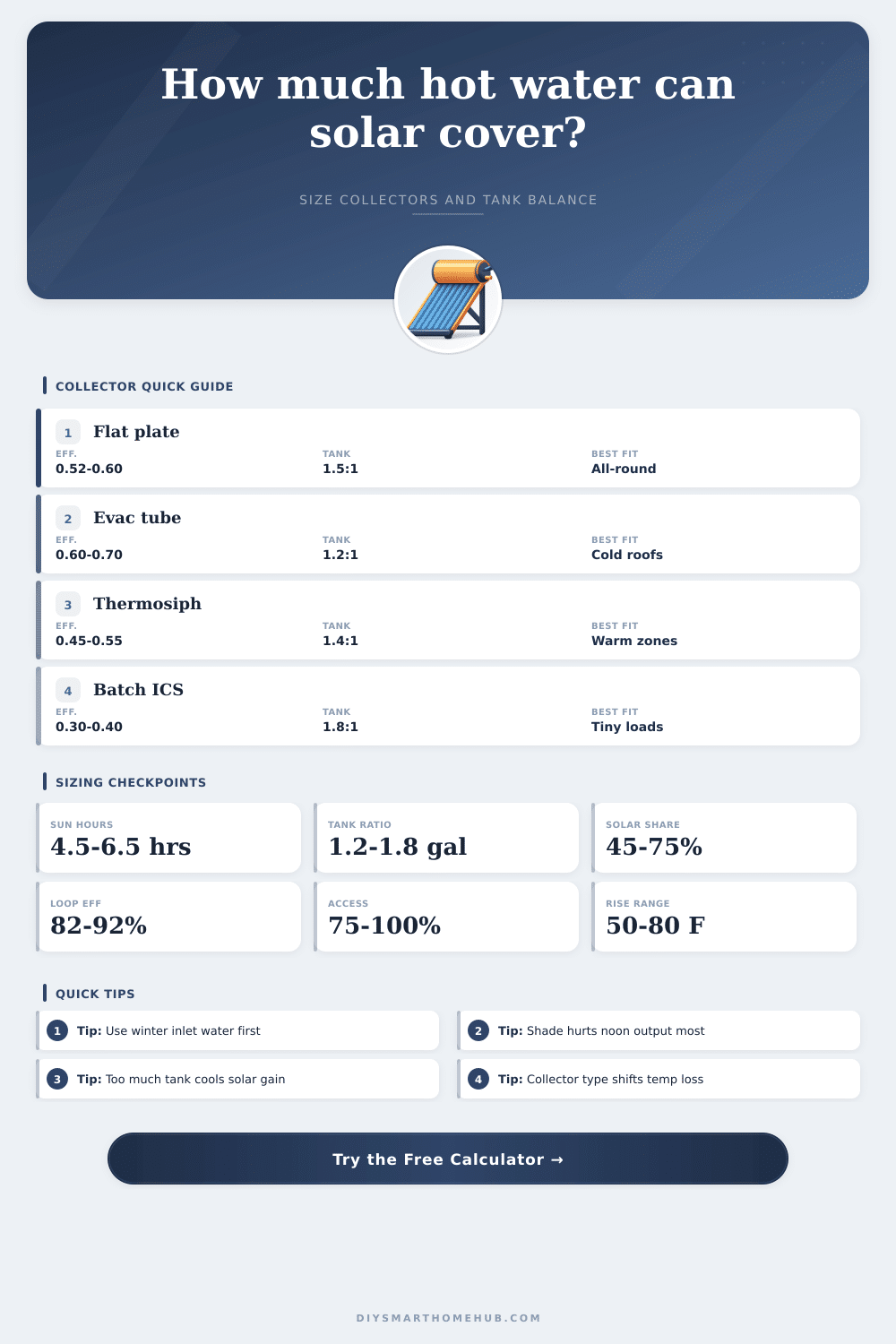
Use these tables to sanity-check collector family, sun quality, hot water demand, and storage sizing before you lock in the design.
| Collector Type | Useful Eff. | Freeze Strategy | Best Fit |
|---|---|---|---|
| Selective flat plate | 0.58 | Closed loop glycol | Balanced all-season retrofit |
| Drain-back flat plate | 0.54 | Auto-drain collector | Freeze-prone roofs with simple controls |
| Evacuated tube | 0.66 | Closed loop glycol | Cold climates and high temperature lift |
| Thermosiphon package | 0.50 | Integral passive loop | Warm climates with short pipe runs |
| Batch ICS | 0.36 | Integral collector storage | Low draw seasonal or mild climates |
| Polymer glazed | 0.45 | Drainable polymer path | Moderate climates and preheat duty |
| Peak Sun Hours | Climate Signal | Collector Feel | Design Note |
|---|---|---|---|
| 3.5-4.2 | Cloudy or northern | Tube arrays help | Protect winter performance with better lift |
| 4.3-5.0 | Mixed shoulder climate | Flat plates fit well | Collector area matters more than extreme storage |
| 5.1-5.8 | Strong annual solar | Most families size well | Good roofs can target the higher solar fraction band |
| 5.9-6.8 | Sunny arid climate | Overheat control matters | Do not oversize storage without use to match |
| Household Pattern | Daily Draw | Collector Area | Storage Tank |
|---|---|---|---|
| Couple or cottage | 25-35 gal/day | 30-40 sq ft | 50-60 gal |
| Small family | 40-55 gal/day | 40-60 sq ft | 70-90 gal |
| Busy family home | 55-75 gal/day | 55-75 sq ft | 80-120 gal |
| High demand multi-bath | 75-95 gal/day | 70-95 sq ft | 100-140 gal |
| Tank Ratio | What It Means | Solar Behavior | Adjustment |
|---|---|---|---|
| Under 1.1 gal/sq ft | Tank is small for collector field | Fast midday rise and possible dump heat | Increase storage or trim collector area |
| 1.2-1.8 gal/sq ft | Balanced domestic sizing | Good daytime charge and evening carryover | Keep current range if draw matches design |
| 1.9-2.3 gal/sq ft | Large storage bias | More carryover but slower full tank temperature | Works well for mild climates and steady use |
| Over 2.3 gal/sq ft | Oversized tank | Collector spends more time chasing tank mass | Reduce tank or add more collector area |
💡 Practical Tip Boxes
Hot water systems sized only from summer inlet temperatures often look stronger than they really are. Winter inlet water quickly reveals whether collector area or the tank ratio is the real bottleneck.
If the collector field is already large but storage is small, adding more area can create midday excess without improving evening coverage. Fix storage balance before expanding the roof array.
Solar water heaters employ sunshine for warm water used in homes, pools or heating on floor. They are made up of simple tools that seize sunshine for warm the water. Rather than usual water heaters that depend on electricity, solar warm system with panels on roof gathers sun energy and deliver warm water to the house.
Folks commonly mix solar water heaters with solar panels for electrical energy. Rather than those that generates electricity, all collectors seize thermal energy from the sun for produce warm water required in homes, offices and businesses.
How Solar Water Heaters Work
Are various kinds of such systems. You can estimate solar water heaters according to flat plates or evacuated tubes. Collectors with evacuated tubes operate by means of thermosyphon and require no pump.
Vacuum tubes are the most efficient. Systems with handle for collector, known also as ICS or compact, carry one or several black tanks in isolated glazed box. Here cold water first passes through the collector for preheat it, later go to the usual backup water heater for ensure permanent warm water.
The Sunbank of 40 gallons are full passive solar water heating system. It installs easily, operate well and cost little. It answers for many usages, since domestic interior or exterior use until commercial needs of warm water.
Because it works with town pressure, the Sunbank do not have glycol, pump nor moving parts, so it requires almost no care. Moreover it is thermally efficient, because absorb between 92% and 96% of the sun radiation, to that it is exposed.
Using sun power for warm water you helps the nature during camping. Solar water heaters you can apply for camping, together with other methods as camp stoves either campfires. Some uses solar shower bags or home-made solar solutions as eco-friendly ways exploit sun energy for warm water without electricity.
Complete solar water heater kits come with all parts for show system on house or shed. They bind directly to the already existing heater and do not bother the usual heat source, whether gas whether electricity.