Propane vs Electric Water Heater Calculator
Compare annual input energy, first-hour delivery, recovery speed, and service demand for selected propane and electric water heater types using your actual hot-water load.
📌 Household Presets
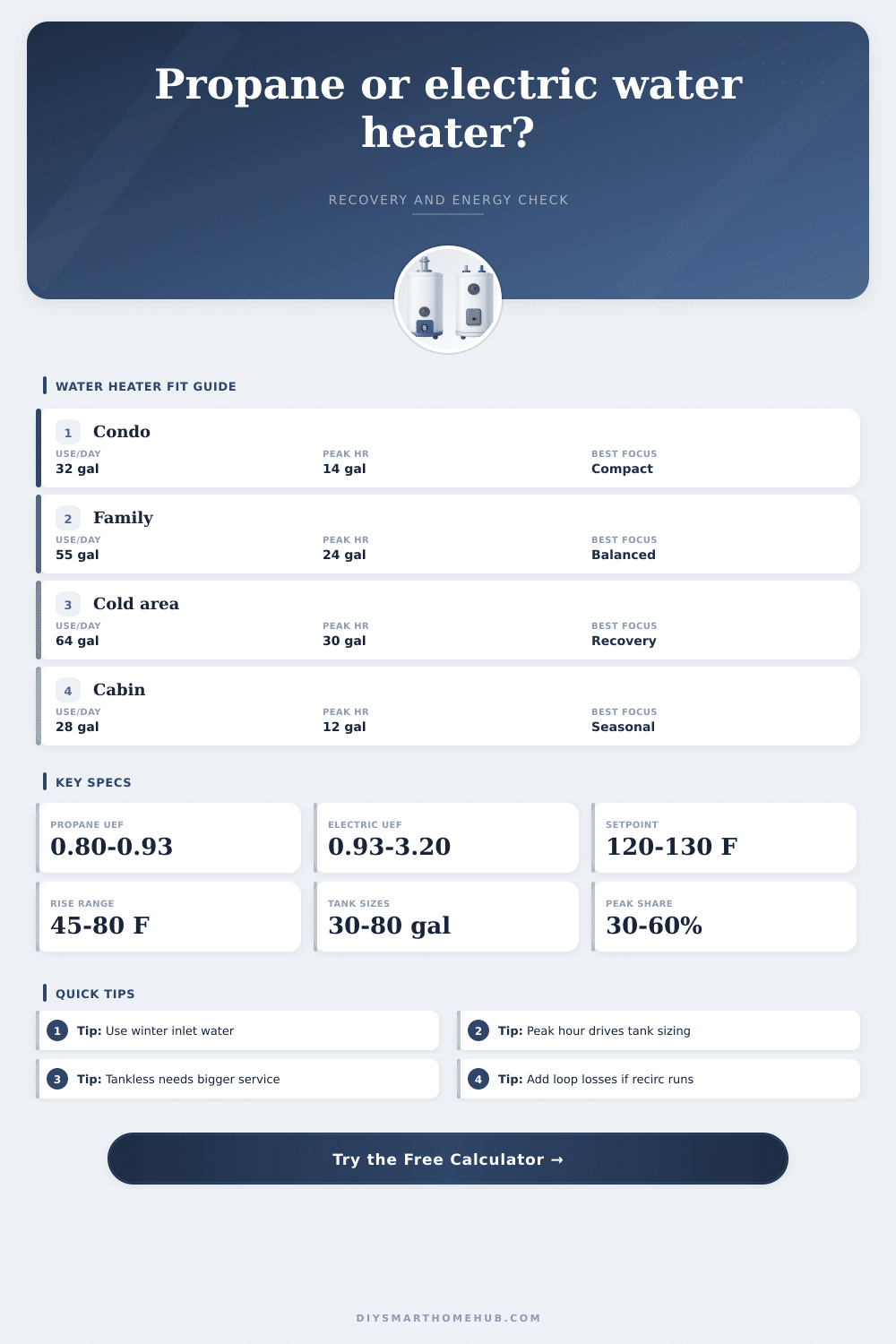
Each preset loads realistic draw, temperature rise, storage, and recovery assumptions so you can compare propane and electric water heaters under common residential usage patterns.
⚙ Comparison Inputs
Delivered hot-water load is calculated from water volume, temperature rise, and use days. The comparison then adds selected piping and standby losses before dividing by each system's UEF.
📊 Comparison Results
Comparison Breakdown
🔍 Selected System Spec Grid
📑 Reference Tables
Estimated Inlet Water and Temperature Rise
| Climate band | Inlet water | Rise to 105°F | Sizing note |
|---|---|---|---|
| Warm coastal | 62–68°F | 37–43°F | Storage carries farther |
| Mixed climate | 50–58°F | 47–55°F | Typical sizing baseline |
| Cold climate | 40–48°F | 57–65°F | Recovery matters more |
| Very cold well water | 35–40°F | 65–70°F | Expect larger first-hour loads |
Propane and Electric Heater Profiles
| Type | UEF | Typical input | Best fit |
|---|---|---|---|
| Standard propane tank | 0.80 | 36,000 BTU/h | Simple vented tank replacement |
| Power-vent propane tank | 0.84 | 45,000 BTU/h | Faster recovery with storage |
| High-recovery propane tank | 0.86 | 65,000 BTU/h | Large family demand peaks |
| Condensing propane tankless | 0.93 | 180,000 BTU/h | Big peak flow with no stored volume |
| Resistance electric tank | 0.93 | 4.5 kW | Straightforward electric replacement |
| High-output electric tank | 0.95 | 5.5 kW | Stronger storage recovery |
| Hybrid heat pump tank | 3.20 | 0.8 kW heat pump | Lowest annual site energy |
| Whole-home electric tankless | 0.98 | 24 kW | No tank, heavy service demand |
Typical Daily Hot-Water Draw Benchmarks
| Usage pattern | Daily draw | Metric draw | Common match |
|---|---|---|---|
| Single occupant | 20–28 gal | 76–106 L | 30–40 gal tank |
| Couple or condo | 30–40 gal | 114–151 L | 40–50 gal tank |
| Family of 3–4 | 45–60 gal | 170–227 L | 50–65 gal storage |
| Busy multi-bath home | 60–80 gal | 227–303 L | High recovery or tankless |
Peak-Hour Targets for First-Hour Delivery
| Morning peak | Suggested FHR | Tank size guide | Tankless note |
|---|---|---|---|
| 12–18 gal | 25–35 gal | 30–40 gal | Usually one shower plus sink |
| 18–26 gal | 40–55 gal | 40–50 gal | Typical condo or starter home |
| 26–35 gal | 55–75 gal | 50–65 gal | Consider propane high recovery |
| 35+ gal | 75+ gal | 65–80 gal or tankless | Verify flow and service limits |
Reference values are typical residential planning numbers. Final equipment selection should match measured inlet water temperature, actual fixture counts, and the first-hour demand your household creates.
💡 Calculator Tips
Propane and electric water heaters offer different ways to get warm water for homes and RV adventures. Many RV water heaters are hybrid types that operates by means of propane and electricity. Those devices work on propane, electricity or even both together.
Using both simultaneously give faster heat for back showers. Some instruction books advise to use gas and electric mode together for faster heating. Some models have internal switch or one control icon for both functions.
Propane vs Electric Water Heaters for RVs and Homes
Occasionally are also switch behind access panel.
Propane tankless water heaters deliver infinite amount of warm water. They fit to above 200 gallons in hour. Rather, normal 50-gallon electric storage tank water heater have only 64 gallons for the first hour.
Propane well heat water and help during power outage, because it operates with generator. Electric water heaters depend of electricity for work. Even tankless electric versions require much energy.
True tankless electric models commonly require more than typical RV 30-amp hookups can give. Whole house electric tankless models require 150 amps in 240 volts for 7.5 gallons in minute.
Propane heaters heat more quickly. Propane heat water in 20 until 30 minutes, during electric commonly must hour or more. Normal propane storage tank water heater operate effectively more than electric storage tank.
Even so, electric storage tank can be less cost than propane. Whether one or another depends of local energy prices. Propane commonly cost less for BTU.
Many users reckon that propane are much more fast and warm than electric.
Have many portable options for camping and outdoor stay. Some sets carry durable and cheap portable water heaters, as tankless either little tanks. Some propane portable devices have digital screens and several safe functions.
They answer for cabins, boats or camping. Some models use 12V DC for lighting and 120V AC for electricity. Other portable types work without mainstream energy by means of batteries for automatic lighting.