Tankless vs Tank Water Heater Calculator
Compare simultaneous flow support, storage recovery, standby loss, and annual input energy using real temperature-rise and first-hour-delivery math for the exact heater classes you are considering.
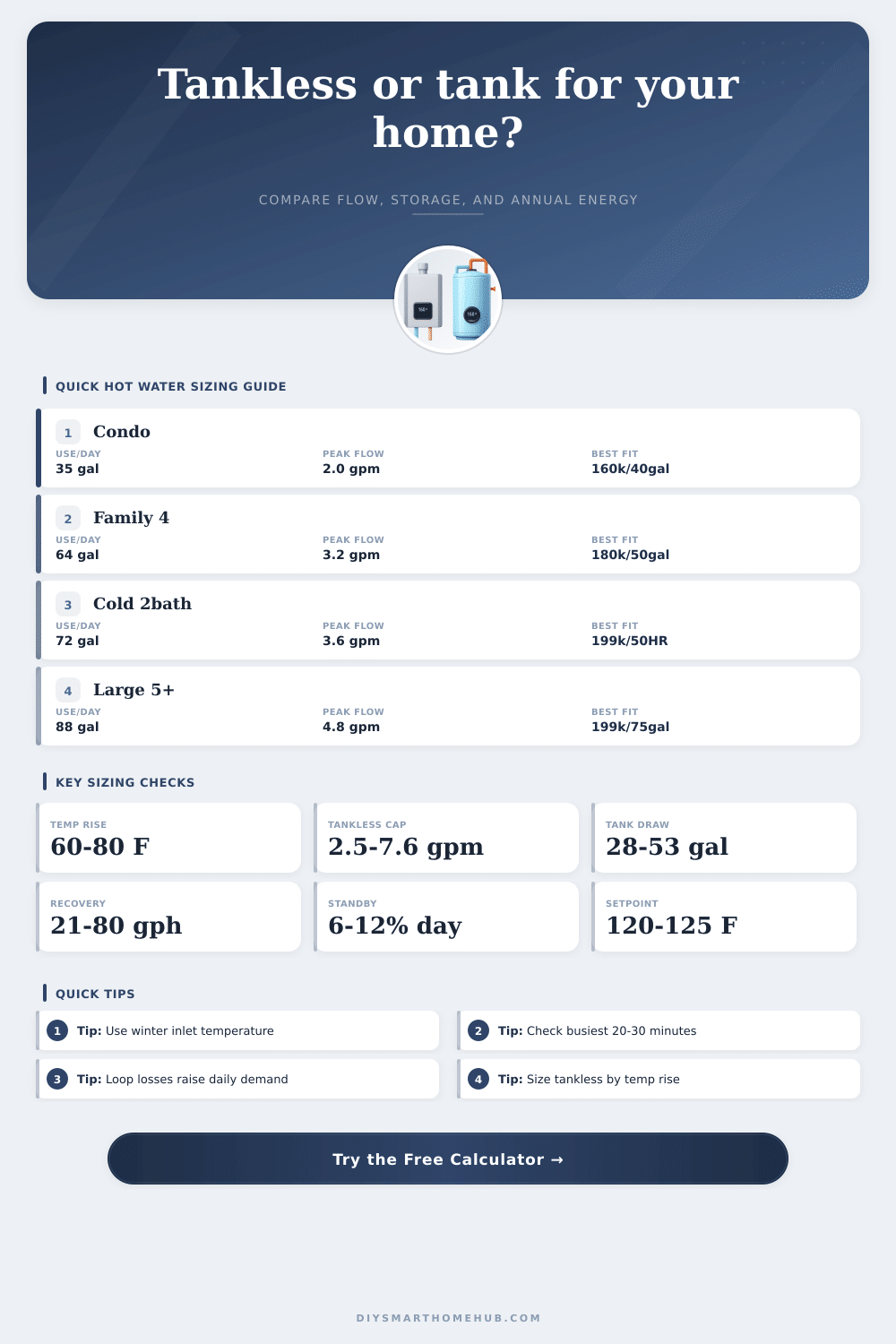
Each preset loads a realistic household draw profile, winter inlet temperature, demand overlap, and representative tankless and storage models so you can compare sizing strategies quickly.
Formula set: delivered thermal load = gallons × 8.34 lb/gal × temperature rise; tankless max flow = input BTU/hr × UEF / (500 × temperature rise); storage peak delivery = usable drawdown + recovery during the peak window.
| Tankless Class | 35°F Rise | 45°F Rise | 55°F Rise | Best Use |
|---|
| Storage Tank | Storage | Recovery | First-Hour Rating | Peak Note |
|---|
| Demand Event | Typical Draw | Peak Flow | Sizing Note |
|---|
| Household Profile | Daily Use | Peak Flow | Suggested Tankless | Suggested Tank |
|---|
Use winter temperature rise for tankless sizing
A tankless heater that looks oversized in summer can fall short when inlet water drops by 10 to 15°F. Size flow against the coldest expected inlet month, not the annual average.
Use peak-hour gallons for tank sizing
Storage tanks handle burst demand with usable drawdown first, then recovery. Compare your busiest 20 to 30 minutes against usable gallons plus recovery during that same window.
Reference assumptions: 8.34 lb per gallon, 500 = 8.34 × 60 for BTU/hr water-flow math, 1 therm = 100,000 BTU, and 1 kWh = 3,412 BTU. UEF, recovery, and first-hour values are representative planning figures for common residential classes.
Tankless water heaters give continuous hot water. They guarantee that you never stay without warm water, what makes them ideal for busy houses with a lot of people. Rather than tanked systems, that always works, those operate only when needed.
So you do not miss energy because of heating of a turned off tank. Although the first price of a tankless heater surpasses that of a usual tank model, it usually serves more long. In addition, they have lower operating and energy costs, that can repay the investment.
Tankless Water Heaters: Benefits, Types, and Care
You can spare around 15 % of energy rather than a tank variant. Tankless heaters employ energy a lot more effectively than tanks, because they genuinely work only during a short time of usage.
One finds many kinds of models on the market. Rheem bid energy-saving domestic tankless heaters for gas, propane and electricity. A. O. Smith has a gas line with ENERGY STAR®-certified models.
Those use feature X3® Scale Prevention Technology for escape annual descaling maintenance. Some models are compact, for instance electricity under-sink 3500W portable heater with a digital screen for kitchens or bathrooms. For usage in RVs, Girard and Furrion are the best marks.
Some tankless units for RVs require around 30 seconds for heat water in the kitchen or one minute for fully warming in bedrooms. Even so some users reckon that the expectation for warm water at the tap is longer than tank versions. Occasionally the system requires strong water flow to turn on.
About maintenance you must care. Common work is simple annual descale by means of five-dollar vinegar. This removes hard water deposits.
If the temperature falls under 32℉, water can damage a tankless heater. Then you blows air from the water lines and adds RV-antifreeze in the cabinet. Some units self heat the lines, when they feel freezing water in the tubees.
Tankless devices are practical, because they do not consume electricity neither propane, when water does not run. You find apt products with free dispatch or buy on-line and receive in store at plumbing sections.