Tankless Water Heater Flow Rate Calculator
Estimate peak mixed demand, convert it to true hot-water flow, and match the load to a gas or electric tankless heater at your actual temperature rise.
📋 Scenario Presets
Choose a real demand pattern to prefill simultaneous fixtures, inlet water conditions, and heater type before fine-tuning the numbers.
⚙ Peak Demand Inputs
📦 Tankless Technology Comparison Grid
These reference cards show how common residential tankless categories trade efficiency, practical flow range, and best-fit demand profile.
Gas Non-Condensing
Usually capped around 180 kBTU/h, often good for roughly 3.1 GPM at a 95°F rise or 6.0 GPM at a 50°F rise.
Gas Condensing
Commonly uses 199 kBTU/h input and stretches farther at cold-climate rises, often covering about 3.8 GPM at 95°F rise.
Whole-House Electric
Nearly all input becomes heat, but the absolute power ceiling limits flow. Expect around 2.9 GPM at a 70°F rise.
Point-of-Use Electric
Best for isolated fixtures or mild-climate sinks. At a 55°F rise, practical hot-water flow is usually near 1.6 GPM.
📊 Reference Tables
| Climate Band | Cold Inlet Temp | Rise to 120°F | Sizing Note |
|---|---|---|---|
| Very warm coastal | 60–65°F | 55–60°F | Electric units can cover more fixtures. |
| Warm Sun Belt | 55–60°F | 60–65°F | Whole-house electric remains viable for small homes. |
| Mixed climate | 45–55°F | 65–75°F | Most family homes land in gas tankless territory. |
| Cold winter region | 37–45°F | 75–83°F | High rise sharply reduces available GPM per unit. |
| Fixture or Appliance | Typical Mixed Flow | Use Temperature | Hot Share at 50 to 120 |
|---|---|---|---|
| Eco shower | 1.5 GPM | 105°F | 79% |
| Standard shower | 2.0 GPM | 105°F | 79% |
| Bathroom faucet | 0.5–1.0 GPM | 102°F | 74% |
| Kitchen faucet | 1.0–1.8 GPM | 110°F | 86% |
| Dishwasher fill | 0.7–1.3 GPM | 120°F | 100% |
| Laundry hot fill | 0.8–1.5 GPM | 110°F | 86% |
| Standard tub filler | 4.0 GPM | 105°F | 79% |
| Large soaking tub | 5.0 GPM | 105°F | 79% |
| Heater Class | Input Size | Approx GPM at 45°F Rise | Approx GPM at 70°F Rise |
|---|---|---|---|
| 180 kBTU gas non-condensing | 180,000 BTU/h | 6.7 GPM | 4.3 GPM |
| 199 kBTU gas condensing | 199,000 BTU/h | 8.3 GPM | 5.3 GPM |
| 27 kW electric whole-house | 92,100 BTU/h | 4.0 GPM | 2.6 GPM |
| 36 kW electric whole-house | 122,832 BTU/h | 5.4 GPM | 3.4 GPM |
| 18 kW point-of-use electric | 61,416 BTU/h | 2.7 GPM | 1.7 GPM |
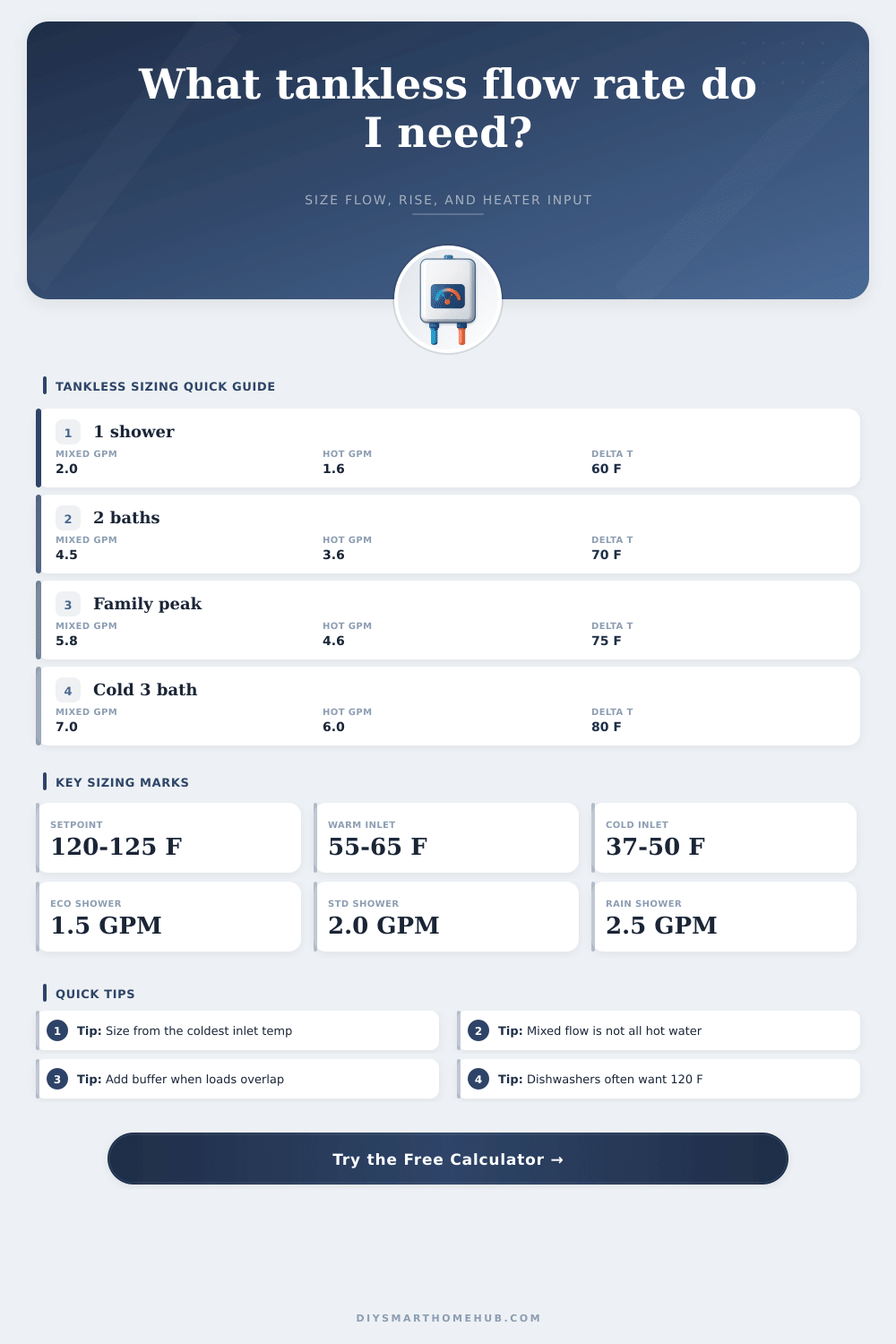
| Common Peak Scenario | Simultaneous Loads | Hot Flow Need | Typical Fit |
|---|---|---|---|
| One eco shower | 1 shower | 1.2–1.4 GPM | Point-of-use or small electric |
| Two bath morning rush | 2 showers + 1 faucet | 3.4–4.1 GPM | Gas non-condensing in mild climates |
| Family with kitchen overlap | 2 showers + kitchen + dishwasher | 4.8–5.6 GPM | 199 kBTU condensing |
| Cold-climate three bath peak | 3 showers + sinks + laundry | 6.0–7.0 GPM | Dual gas units or staged zones |
Reference table flow estimates assume typical residential use temperatures, no recirculation loop penalty, and a clean heat exchanger. The live calculator adjusts the math to your selected inlet water and technology efficiency.
💡 Sizing Tips
Use winter inlet water, not annual average
A tankless heater is limited by temperature rise. If your coldest incoming water is 40°F instead of 55°F, the same unit delivers noticeably less hot-water flow at the shower.
Convert mixed fixture flow to real hot-water flow
Fixtures usually blend hot and cold at the valve. A 2.0 GPM shower at 105°F does not require the full 2.0 GPM from the heater when the setpoint is 120°F, so mixed-to-hot conversion prevents oversizing.
Easy indication shows the biggest amount of warm water that unit fits to give at the same time. It matters to satisfy the needs of every device and shower in the home. Tankless units measure it in GPM.
Usually they deliver warm water in 2… 5 gallons a minute. Gaseous tankless heaters reach higher rates than electrical ones.
How Much Hot Water Does a Tankless Heater Give?
They do not reduce the flow normally. Rather, they ensure wanted temperature rise for undoubted flow. Too big flow will limit the warming.
Many tankless units also operate the gas flow to control the rise at little flows as in sinks.
Tankless heaters estimate its skill according to the gaseous energy input. That is given by means of BTU/h. Bigger BTU allows stronger maximum flow.
For normal family you want a model with 7-9 GPM to effectively cover everyday hot water needs. Well choosing apt tankless heater for the whole house help to save and secure satisfaction of water demands. Average unit requires at least 3.25 GPM.
But it depends on usage patterns, family size and local climate. For instance, for bathroom it must serve sink in 0.75 GPM and shower in 2.5 GPM, so entirely 3.25 GPM at the same time. Rheem tankless heaters go until 11 gallons a minute.
Quite a lot for wash dishes, fill washing machine and use three showers without chill.
Tankless heaters operate heating water as need, while it passes the heating element. Slow flow gives more time for warming. Because it is on-demand, water reaches the wanted temperature before leaving the exchanger.
Some units turn on at half gallon for minimal flow. More little will not operate. A flow sensor detects the move.
Scale on it can create problems. Vinegar helps to clean and restore the flow. You must flush them regularly, especially with hard water.
Yearly with vinegar is needed for good flow and long life with difficult water.