Water Heater First Hour Rating Calculator
Estimate usable mixed gallons for the busiest hour by combining stored hot water, one-hour recovery, delivery-temperature mixing, and a draw-pattern penalty that reflects how fast the load arrives.
📋Preset scenarios
Each preset sets a real storage-heater profile, then runs the first-hour estimate automatically so you can compare tank size, recovery speed, and concentrated demand.
🔧First-hour inputs
The model treats first-hour rating as mixed gallons at the faucet temperature, not raw tank gallons. Recovery is reduced when the draw is front-loaded or several outlets run together.
Calculated first-hour output
The estimate below combines usable storage, recovery during the first hour, and a penalty for concentrated demand.
Full breakdown
📈Heater profile comparison grid
These built-in profiles keep the calculator topic-specific. Storage factor controls how much of the tank is realistically useful at the start, while recovery capture reflects how much input turns into hot-water recovery during the hour.
📚Reference tables
Use the tables below to stress-test your inputs before deciding whether the current heater can satisfy the busiest hour in the home.
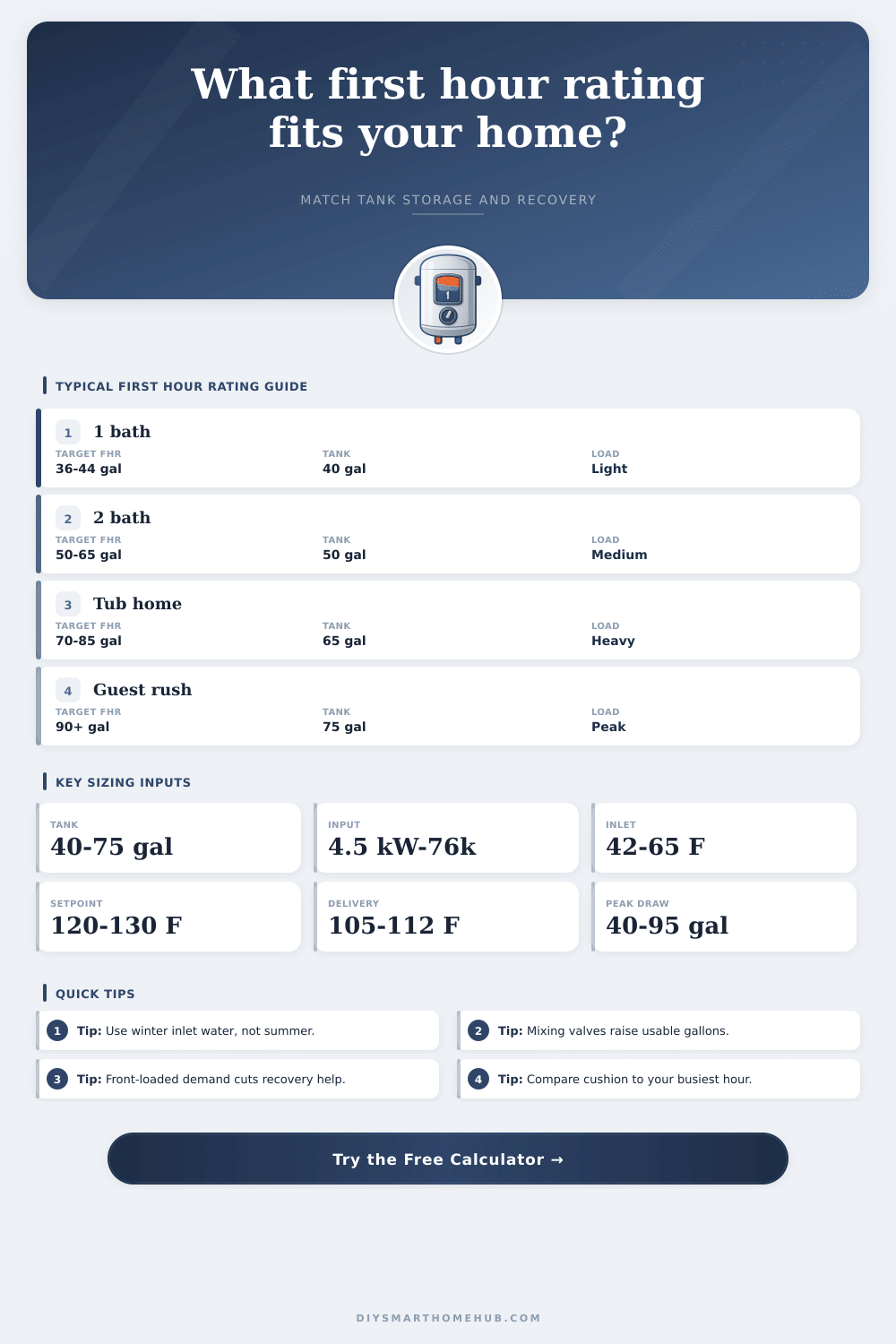
Typical household first-hour targets
| Scenario | Peak draw | Target FHR | Common tank |
|---|---|---|---|
| One bath home | 35 to 42 gal | 40 to 50 gal | 30 to 40 gal |
| Two bath home | 48 to 60 gal | 55 to 70 gal | 40 to 50 gal |
| Family with laundry overlap | 62 to 78 gal | 70 to 85 gal | 50 to 65 gal |
| Soaking tub plus showers | 80 to 95 gal | 90 plus gal | 65 to 75 gal |
Fixture and event draw guide
| Fixture or event | Hot draw | Notes | Peak effect |
|---|---|---|---|
| Low-flow shower | 10 to 16 gal | About 7 to 8 min | Moderate |
| Standard shower | 16 to 22 gal | 8 to 10 min draw | High |
| Bath fill | 20 to 30 gal | Fast front-loaded draw | Very high |
| Laundry cycle | 10 to 18 gal | Often overlaps showers | Moderate |
Inlet temperature and rise reference
| Inlet | Rise to 120 F | Rise to 125 F | Mixed-gallon effect |
|---|---|---|---|
| 42 F | 78 F | 83 F | Lower recovery per hour |
| 50 F | 70 F | 75 F | Common winter planning case |
| 58 F | 62 F | 67 F | Moderate recovery load |
| 65 F | 55 F | 60 F | Best case for FHR |
Typical tank and input pairings
| Type | Tank | Input | Observed FHR band |
|---|---|---|---|
| Atmospheric gas | 40 gal | 36k to 40k BTU/h | 45 to 62 gal |
| Electric resistance | 50 gal | 4.5 to 5.5 kW | 50 to 63 gal |
| Power vent gas | 50 gal | 50k to 60k BTU/h | 65 to 85 gal |
| Indirect or high-input | 60 to 75 gal | 70k plus BTU/h | 90 plus gal |
💡Focused sizing tips
Use the coldest inlet water you will actually see
First-hour rating is most often missed because summer inlet water looks generous. A winter inlet that is 8 to 12 degrees colder can remove several gallons of recovery during the same hour.
Model the busiest 60 minutes, not average daily use
A heater can look fine on total daily gallons and still run short when showers, a tub, and laundry cluster together. The concentration pattern and outlet count are meant to expose that risk.
The first hora rating shows the maximum amount of warm water, in gallons, that a water heater can deliver during one hour. This starts when the device is entirely warm. For well-sized water heater home.
Included heat pump model with reservoir. Use this indication. It exactly points how many warm water the system can give when you most require it.
What Is the First Hour Rating?
The first hora rating depends on the storage capacity and the recovery rate. The recovery rate point as far as quickly the water in the reservoir gets warm. During the rating give the available amount for the first hour, the recovery time decide the haste after intensive use.
Higher power for electrical models or bigger BTU-input expands the recovery rate. Traditional gas water heaters surpass electrical exceeding even heat pumps. They recover much more quickly so theirs first hora rating is considerably higher than same magnitude electrical.
The value you find on the label of the water heater. For count it take the storage magnitude in gallons and proliferate by means of 0,70. Add the recovery rate to that amount, this gives the first horan delivery in gallons for hour.
It helps to estimate activities that requires warm water during peak hours for instance showers laundry and dishwashing. Sumu the gallons for those moments and compare with the First Hora Rating. If the household need surpasses the FHR the device hardly will accomplish during peak use.
Bad functional thermostats or faulty sensors inhibit the unit reach or preserve ideal temperatures. That extends the recovery and lowers the warm water output during the first hour. Even if the reservoir is set in 125 degrees the water temperatures range between 105 and 125 degrees in the 70 percent amount.