💨 CFM Calculator
Calculate cubic feet per minute for any room or duct. Plan smart home HVAC and ventilation with precision.
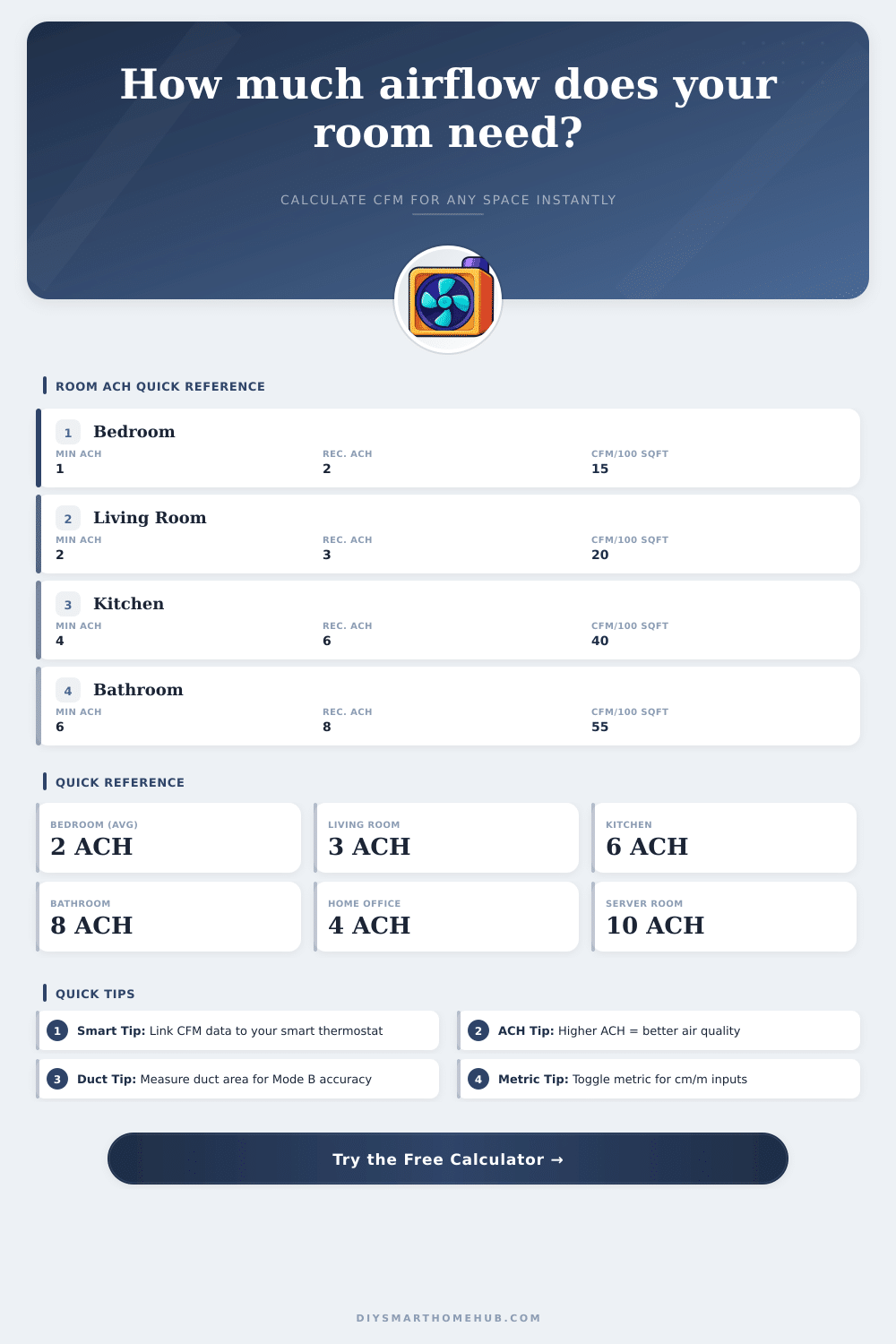
| Space Type | Min ACH | Rec. ACH | Max ACH | Smart HVAC Note |
|---|---|---|---|---|
| Storage Room | 0.5 | 1 | 2 | Passive ventilation often sufficient |
| Bedroom | 1 | 2 | 4 | Schedule lower ACH at night |
| Living Room | 2 | 3 | 5 | Occupancy sensor can modulate |
| Home Office | 3 | 4 | 6 | CO2 sensor trigger recommended |
| Kitchen | 4 | 6 | 10 | Range hood adds significant CFM |
| Bathroom | 6 | 8 | 12 | Humidity sensor auto-trigger |
| Garage | 3 | 4 | 6 | CO sensor integration advised |
| Basement | 2 | 3 | 5 | Radon mitigation may raise ACH |
| Server Room | 6 | 10 | 15 | Temp sensor closed-loop control |
| Lab / Cleanroom | 8 | 10 | 20 | Pressure differential monitoring |
| Room Area (sqft) | 8 ft Ceiling | 9 ft Ceiling | 10 ft Ceiling | Typical Use |
|---|---|---|---|---|
| Under 100 | 25 – 50 CFM | 28 – 55 CFM | 31 – 62 CFM | Small bath, closet |
| 100 – 150 | 35 – 80 CFM | 40 – 90 CFM | 44 – 100 CFM | Bedroom, office |
| 150 – 250 | 60 – 130 CFM | 68 – 146 CFM | 75 – 162 CFM | Master bed, dining |
| 250 – 400 | 100 – 200 CFM | 113 – 225 CFM | 125 – 250 CFM | Living room, kitchen |
| 400 – 600 | 160 – 320 CFM | 180 – 360 CFM | 200 – 400 CFM | Open plan, studio |
| 600 – 1000 | 240 – 500 CFM | 270 – 562 CFM | 300 – 625 CFM | Garage, basement |
| Over 1000 | 400+ CFM | 450+ CFM | 500+ CFM | Commercial, large open |
CFM calculator is a handy tool that helps estimate how much airflow a space needs. It uses Cubic Feet per Minute to estimate the amount of air that passes through a spot during one minute. Actually, CF shows volume, M shows time, so CFM is a rate not simply volume.
Remember that detail
CFM calculator: what it is and how to use it
HVAC CFM calculator is useful for estimating required airflow for every room in a house or business, according to cubic feet per minute flow and the number of air changes per hour (ACH), needed for good ventilation. It shows how to estimate CFM, how to calcluate it for a room according to floor area and ceiling height, and how to estimate ACH.
Do this: look at the room and measure its length, width and height. Multiply those three values. Length times width times height gives the cubic feet of the space.
For instance, 5 x 10 x 7 equals 350 cubic feet. Later the calculator uses room dimensions and ACH to estimate the required airflow.
Even so CFM calculators are not just for rooms and ventilation. They also help to choose the right carburetor size for an engine, for maximum power and efficiency. A typical formula is: CID x RPM / 3456 x volumetric efficiency equals CFM size.
For instance, 350 cubic inch engine at 5500 RPM with 85% volumetric efficiency gives around 467 CFM.
There are also CFM calculators for compressed air. A free online CFM calculator helps size an air compressor and ensure enough flow for compressed air needs. One way is to empty the tank and note the seconds to fill it.
CFM specifications for fans are stated at zero static pressure, because that is where you measure the flow. CFM shows how much air a fan moves during one minute at zero static pressure. Outside United States, you do not always use CFM.
In many lands you estimate liters per minute or cubic meters per hour.
According to place and humidity, airflow ranges between 350 and 700 CFM. 400 CFM is only a rule of thumb. For sizing pipes, if CFM is already known, follow general guidelines.
CFM equals duct area x velocity, and it matters to match the whole pipe size and CFM to the totalcapacity of the system.