🔊 Decibel Addition Calculator
Combine multiple sound sources using logarithmic dB math — perfect for smart home noise planning.
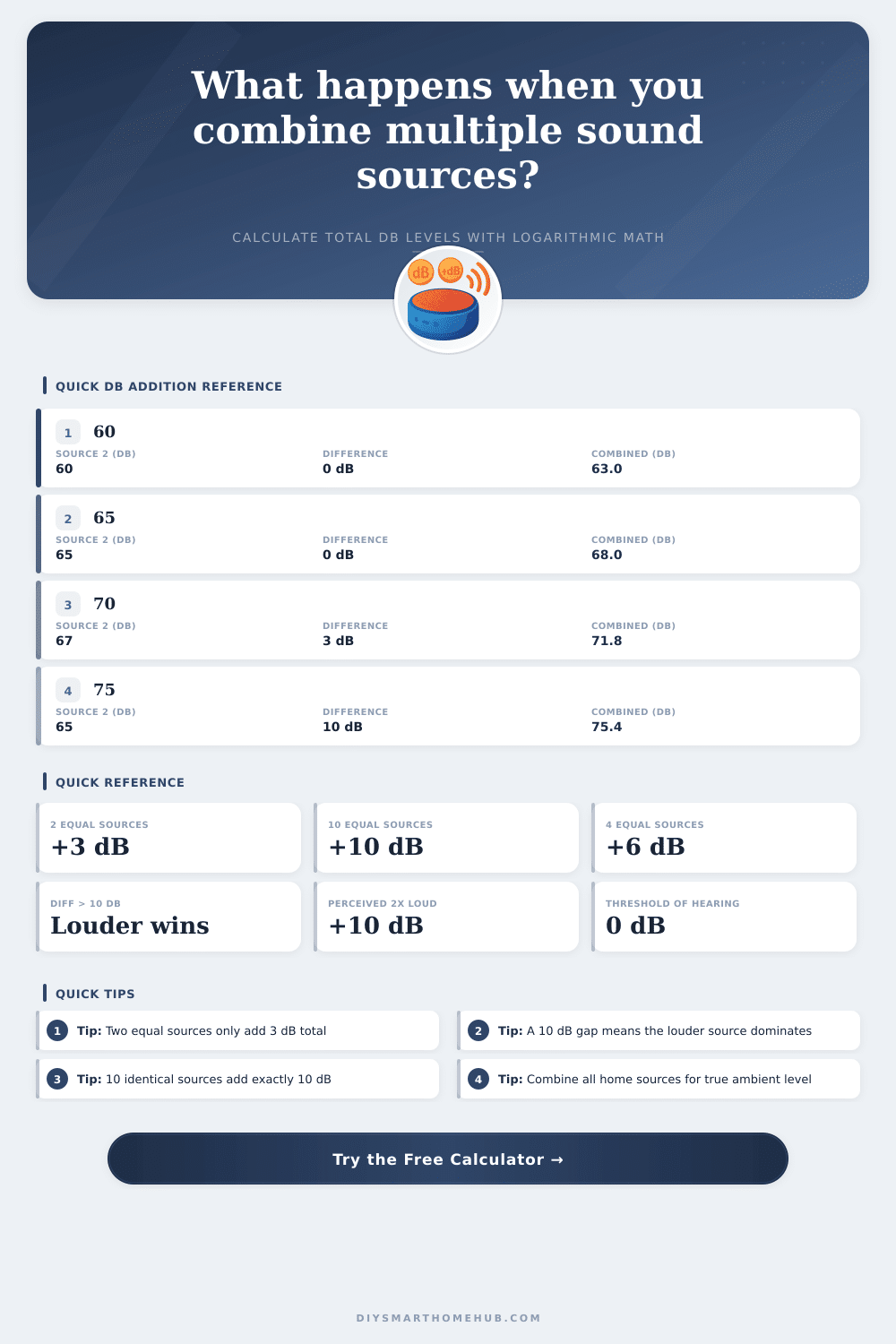
| Source 1 (dB) | Source 2 (dB) | Difference | Combined (dB) | Notes |
|---|---|---|---|---|
| 60 | 60 | 0 dB | 63.0 dB | Always +3 dB when equal |
| 65 | 65 | 0 dB | 68.0 dB | Two smart speakers |
| 70 | 70 | 0 dB | 73.0 dB | Moderate source pair |
| 70 | 67 | 3 dB | 71.8 dB | +1.8 above louder |
| 75 | 72 | 3 dB | 76.8 dB | +1.8 above louder |
| 70 | 64 | 6 dB | 71.0 dB | +1.0 above louder |
| 75 | 65 | 10 dB | 75.4 dB | Louder nearly dominates |
| 80 | 70 | 10 dB | 80.4 dB | Quieter adds only 0.4 dB |
| 65 | 55 | 10 dB | 65.4 dB | HVAC vs fridge example |
| 60 | 50 | 10 dB | 60.4 dB | Soft background irrelevant |
| Room Scenario | Sources (dB each) | Combined Level | Description |
|---|---|---|---|
| Quiet Bedroom | AC 45 + Fan 40 | ~46.2 dB | Low background noise |
| Home Office | PC 40 + HVAC 45 + Keyboard 50 | ~51.3 dB | Typical work environment |
| Kitchen Active | Fridge 45 + Dishwasher 55 + Exhaust 60 | ~61.2 dB | Exhaust fan dominates |
| Living Room TV | TV 65 + HVAC 55 + Ambient 50 | ~65.8 dB | TV clearly dominant |
| Home Theater | Speakers 75 + HVAC 55 + Projector 45 | ~75.3 dB | Speakers dominate fully |
| Laundry Room | Washer 65 + Dryer 65 + Pipes 55 | ~68.6 dB | Dual-machine combination |
| Smart Home Hub Room | Server 55 + Fans 50 + UPS 45 | ~56.8 dB | Server ambient noise |
| Outdoor Patio | Traffic 65 + HVAC exhaust 60 + Wind 55 | ~67.4 dB | Multiple ambient sources |
Decibels don’t add up like regular numbers. Two sounds at 100 dB result not in 200 dB, but only around 103 dB. Many people mess up because of that because school teaches that 100 plus 100 equals 200.
Even so acoustics follows entirely other logic for adding sounds.
Decibels Do Not Add Like Regular Numbers
Decibels work on a logarithmic scale, not linear. Every step multiplies by a certain factor of the prior. For dB, every +10 dB increases the strength tenfold.
Tenfold stronger noise matches +10 dB. So you can not simply stack dB from various sources.
To add them, you convert dB to power level, add and convert back to dB. The basic idea is that dB represents pressure of sound, where dB = 10 × log(SPL). So first you convert every dB to SPL.
To compare two dB, divide them by 10 and rasie 10 to that power. For instance 20 dB are 10^2 = 100. The total L equals 10 × log(L1 + L2 +…
), where L1, L2 etc. Are dB of the sources.
Some rules help to remember that easily. Doubling of sound strength adds 3 dB. Double output of power gives +3 dB.
Tenfold power is +10 dB, and millionfold is +60 dB. Going the other way, -3 dB halves power, -6 dB quarters it, -10 dB is won tenth.
+2 dB multiplies sound by around 1,585. Keep going until +10 dB, and you have factor 10. This is the logarithmic relation, similar to the Richter Scale for earthquakes.
Simple operations make it easy to compare levels.
An online dB calculator can combine up to ten different sounds, if levels are known between 0 and 200 dB. Even so tonal or coherent sources need attention, because simple addition can over or under estimate. Even 1 dB change canbe noticeable, although numbers look small.