SEER to EER Converter
Convert SEER ratings to EER, COP, and kW/ton using AHRI Standard 210/240 formulas
| SEER Range | EER Equivalent | Class | Recommendation |
|---|---|---|---|
| 13 – 15 | 9.9 – 11.4 | Minimum | Meets federal minimum; replace soon |
| 15 – 17 | 11.4 – 13.0 | Standard | Average new-unit efficiency |
| 17 – 19 | 13.0 – 14.6 | Good | Above average; good savings |
| 19 – 21 | 14.6 – 16.1 | ENERGY STAR | Qualifies for rebates; recommended |
| 21 – 24 | 16.1 – 18.4 | High-Efficiency | Excellent; significant energy savings |
| 24+ | 18.4+ | Premium | Top tier; best for hot climates |
| Metric | Measured At | Standard | Notes |
|---|---|---|---|
| SEER | Full cooling season avg. | AHRI 210/240 | Used for North American ratings |
| SEER2 | Full cooling season avg. | AHRI 210/240-2023 | Updated test; ~5% lower than SEER |
| EER | 95°F outdoor / 80°F indoor | AHRI 210/240 | Instantaneous efficiency at peak |
| COP | Same as EER | ISO / EN14511 | EER ÷ 3.412; used in EU/global |
| kW/ton | At rated conditions | ASHRAE | 12 ÷ EER; lower = more efficient |
| HSPF | Heating season avg. | AHRI 210/240 | Heating efficiency of heat pumps |
| AC Unit Type | Typical SEER | Typical EER | COP |
|---|---|---|---|
| Window AC (basic) | 10 – 12 | 8.2 – 9.7 | 2.4 – 2.8 |
| Central AC (min) | 13 – 15 | 9.9 – 11.4 | 2.9 – 3.3 |
| Central AC (standard) | 15 – 18 | 11.4 – 13.8 | 3.3 – 4.0 |
| Mini-split (single zone) | 18 – 25 | 13.8 – 20.3 | 4.0 – 5.9 |
| Mini-split (multi-zone) | 16 – 22 | 12.3 – 17.8 | 3.6 – 5.2 |
| Inverter heat pump | 20 – 30 | 16.4 – 24.5 | 4.8 – 7.2 |
SEER stands for Seasonal Energy Efficiency Ratio, and it shows how well the device works through the whole range of temperature that you actually meet in cooling season. EER measures only the Energy Efficiency Ratio. Here is the difference: EER takes efficiency in one precise moment, imagine it as snapshot in 95°F outside, 80°F inside and 50% humidity The main spot is that word “seasonal”: EER takes only BTU/hr to watts ratio in one warm temperature, but SEER considers that same relation through many different temperatures during the year.
What separates them is the way they do the work. EER shows how efficient the system is when it operates at maximum pace under set conditions, without something braking it. SEER rather estimates the whole produced BTU against consumed watt-hours through the whole cooling season.
Difference Between SEER and EER
You cannot simply exchange them, because for example inverter systems work more well when not at max heat. They simply are built diferently.
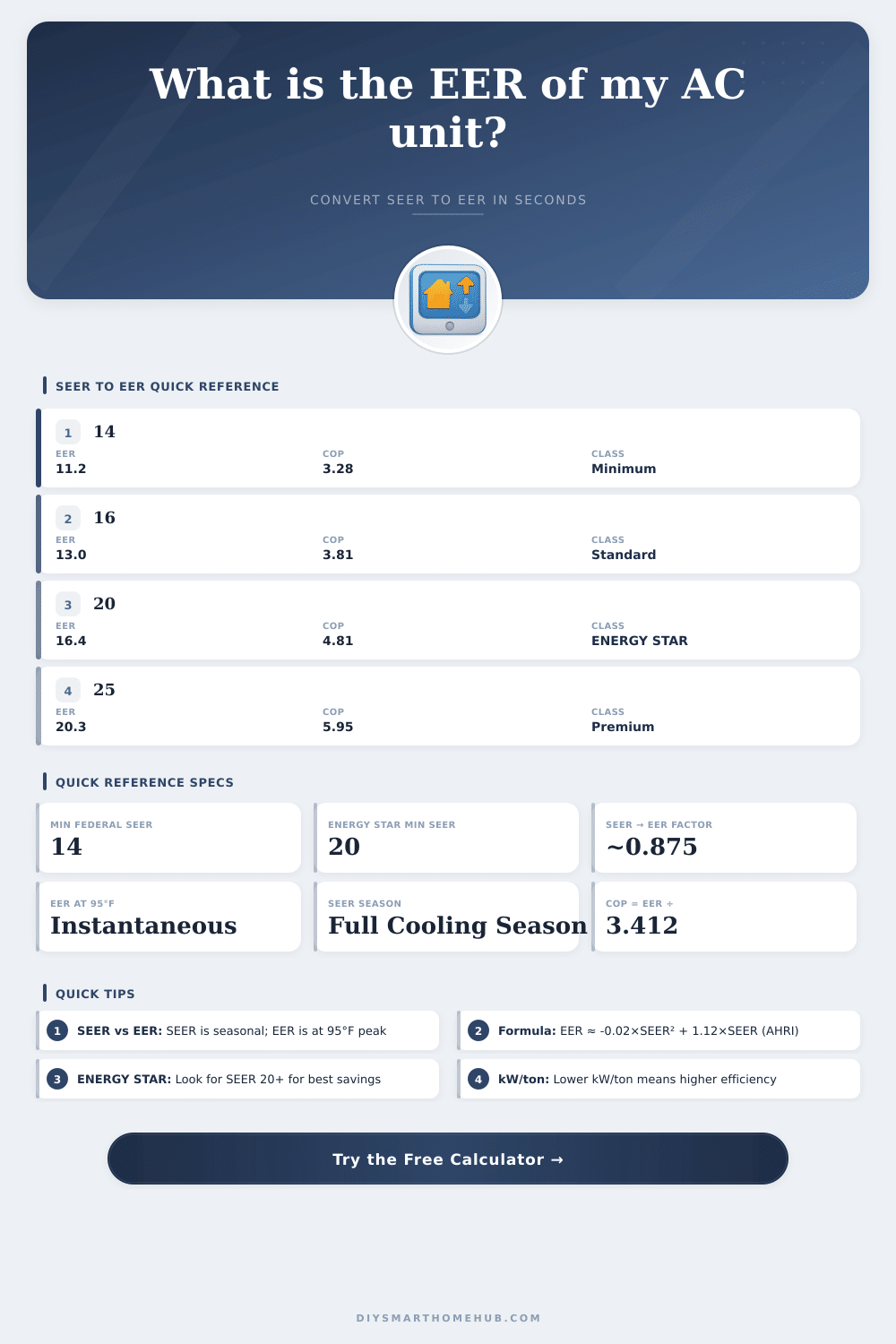
Good news: there is a formula that works well for the most cases. The US Department of Energy found a reasonable correlation: square your SEER rating, multiply by -0.02, then add 1.12 times the SEER. For a simpler way, multiply SEER by 0.875, and you are near EER, although the multiplier adjusts according to climate.
The industry uses standard formula of AHRI, that all accepted.
Using a converter of SEER to EER, you remove all calculations. Simply enter the SEER rating, and it gives the EER. Assume you have a mini-split AC in 20 SEER, enter, and see its EER immediately.
There are also tools that reverse that, converting EER to SEER, if you need that.
In places with gentle climate, as Southern California, SEER is the better focus. Practical rule: geothermal heat pumps depend on EER, while air conditioners depend on SEER. EER does not work for year calculations, because it counts only under particular conditions; especially outdoor temperature.
It is not an average. Hence you created SEER, for give a weighted seasonal measure, that makes more sense.
Some big devices do not even have SEER ratings. Testing cannot well handle units of 10 tons or more. Hence EER and SEER are not entirely interchangeable.
Now comes the new stuff. SEER2 is based on updated test methods. For compare old and new systems, use a factor of around 1.05.
Old SEER 10 matches to around 9.5 SEER2. Because EER2 measures in 95°F outside, SEER2 naturally gives a higher number, in less warm temperatures the pump works more easily. Some calculators now convert between SEER, HSPF, SEER2, HSPF2, COP and kW/Ton everything together.
EER is basically COP in BTU terms. Take your COP number, multiply by 3.41214 BTU per watt-hour, and you have EER. Other useful convert from kW/Ton: divide by 12, and that is your EER.