BTU Tonnage Calculator
Convert between BTU/hr, tons of refrigeration, kW, watts, kcal/hr and MBH for smart home HVAC planning
Unit Converter
Select quick presets or enter a custom value below.
Please enter a valid positive number.
Tonnage Spec Grid
Full Conversion Table — 0.5 to 20 Tons
| Tons | BTU/hr | kW | Watts | MBH | kcal/hr |
|---|
HVAC Capacity Reference
| System Type | Typical Tons | BTU/hr Range | Application |
|---|---|---|---|
| Window AC Unit | 0.5 – 1.5 | 6,000 – 18,000 | Single room cooling |
| Mini-Split (Single Zone) | 0.75 – 2.0 | 9,000 – 24,000 | Room or zone, smart home zoning |
| Mini-Split (Multi-Zone) | 2.0 – 5.0 | 24,000 – 60,000 | Multi-room smart zoning |
| Residential Central AC | 1.5 – 5.0 | 18,000 – 60,000 | Whole-home ducted cooling |
| Heat Pump (Residential) | 1.5 – 5.0 | 18,000 – 60,000 | Heating & cooling, high efficiency |
| Gas Furnace | N/A | 40,000 – 120,000 | Forced-air home heating |
| Packaged Rooftop Unit | 3.0 – 25 | 36,000 – 300,000 | Light commercial |
| Scroll Chiller | 10 – 60 | 120,000 – 720,000 | Commercial/industrial cooling |
| Large Centrifugal Chiller | 100 – 2000 | 1.2M – 24M | Large commercial/industrial |
❄ Smart Home BTU Planning
When integrating HVAC into a smart home system, accurate BTU ratings ensure your thermostat, zoning controller, and sensors operate within the correct capacity range.
- 1 ton = 12,000 BTU/hr — the universal baseline
- Match BTU output to calculated room heat load
- Oversized units short-cycle and reduce dehumidification
- Use kW ratings when pairing with solar or battery storage
- MBH (1,000 BTU/hr) is common in commercial spec sheets
❄ Tonnage Sizing Guidelines
Cooling load depends on climate zone, insulation, window area, and occupancy. These are general starting points — always verify with a Manual J calculation for permanent installs.
- Mild climate: ~500–600 sq ft per ton
- Hot/humid climate: ~400–500 sq ft per ton
- Very hot climate: ~300–400 sq ft per ton
- Standard duct sizing: 400 CFM per ton
- Heat pumps: size by heating load in cold climates
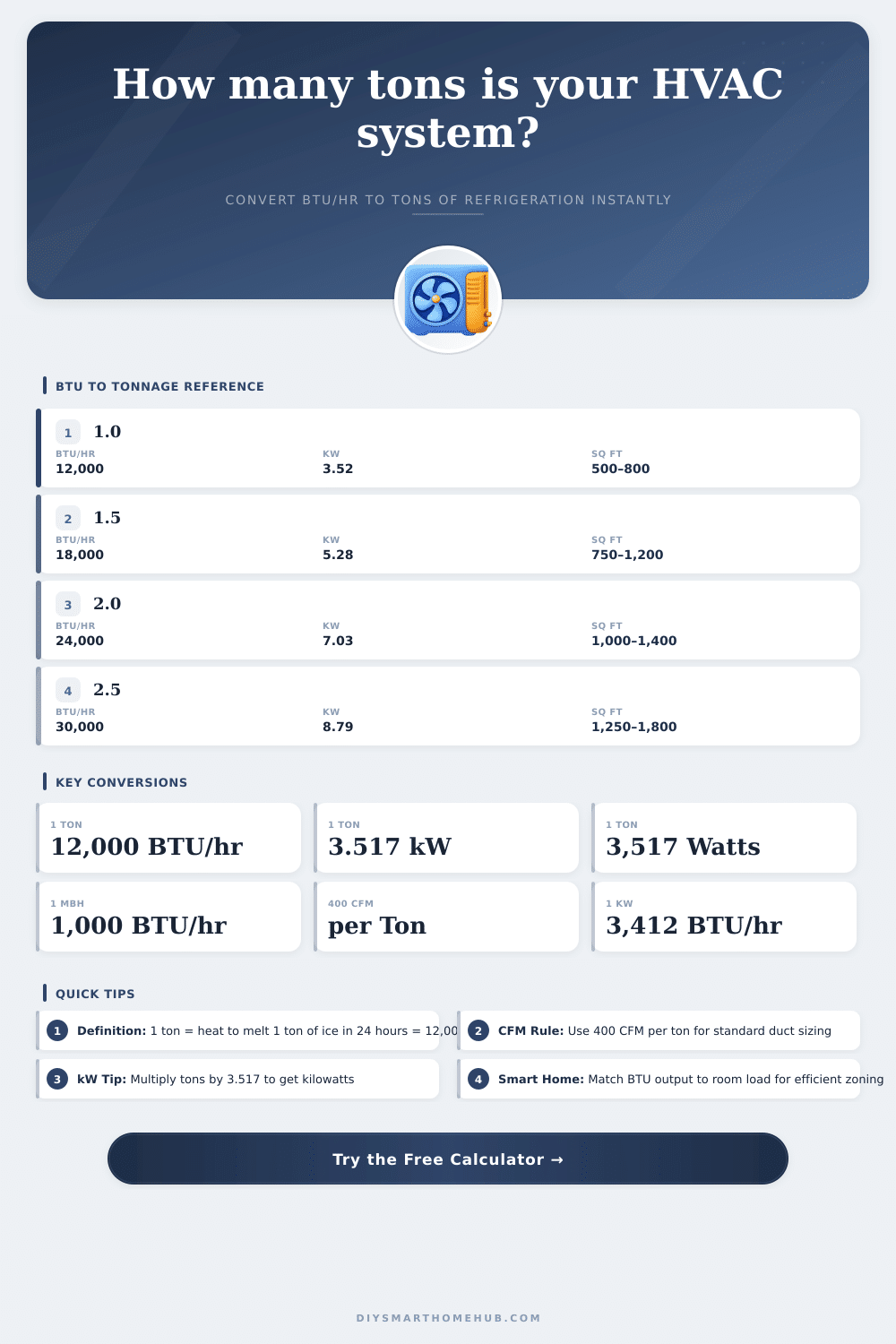
BTU tonnage is one of those words that commonly appears when you talk about air conditioning and refrigeration. A ton of refrigeration shows power. It matches the energy necessary to melt or freeze 2000 pounds (one short ton) of ice during a day.
One ton of refrigeration corresponds to around 12,000 BTU per hour or 3.5 kW.
What Is a Ton of Cooling?
Where does this whole ton thing come from? When air conditioning and mechanical refrigeration was first invented they had to find a simple and practical way to estimate their capacity. Before, people used ice blocks to cool spaces.
Melting a one-pound block of ice at 32 degrees requires around 143 BTU. For a whole 2000-pound block you need about 286,000 BTU. One ton of ice, melted during 24 hours, absorbs almost 288,000 BTU of heat.
The latent heat of water fusion is around 144 BTU each pound. Dividing that by 24 huors, you get cooling power of approximately 12,000 BTU per hour.
BTU, or British Thermal Unit, is the heat required to raise one pound of water by one degree Fahrenheit. BTU helps to measure how much thermal energy something gives off.
Converting between BTU and tons is easy. Cooling power in tons matches BTU per hour divided buy 12,000. For instance, a dual zone mini split at 18,000 BTU per hour gives 18,000 ÷ 12,000 = 1.5 tons.
A unit at 36,000 BTU is 36 ÷ 12 = 3 tons. Two tons equals 24,000 BTU. A 2.5 ton air conditioner reaches 30,000 BTU per hour.
Here it gets a little tricky. Makers call them 5-ton units, but with an air handler or gas furnace the ratings get closer to 56,000 BTU. That counts for every tonnage level.
For furnaces it is not always 12,000 BTU per ton. Two 4-ton units can have different BTU ratings (one at 70),000 BTU, another at 88,000 BTU.
Some makers put BTU info in the model number. For instance, Bryant 574D030 shows 30,000 BTU, so 2.5 tons. Others put the tonnage directly in the unit number.
A good starting point for sizing is 20 to 25 BTU per square foot, then adjust for climate, sunshine and insulation. A too big AC short-cycles and stays humid, while atoo small one runs nonstop and still feels warm.