💨 Return Duct Size Calculator
Size your return air duct, filter, and grille for balanced HVAC ventilation
Calculator Mode
Return Duct Sizing Results
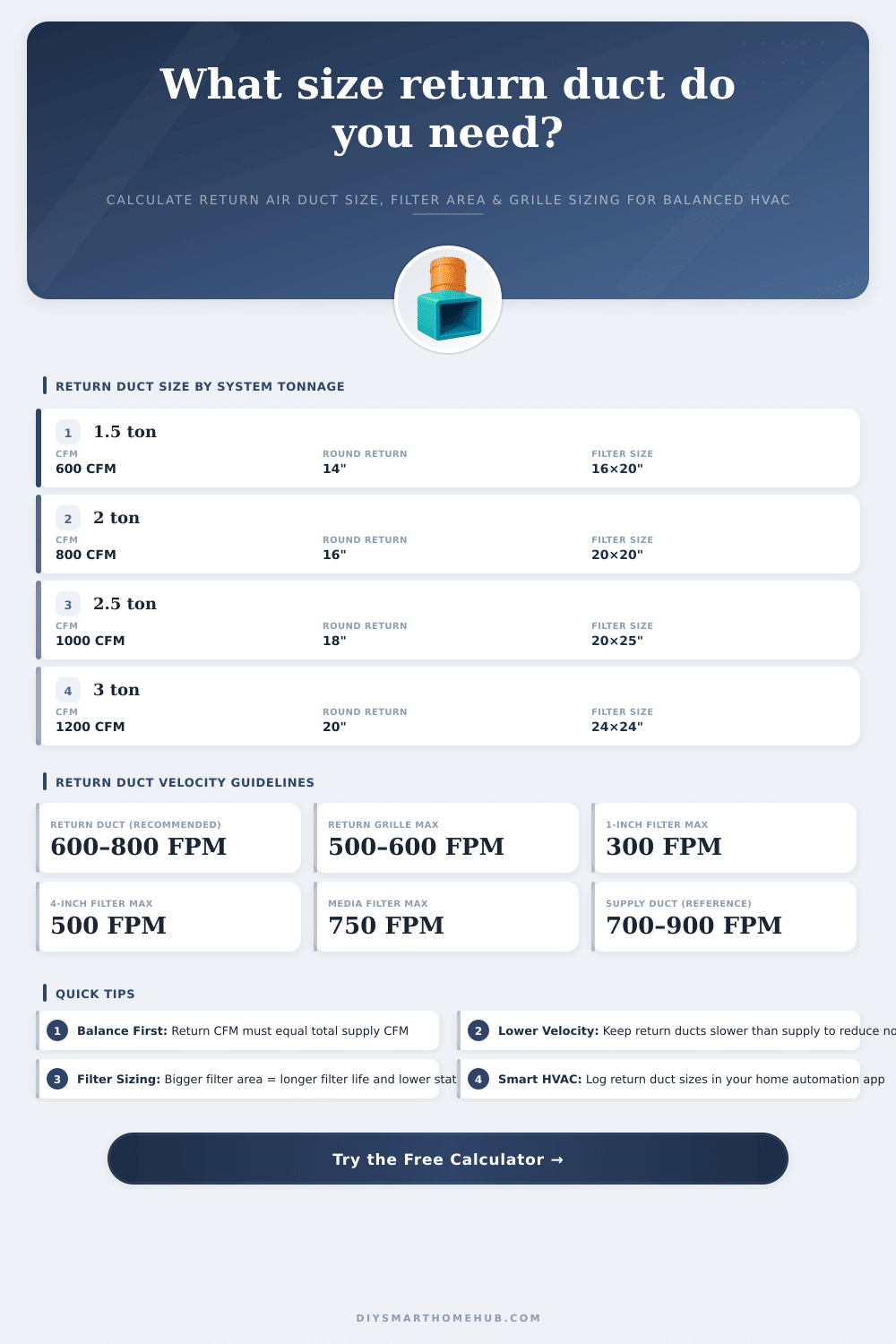
Return Duct Quick Reference — By System Size
Return Duct Sizing Table
| System Tons | CFM | Round Return | Rect Return (2.5:1) | Filter Size | Grille Free Area |
|---|
Filter Face Velocity Reference
| Filter Type | Max Face Velocity | Min Area per 1000 CFM | Notes |
|---|---|---|---|
| 1-inch Fiberglass / Pleated | 300 FPM | 3.33 ft² | Replace monthly; low static |
| 4-inch Pleated | 500 FPM | 2.00 ft² | Replace every 6–12 months |
| Media / HEPA Filter | 750 FPM | 1.33 ft² | High capture efficiency; monitor static |
| Return Grille (face) | 500 FPM recommended | — | 600 FPM absolute max; higher causes noise |
| Return Grille (free area) | 400 FPM ideal | 2.50 ft² per 1000 CFM | Grille free area ≈ 60–75% of face area |
Get the right size of return duct is key for how well heating or cooling systems work. Multiply the tonnage of the air conditioner by 144 to get the square inches for the return duct. For instance, for a 3-ton unit that results in 432 square inches
A 5-ton air conditioner usually requires around 2,000 cubic feet of air per minute. That is based on the standard of 400 CFM per ton. For good sizing you need right supply and return ducts and a plan that ensures even airflow.
How to Size Return Ducts for Air Conditioners
Size the return duct at 400 CFM per ton, but do not go over 0.08 static pressure. The safest is 0.05 static.
The return trunk should at least match the supply size, or even be 10 to 20 percent larger. In a system with one return and one supply trunk, the ratio return to supply should be 1:1 or more. For a furnace of 100,000 BTU you need around 200 square inches for the supply duct, while the return must be 30 percent bigger.
A 2-ton system requires 800 CFM and 400 square inches of return grille area. One 14-inch flexible duct delivers only around 700 CFM, so changing to a 16-inch duct that fits 1,000 CFM is a good itdeas. For such a system use return grilles of 14×30, 25×20, 20×20 or 16×25 inches.
For a 2-ton unit with 800 CFM use a 20×20 filter return grille.
A 16-inch round duct moves air at 1,200 feet per minute. A 12-inch round duct delivers the same, but at 2,000 feet per minute. Both exceed the usual return speed of around 700 feet per minute.
That is too fast.
Too small ducts increase static pressure, lower efficiency and add noise. A 3-ton system with 1,200 CFM using a 16-inch flexible duct without bends can only handle 1,000 CFM. Return air should flow much slower, so you might need several runs.
For a 3-ton system with 6-inch ducts you need 10 to 12 such returns in the home.
It is better to oversize the return. A big return makes the system quieter. If an 18- or 20-inch return fits, that helps a lot.
No harm comes from larger ducts. Use the biggest possible return grille with half-inch spacing between strips. A ductulator tool helps find the right duct for the airflow need.
If the opening is smaller than the duct, use a sheet metal transition to connect them. It works well.