Ceiling Fan CFM Calculator
Find the right airflow rating for your room — optimized for smart home fan automation.
Calculator Mode
Results
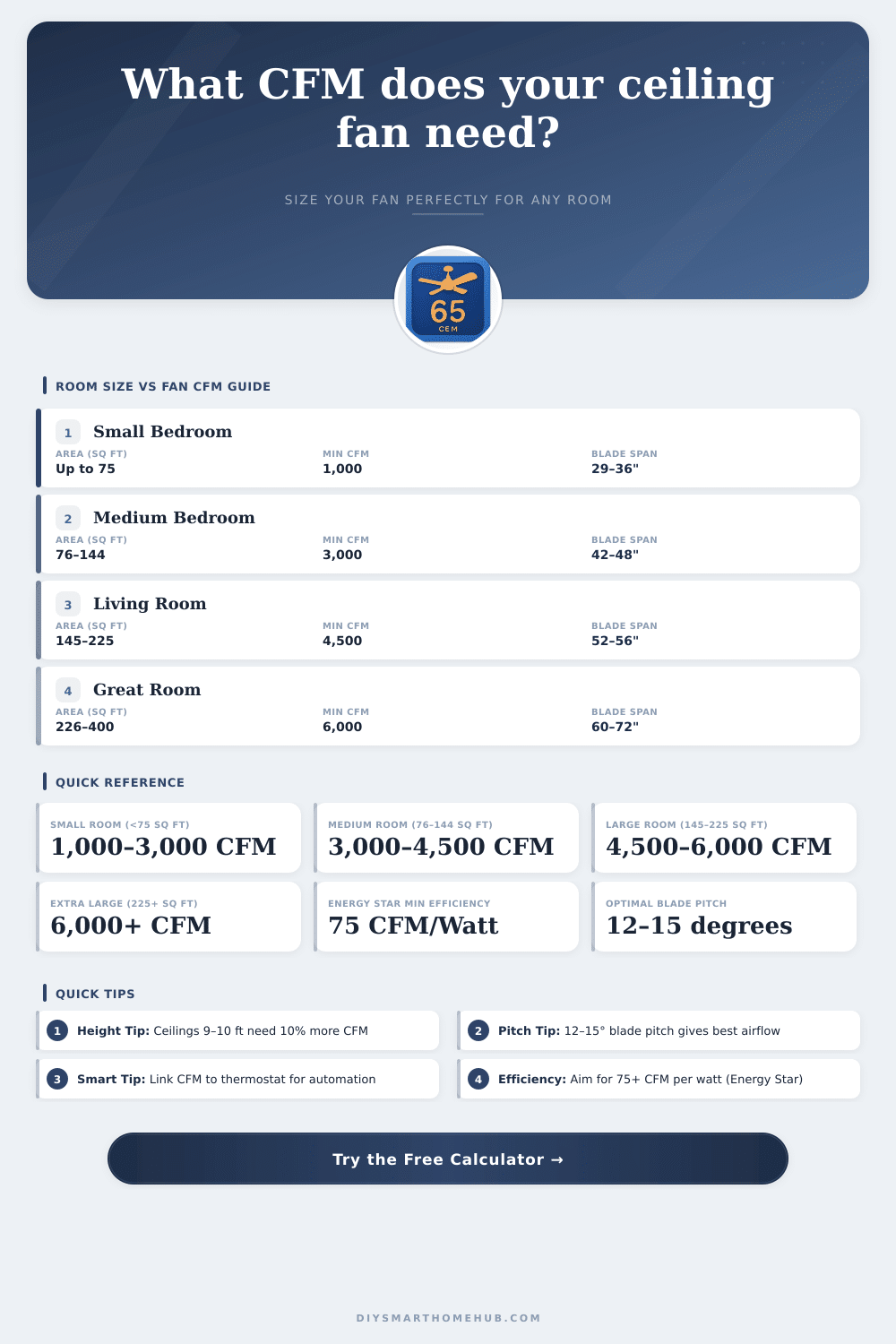
Fan Sizing Reference Grid
Fan Sizing Table by Room Area
| Room Area | Blade Span | Min CFM | Recommended CFM | Energy Star CFM |
|---|---|---|---|---|
| Under 75 sq ft | 29\" – 36\" | 1,000 | 1,500 – 3,000 | 1,250+ |
| 76 – 100 sq ft | 36\" – 42\" | 2,000 | 2,500 – 3,500 | 2,100+ |
| 101 – 144 sq ft | 42\" – 48\" | 3,000 | 3,500 – 4,500 | 3,200+ |
| 145 – 175 sq ft | 48\" – 52\" | 4,000 | 4,500 – 5,500 | 4,500+ |
| 176 – 225 sq ft | 52\" – 56\" | 4,500 | 5,000 – 6,000 | 5,000+ |
| 226 – 300 sq ft | 56\" – 60\" | 5,500 | 6,000 – 7,500 | 6,000+ |
| 301 – 400 sq ft | 60\" – 72\" | 6,500 | 7,500 – 9,000 | 7,000+ |
| Over 400 sq ft | 72\"+ or dual fan | 8,000 | 9,000+ | 8,500+ |
Ceiling Height CFM Adjustment Table
| Ceiling Height | CFM Multiplier | Blade Clearance Note | Downrod Length |
|---|---|---|---|
| 7 – 8 ft (standard) | 1.0x (baseline) | Min 7\" from ceiling | Flush mount / 0\" |
| 9 – 10 ft | 1.1x (+10%) | Hang at 8–9 ft AFF | 6\" – 12\" downrod |
| 11 – 12 ft | 1.2x (+20%) | Hang at 9–10 ft AFF | 12\" – 18\" downrod |
| 13 – 14 ft | 1.3x (+30%) | Hang at 10–11 ft AFF | 24\" – 36\" downrod |
| 15+ ft | 1.4x (+40%) | Hang at 10–12 ft AFF | 36\"+ downrod |
AFF = Above Finished Floor. Target fan height: 8–10 ft for optimal airflow circulation.
Smart Home Automation Tip: CFM-Based Fan Control
Connect your smart ceiling fan controller to your thermostat or humidity sensor. Program it to ramp up CFM when temperature exceeds your set point, and reduce speed during cooler periods. A fan delivering 4,500+ CFM on high speed can create a perceived cooling effect of 4–8°F, allowing you to raise your thermostat by that amount and save energy without sacrificing comfort.
Smart Home Automation Tip: Scheduling and Occupancy Sensing
Pair your ceiling fan with an occupancy sensor and a smart schedule. When no motion is detected for 10–15 minutes, automatically drop the fan to low speed or off. During sleep hours, program the fan to a consistent low-CFM setting (typically 30–40% of rated CFM) for quiet, efficient overnight airflow. This reduces wattage by 50–70% versus running at full speed.
CFM, that shows how many cubic feet of air ceiling fans push through the room in full speed. In higher number you receive more air flow what helps to cool even more well. Simply said: big CFM values ensure efficient cooling
For standard room with 8-foot ceilings, require between 4000 and 5000 CFM for good result. That surrounding figure commonly find in kinds of fans. The trouble is that they come in many sizes with very different CFM outputs.
What CFM Means and How to Choose a Ceiling Fan
If the spec sheet do not point it clearly, no always easily estimate how many air given model moves.
CFM depends on two main causes: diameter of the blades and RPM. More blades expand the flow, but not the speed. Strong engines with angled blades give more CFM.
Blades with little corner bound to weak engine? Not much you get. Most seriously are the blade inclination.
In sharp corner the air pushes more strongly. Although number of blades attracts attention, genuinly decides form and inclination for good CFM.
For estimate energy efficiency, divide the CFM by means of watts used in high speed. That gives cubic feet per minute per watt, excellent measure for the impact of your mony.
Heavy ceiling fans use strong engine, commonly efficient DC ones, together with long blades angled for push air through big areas. Little of CFM leave you warm and sweaty even in maximum. Too much CFM causes drafts and unnecessary electrical expense.
Minimum leave 18 inches between blade tips and walls, so that the air move well.
Ceiling height complicates the cause. Above 9 feet you lose around 5 until 8 percentages of CFM in foot below at the floor. In 12-foot ceiling that can be 15 until 25 percentages less.
For instance, one installation has 10-foot ceiling with 88-inch Monte Carlo fan for 15 000 CFM, using 18-inch downrod for good air spread.
Big models move a lot of air. The 72-inch Hunter Downtown reaches 11 500 CFM, while 96-inch Liberator reaches around 18 000 CFM. Consumption usually goes from 40 watts in low until 100 watts in highspeed.